Diversity Hiring Checklist for HR Leaders in 2026
Diversity Hiring Checklist for HR Leaders in 2026

A diversity hiring checklist is a structured set of steps designed to eliminate bias and build inclusivity at every stage of recruitment. Organizations with diverse leadership outperform peers by up to 39%, and 76% of candidates consider a company’s diversity record before accepting an offer. The formal industry term for this practice is “inclusive hiring,” and the checklist format makes it operational. EEOC discrimination charges rose 9.2% year-over-year to 88,531 in FY 2024, which means the legal and financial stakes of getting this wrong have never been higher.
Why a diversity hiring checklist starts with bias correction
Unconscious bias is the automatic, unintentional preference for candidates who look, sound, or think like the people already in the room. It is not a character flaw. It is a predictable cognitive pattern that shows up in every unstructured hiring process.
The most common misconception about inclusive hiring is that it means lowering standards or filling quotas. Diversity hiring corrects unconscious bias within existing processes to improve quality. It does not replace merit. It removes the noise that obscures merit.

Legal HR experts are clear on this point. Consistent, documented hiring processes with broad candidate pools and standardized evaluation reduce discrimination risk without crossing into unlawful quota territory. The distinction matters because quotas create legal exposure. Process standardization does not.
Practical bias correction produces measurable results. When hiring managers use the same rubric for every candidate, they compare apples to apples. When panels include people from different backgrounds, groupthink loses its grip on the final decision.
- Affinity bias: Favoring candidates with similar backgrounds, schools, or hobbies
- Halo effect: Letting one strong trait overshadow a full evaluation
- Name bias: Rating resumes differently based on perceived ethnicity from a name
- Confirmation bias: Seeking information that confirms a first impression
Pro Tip: Run a quick audit of your last 10 hires. If they share the same alma mater, neighborhood, or demographic profile, your process has a bias problem worth fixing before your next search.
Key steps in an effective diversity hiring checklist
The checklist below covers the full recruitment funnel, from audit to retention. Each step is grounded in evidence-based practice.
1. Audit your current hiring funnel
Map every stage where candidates drop out. Look for patterns by demographic group. If women or candidates from underrepresented groups exit disproportionately at the resume screen or after the first interview, that stage contains a bias point worth fixing.
2. Write inclusive job descriptions
Remove gendered language, unnecessary degree requirements, and jargon that signals cultural fit over competence. Tools like the Gender Decoder flag masculine-coded words that deter qualified applicants. Focus on outcomes the role requires, not credentials that correlate with privilege.
3. Expand your sourcing channels
Post on niche job boards that serve underrepresented communities. Partner with HBCUs, community colleges, and professional associations like the National Society of Black Engineers or Prospanica. Relying only on LinkedIn and employee referrals reproduces the demographics you already have.
4. Blind and standardize resume screening
Blind recruitment, which means anonymizing names, photos, and demographic details before review, leads to fairer evaluations. Pair blinding with a consistent scoring rubric so every reviewer applies the same criteria.
Pro Tip: Assign a numeric ID to each resume before distributing to reviewers. Reintroduce candidate names only after the shortlist is set.
5. Use structured interviews with fixed questions
Standardized interview questions and rubrics reduce bias and improve the predictive validity of hiring decisions. Every candidate answers the same questions. Every answer is scored against the same criteria. Deviation from this format invites subjectivity back in.
6. Build diverse interview panels
A panel that reflects only one demographic will unconsciously favor candidates who mirror it. Include interviewers from different functions, levels, and backgrounds. Rotate panel membership across searches to avoid calcifying a single perspective.
7. Accommodate accessibility needs
Ask candidates at the scheduling stage whether they need accommodations. This covers physical access, assistive technology, extended time for assessments, and sign language interpretation. Failing to ask is itself a barrier.
8. Apply pay equity standards
Set salary ranges before the search begins and share them in the job posting. Negotiation-based pay perpetuates historical wage gaps. Publishing ranges removes the variable that most consistently disadvantages women and candidates from underrepresented groups.
9. Measure and report DEI metrics
Track pipeline diversity, interview-to-hire ratios, offer acceptance rates, and 12-month retention by demographic. Tracking KPIs like pipeline diversity and retention by demographic enables continuous improvement. Without data, you are managing by assumption.
| Checklist step | What to measure |
|---|---|
| Funnel audit | Drop-off rate by demographic at each stage |
| Job description review | Readability score and gendered language count |
| Sourcing expansion | Applications from new channels vs. baseline |
| Blind screening | Shortlist demographic composition |
| Structured interviews | Interviewer score variance across candidates |
| Pay equity | Offer range adherence rate |
| Retention | 12-month retention by demographic group |
Tools and practices for standardized candidate assessment
Skills-based hiring is the most direct way to reduce pedigree bias. Structured skills assessments provide objective measures of candidate suitability, reducing reliance on subjective criteria like where someone went to school or who referred them.
The shift from credential screening to skills screening has a concrete effect. A candidate without a four-year degree who passes a well-designed work sample test demonstrates more relevant ability than a credentialed candidate who cannot. Standardized tests in hiring give every candidate the same opportunity to prove competence on equal terms.
Effective assessment practices include:
- Work sample tests: Assign a realistic task that mirrors actual job duties
- Structured scoring rubrics: Define what a strong, average, and weak response looks like before reviewing any submissions
- Calibration sessions: Have two or more reviewers score independently, then compare to surface scoring drift
- Blind assessment review: Remove candidate names from submissions before scoring
AI-assisted recruitment platforms add another layer of consistency. They apply the same evaluation logic to every submission, flag scoring inconsistencies across reviewers, and generate structured feedback that hiring managers can audit. This does not replace human judgment. It makes human judgment more consistent.
Applicant screening best practices for smaller organizations follow the same principles. The tools scale down; the logic does not change. A small team can run blind resume review and structured scoring with a spreadsheet and a clear rubric.
Pro Tip: Pilot your assessment with current employees in the target role before deploying it to candidates. If your top performers score well and your weakest performers score poorly, the test has predictive validity.
Measuring success and sustaining inclusive hiring efforts
Diversity hiring without measurement is a policy, not a practice. The goal is to build a feedback loop that tells you what is working, what is not, and where to intervene.
The most useful KPIs for an equity recruitment guide are:
- Pipeline diversity ratio: The share of underrepresented candidates at each funnel stage
- Interview-to-hire ratio by demographic: Reveals whether certain groups are screened out at disproportionate rates after reaching the interview stage
- Offer acceptance rate by demographic: Low acceptance from specific groups signals a candidate experience or compensation problem
- 90-day and 12-month retention by demographic: High early attrition from diverse hires points to an onboarding or culture problem, not a hiring problem
- Candidate experience survey scores: Ask all candidates, including those who were rejected, to rate the fairness and clarity of the process
Set transparent targets rather than quotas. A target says “we aim to have 40% of our interview panels include at least one person from an underrepresented group.” A quota says “we will hire X people from group Y.” The first is legal and process-focused. The second creates legal risk and undermines the credibility of every hire.
Review your metrics quarterly. Annual reviews are too slow to catch a broken process before it affects dozens of candidates.
Key takeaways
A well-executed diversity hiring checklist combines bias correction, standardized evaluation, and consistent measurement to produce fairer outcomes and stronger hires.
| Point | Details |
|---|---|
| Start with a funnel audit | Identify where underrepresented candidates drop out before changing anything else. |
| Blind and structure every screen | Anonymize resumes and use fixed rubrics to remove subjectivity from early decisions. |
| Expand sourcing deliberately | Partner with HBCUs, niche job boards, and professional associations to reach new talent pools. |
| Use skills-based assessments | Work sample tests and structured scoring reduce pedigree bias more than any other single change. |
| Track KPIs quarterly | Pipeline diversity, interview-to-hire ratios, and retention data reveal what is actually working. |
What I’ve learned about making diversity hiring stick
The hardest part of implementing an inclusive hiring strategy is not the checklist. The checklist is the easy part. The hard part is getting leadership to treat the process as non-negotiable rather than aspirational.
I have seen organizations invest in bias training, rewrite job descriptions, and then let a senior hiring manager override the structured process because they “had a gut feeling” about a candidate. That one override undoes months of work and signals to the rest of the team that the process is optional.
Leadership buy-in has to be behavioral, not just verbal. That means executives participating in calibration sessions, not just endorsing DEI statements. It means holding hiring managers accountable for process adherence, not just outcomes. And it means treating a diverse shortlist as a floor, not a finish line.
The “culture fit” framing is another trap. Fit is almost always a proxy for familiarity. The better question is “culture add.” Does this person bring a perspective, experience, or skill set that the team currently lacks? That reframe alone changes how panels evaluate candidates.
One more thing: scale does not change the fundamentals. A 10-person startup and a 10,000-person enterprise both benefit from bias-free hiring assessments. The tools differ. The logic is identical.
— Pavel
How Testask supports structured, bias-free hiring
Hiring teams that want to put this checklist into practice need tools that enforce consistency at scale.
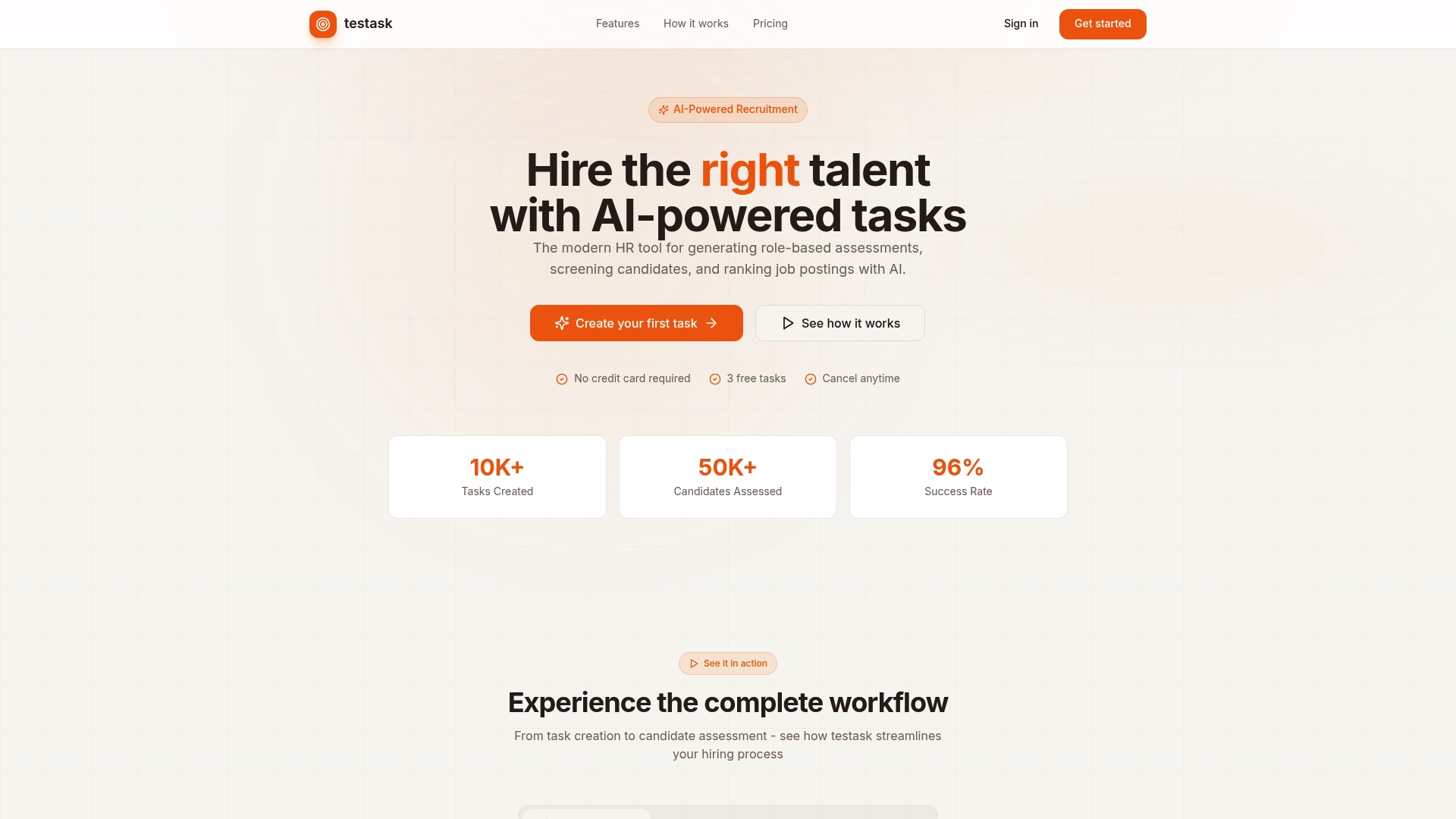
Testask is an AI-powered recruitment assessment platform that helps HR teams create tailored test tasks, evaluate candidate submissions with structured scoring, and collaborate on reviews with AI-assisted analysis. Every candidate receives the same assessment under the same conditions. Reviewers score against a shared rubric, and the platform flags scoring drift before it affects decisions. For teams building or refining an inclusive hiring process, Testask provides the infrastructure to make standardized, skills-based evaluation repeatable across every search.
FAQ
What is a diversity hiring checklist?
A diversity hiring checklist is a structured set of steps that removes bias from each stage of recruitment, from job description writing through offer and onboarding. It covers sourcing, screening, interviewing, assessment, and metrics tracking.
Does diversity hiring mean lowering standards?
No. Diversity hiring corrects the biases that prevent qualified candidates from being evaluated fairly. It improves decision quality by expanding the pool and standardizing evaluation criteria.
Are hiring quotas legal in the United States?
Quotas that give preference based on demographic characteristics are generally unlawful under Title VII. The legal approach is to expand candidate pools and standardize assessments to increase fairness without mandating specific demographic outcomes.
What KPIs should I track for inclusive hiring?
Track pipeline diversity ratios, interview-to-hire ratios by demographic, offer acceptance rates, and 12-month retention by demographic group. Measuring these metrics reveals where the process breaks down and where to intervene.
How does blind recruitment reduce bias?
Blind recruitment removes identifiable information such as names, photos, and graduation years from resumes before review. This prevents evaluators from making decisions based on perceived demographic characteristics rather than demonstrated qualifications.
Recommended
- Best Hiring Practices 2026: What HR Teams Need to Know | Testask Blog | testask
- Recruitment Trends in 2026: What HR Leaders Must Know | Testask Blog | testask
- HR Interview Checklist for Hiring Managers: 2026 | Testask Blog | testask
- Top talent acquisition tips for smarter hiring in 2026 | Testask Blog | testask