The Role of Skill Evaluation in Smarter Hiring
The Role of Skill Evaluation in Smarter Hiring

Skill evaluation is the structured, objective measurement of a candidate’s ability to perform job-specific tasks, and it is the most reliable method HR professionals have for predicting on-the-job performance. Resumes tell you what candidates claim. Skill assessments tell you what they can actually do. Hiring a candidate who lacks required skills can cost 50% to 200% of their annual salary once you factor in recruitment, onboarding, lost productivity, and replacement. That figure makes the role of skill evaluation not just a process improvement, but a financial imperative. Platforms like Testask, structured work samples, and validated technical tests give hiring managers the data they need to select candidates with confidence rather than instinct.
What are the main benefits of skill evaluation in hiring?
Skill evaluation directly reduces the most expensive mistake in recruitment: hiring the wrong person. 20% of employee turnover happens within the first 45 days, and skill misalignment is the primary driver. When you assess candidates before extending an offer, you close the gap between what the role demands and what the hire can deliver.
The benefits extend well beyond avoiding bad hires:
- Objective comparison: Skills tests benchmark every candidate against the same standard, removing the inconsistency of gut-feel interviews. Skill assessments remove hiring bias by giving recruiters a fair, data-backed basis for comparison.
- Faster screening: A 27% increase in companies adopting formal assessment tools reflects how much time automated screening saves. Recruiters focus on qualified candidates rather than sifting through high-volume applications manually.
- Stronger candidate-job fit: When you measure the specific competencies a role requires, you match people to positions where they are set up to succeed, not just positions they applied for.
- Reduced unconscious bias: Structured assessments shift the hiring conversation from “Does this person feel right?” to “Does this person score right?” That shift protects both the organization and the candidate.
The importance of skill assessment also shows up in onboarding speed. New hires with unidentified skill gaps take significantly longer to reach full productivity. Catching those gaps before day one means your onboarding investment goes toward reinforcement, not remediation.
Pro Tip: Run a short pilot of your skill assessments with current high performers in the target role. Their scores create a benchmark that makes evaluating new candidates far more meaningful.

Which skill evaluation techniques deliver the most reliable results?
No single method captures the full picture of a candidate’s capabilities. Combining different assessment methods yields the highest predictive accuracy in hiring, and the most effective programs layer two or three complementary approaches.
| Method | Best for | Key limitation |
|---|---|---|
| Work samples | Measuring real task execution in context | Time-intensive to design and score |
| Technical skills tests | Assessing hard skills quickly at scale | Can miss problem-solving depth |
| Structured interviews | Evaluating reasoning and soft skills | Susceptible to interviewer bias without training |
| Self-assessments | Gathering candidate self-awareness data | Prone to inflation; unreliable as standalone |
| Cognitive ability tests | Predicting learning speed and adaptability | May disadvantage candidates without test practice |
The quality of any method depends on three properties. Effective skills assessments must demonstrate content validity (the test covers what the job actually requires), reliability (results are consistent across administrations), and criterion validity (scores predict real performance). Superficial tests that miss these standards produce noisy data, and noisy data leads to the same poor decisions you were trying to avoid.
General cognitive ability deserves more weight than most HR teams give it. Cognitive ability is a strong predictor of job performance but is routinely underweighted in assessments focused almost entirely on technical skills. A candidate who scores well on a coding test but struggles with abstract reasoning may hit a ceiling faster than one who scores moderately on both.
Work samples remain the gold standard for roles where output quality is the primary measure of success. A content marketer asked to write a brief, a data analyst asked to clean a dataset, or a customer success manager asked to respond to a mock escalation all reveal capabilities that no resume line item can replicate. The Testask platform is built around this principle, letting hiring teams generate tailored test tasks that mirror actual job conditions.
Pro Tip: When using a comparison table like the one above to select your methods, weight your choices by the role’s primary performance driver. A role that demands speed and volume calls for a different mix than one that demands judgment and nuance.
How can HR professionals integrate skill evaluation into their recruitment workflow?
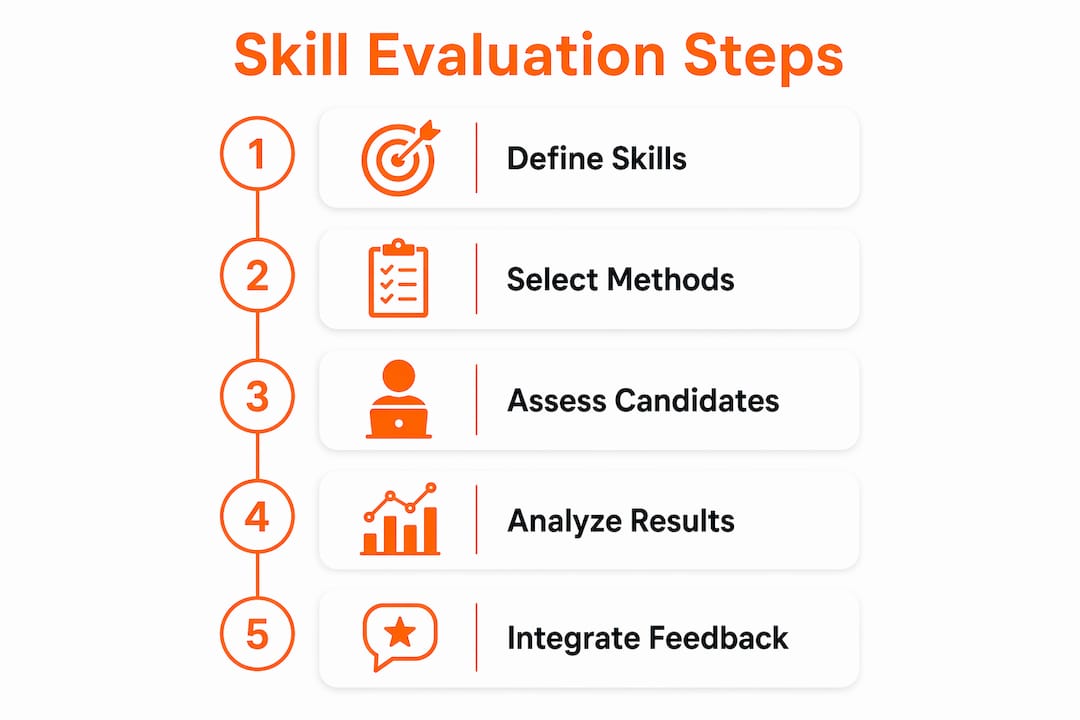
Integrating the role of competencies assessment into a repeatable hiring process requires more than selecting a test and sending it to candidates. It requires a deliberate sequence that connects assessment design to hiring decisions.
-
Define required competencies first. Before selecting any tool, list the three to five skills that most directly predict success in the role. Use input from current high performers, not just the job description. Job descriptions often reflect what the role was, not what it needs to be.
-
Select assessments that match each competency. Map each skill to the method most likely to surface it accurately. Technical skills map well to structured tests or work samples. Collaboration and communication skills map better to structured interviews or scenario-based exercises.
-
Administer assessments consistently. Every candidate for the same role should receive the same assessment under the same conditions. Inconsistency in administration introduces the exact bias that structured evaluation is designed to remove. Review your assessment checklist before each hiring cycle to confirm nothing has drifted.
-
Interpret results in context. A score is a data point, not a verdict. Pair assessment results with structured interview notes and reference checks before making a final decision. The goal is triangulation, not automation of the hire.
-
Review and update your framework regularly. Continuous maintenance of skill evaluation frameworks is non-negotiable as job roles evolve. What was a valid competency measure two years ago may now test for outdated skills. Schedule a framework review at least once per year, or whenever a role changes significantly.
Platforms like Testask reduce the operational friction at steps two through four by automating test delivery, centralizing candidate submissions, and surfacing AI-assisted analysis that helps hiring teams compare results without manual scoring overhead. That efficiency matters most when you are running multiple searches simultaneously.
Pro Tip: Build a short debrief into your hiring process where the recruiter and hiring manager review assessment results together before the final interview. This prevents one person’s interpretation from dominating the decision.
What challenges should hiring managers know about skill evaluation?
Skill evaluation is not a solved problem, and treating it as one is where most hiring programs go wrong. Fewer than half of HR leaders have clear talent acquisition strategies that reflect how fast required capabilities are shifting. That gap shows up directly in assessment design.
Several specific challenges deserve attention:
- Measuring soft skills accurately is hard. Communication, adaptability, and leadership do not score cleanly on a multiple-choice test. Structured behavioral interviews and scenario simulations get closer, but they require trained interviewers to be reliable.
- Poor assessment design can actively mislead you. Poorly designed skills evaluations can reduce decision quality rather than improve it. Over-constraining a task, failing to establish a skill baseline, or testing for proxy behaviors instead of the actual competency all produce data that points in the wrong direction.
- Skill evaluation is diagnostic, not punitive. Assessment framed as development increases engagement and produces more honest responses than evaluation framed as pass/fail gatekeeping. This applies both to candidates during hiring and to employees during performance cycles.
- Baselines matter more than most teams realize. Establishing a no-skill baseline is the only way to confirm that a skill actually improves performance rather than simply correlating with it. Without a baseline, you cannot distinguish between a skill that drives results and one that high performers happen to have.
“The difference between a skill evaluation that improves hiring and one that creates false confidence is almost entirely in the design. A well-constructed assessment reveals capability. A poorly constructed one just filters for familiarity with the test format.”
The distinction between diagnostic evaluation and performance review also matters structurally. Diagnostic skill evaluation identifies gaps and guides development decisions. Performance reviews measure output against targets. Conflating the two produces neither good hiring data nor useful performance feedback. Keep them separate in both design and communication.
Key takeaways
Skill evaluation is the most direct method for reducing hiring errors, and its value compounds when assessments are well-designed, consistently administered, and regularly updated to reflect current role requirements.
| Point | Details |
|---|---|
| Cost of skill mismatch | Bad hires cost 50% to 200% of annual salary; skill evaluation reduces this risk directly. |
| Multi-method accuracy | Combining work samples, structured interviews, and tests yields higher predictive accuracy than any single method. |
| Assessment quality standards | Valid assessments must demonstrate content validity, reliability, and criterion validity to predict performance. |
| Workflow integration | Define competencies first, then select tools, administer consistently, and review frameworks annually. |
| Diagnostic framing | Skill evaluation works best when positioned as gap identification, not pass/fail gatekeeping. |
Why I think most hiring teams underinvest in assessment design
After working with dozens of HR teams on recruitment process improvements, the pattern I see most often is this: organizations invest in assessment tools but not in assessment design. They purchase a platform, activate a library of pre-built tests, and assume the hard work is done. It is not.
The tool is the delivery mechanism. The design is the actual lever. A well-designed work sample built around a real task from the role will outperform a generic technical test every time, regardless of which platform delivers it. The teams that see the strongest hiring outcomes are the ones that treat assessment design as a skill in itself, one worth developing internally or sourcing from specialists.
I also think the profession underweights cognitive ability more than it should. Technical skills are visible and easy to test. Cognitive ability is less visible but more predictive of long-term performance, especially in roles that evolve quickly. If your current assessment mix is 80% technical and 20% everything else, that ratio is worth reconsidering.
The future of professional skill evaluation is not more tests. It is smarter tests, built closer to actual job conditions, scored with AI assistance, and reviewed by hiring teams who understand what the data means. That combination is what separates organizations that hire well from those that hire often.
— Pavel
See how Testask makes skill evaluation faster and more accurate
Testask is an AI-powered recruitment assessment platform built for HR teams and hiring managers who need reliable candidate evaluation without the manual overhead. You can generate tailored test tasks that mirror real job conditions, review candidate submissions with AI-assisted scoring, and collaborate with your team on hiring decisions from a single workspace. The platform supports the employment assessment best practices that separate high-quality hiring programs from reactive ones. If you are ready to move beyond resume screening and build a skill evaluation process that actually predicts performance, start with Testask and see the difference structured assessment makes.
FAQ
What is the role of skill evaluation in recruitment?
Skill evaluation provides an objective, structured measure of a candidate’s ability to perform job-specific tasks, giving hiring managers data that resumes cannot supply. It reduces costly bad hires by identifying skill gaps before an offer is extended.
How do you evaluate skills effectively in the hiring process?
The most effective approach combines work samples, structured interviews, and validated skills tests, each mapped to a specific competency the role requires. Administering assessments consistently across all candidates and interpreting results alongside interview data produces the most reliable hiring decisions.
What are the most common skill evaluation techniques?
Work samples, technical skills tests, structured behavioral interviews, cognitive ability tests, and self-assessments are the primary methods used in professional hiring. No single method is flawless for every skill dimension, which is why combining methods improves accuracy.
How often should skill evaluation frameworks be updated?
Skill evaluation frameworks should be reviewed at least once per year, or whenever a role changes significantly. Outdated frameworks test for competencies that no longer predict performance in the current version of the role.
What is the difference between skill evaluation and a performance review?
Skill evaluation is diagnostic, focused on identifying capability gaps and predicting future performance. A performance review measures past output against defined targets. Conflating the two undermines the accuracy of both processes.
Recommended
- Streamline candidate evaluation: proven steps for better hiring | Testask Blog | testask
- Screening process best practices: smarter, fairer hiring steps | Testask Blog | testask
- Build an employee assessment checklist that works | Testask Blog | testask
- Why improve candidate screening? Efficiency, quality, AI | Testask Blog | testask