Why Measure Candidate Potential: A 2026 HR Guide
Why Measure Candidate Potential: A 2026 HR Guide

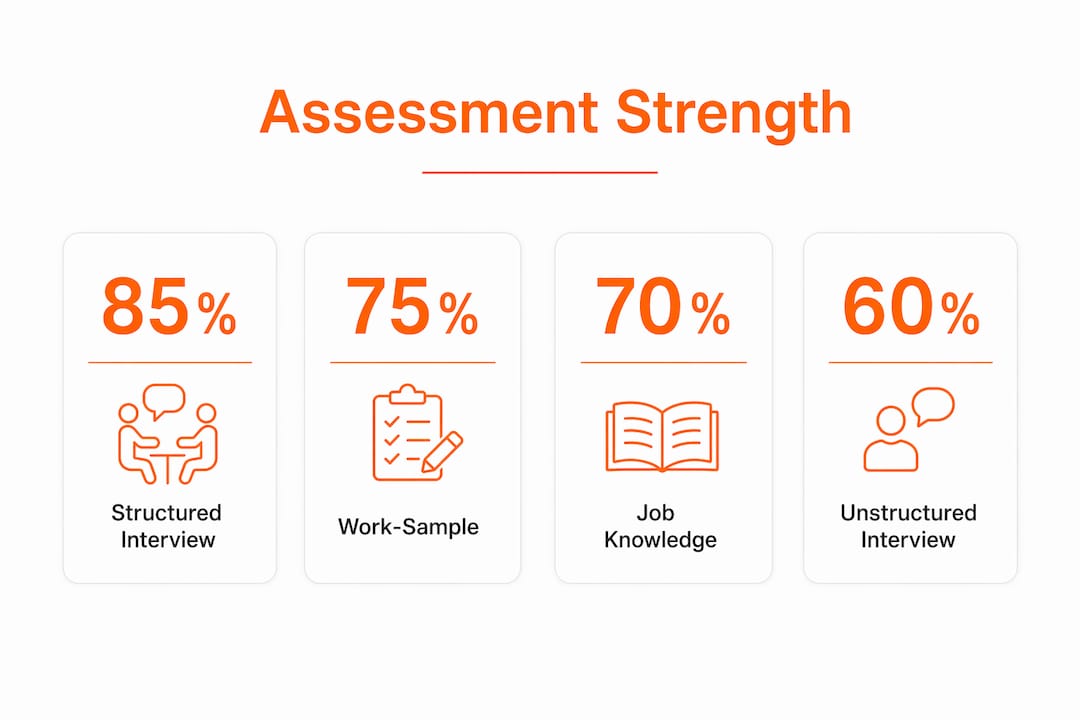
Measuring candidate potential is defined as evaluating a person’s capacity to learn, adapt, and grow into a role, rather than filtering solely on past credentials. This distinction matters because resumes capture history, not trajectory. Structured interviews, job knowledge tests, and work-sample assessments consistently outperform unstructured interviews and credential-based screens as predictors of job performance. That finding alone explains why the importance of candidate assessment has moved from a nice-to-have to a core hiring discipline. The recruiters who understand this shift fill roles faster, retain talent longer, and build teams that actually perform.
Why measure candidate potential instead of screening by resume?
Candidate potential is not a single trait. Potential consists of learning velocity, intellectual curiosity, adaptability under ambiguity, and pattern recognition as independent, assessable dimensions. Each one predicts how a person will perform in a role that evolves, not just the role as it exists today. A resume tells you where someone has been. These dimensions tell you where they can go.
Credential-based filtering creates a false sense of precision. A candidate with a prestigious degree and five years of experience may lack the learning agility to handle a product pivot or a team restructure. Meanwhile, a candidate with a non-traditional background may score high on pattern recognition and adaptability. Filtering by credentials alone means you never see that second candidate clearly.

Structured assessment elevates recruitment from subjective guessing to data-driven science that complements human judgment with defensible evidence. That shift matters especially when hiring managers face pressure to fill roles quickly. Speed without structure produces bad hires. Structure without speed produces candidate drop-off. The goal is both, and measuring potential gives you a framework to achieve it.
What evidence-based methods actually measure potential?
The most reliable approach combines multiple assessment formats into a single evaluation sequence. Multi-modal AI assessments combining structured interviews, live problem sets, and soft-skills evaluations achieve 16% higher predictive accuracy compared to resume screening alone. That gap is significant enough to change hiring outcomes at scale.
The reason multi-modal assessments outperform single-format tools is signal diversity. A structured interview captures verbal reasoning and communication. A live problem set captures real-time thinking under pressure. A soft-skills evaluation captures interpersonal behavior. No single format captures all three. When you combine them, the signals complement each other rather than overlap.
Work-sample assessments deserve particular attention. They ask candidates to complete a task representative of actual job duties, which removes the gap between “says they can do it” and “demonstrates they can do it.” For technical roles, this might be a code review. For a marketing role, it might be a brief campaign outline. The format adapts to the role, and the output is directly comparable across candidates.
Pro Tip: Use a scoring rubric before you run any work-sample assessment. Define what “excellent,” “acceptable,” and “below standard” look like for each dimension before you see a single submission. This prevents post-hoc rationalization of a candidate you already liked.
| Assessment method | Predictive strength | Best used for |
|---|---|---|
| Structured interview | High | Communication, reasoning, cultural fit |
| Work-sample task | High | Role-specific skills, output quality |
| Job knowledge test | Moderate to high | Technical depth, domain expertise |
| Soft-skills evaluation | Moderate | Collaboration, adaptability, drive |
| Unstructured interview | Low | Relationship building only |
Which dimensions of potential should you evaluate?
Listening for how candidates learn and adapt reveals high potential more reliably than measuring only past achievements. The practical implication is that your interview questions need to shift from “tell me what you accomplished” to “tell me how you figured it out.” That single reframe changes the quality of information you collect.
The four core dimensions of candidate potential each require a distinct evaluation approach:
- Learning velocity. Ask candidates to describe a time they had to acquire a new skill under time pressure. Rate how quickly they moved from confusion to competence, not just whether they succeeded.
- Intellectual curiosity. Look for candidates who ask questions during the interview, not just answer them. Curiosity shows up in the quality of the questions a person asks, not just the answers they give.
- Adaptability under ambiguity. Present a scenario with incomplete information and ask how they would proceed. Candidates with high adaptability will name their assumptions explicitly and propose a path forward anyway.
- Pattern recognition. Give candidates a brief case or data set and ask what they notice. Strong candidates identify the non-obvious connection, not just the surface-level trend.
Building a candidate scoring scorecard for these four dimensions lets your team evaluate each one independently before comparing notes. That independence matters because group discussion tends to collapse nuanced observations into a single “gut feeling.” Scorecards preserve the signal.
The distinction between potential and past achievement is not about ignoring experience. It is about weighting it correctly. A candidate who has done the exact same job for ten years may score lower on learning velocity than a candidate who has done three different jobs in five years. Both profiles have value. Knowing which one your role requires is the job of the assessment.
What are the common pitfalls in measuring candidate potential?
The most common mistake is assessment stacking. Overloading candidates with multiple disconnected assessments increases friction and lowers process effectiveness. Candidates who face four separate tools in sequence drop out at higher rates, and the ones who stay may be performing assessment fatigue rather than genuine capability. The fix is to design your evaluation sequence around the specific failure modes of the role, not around every assessment tool you have access to.
- Stack assessments by role failure mode, not by tool availability. Identify the two or three ways a person most commonly fails in this role, then build assessments that surface those risks directly.
- Score independently before discussing. Anchoring bias in team debriefs distorts candidate evaluation. The first person to speak in a debrief sets the frame for everyone else. Require written scores submitted simultaneously before any group conversation begins.
- Validate your tools against real outcomes. Assessment tools must correlate with actual job performance and retention. A correlation below 0.3 between assessment scores and six-month performance ratings signals that the tool is not predicting what you think it is.
- Configure assessments by role, not by department. A single assessment template applied across an entire engineering team will miss the differences between a front-end developer and a data engineer. Role-specific configuration is not optional.
Pro Tip: Run a quarterly audit of your assessment results against new-hire performance data. If your top-scoring candidates are not your top performers at six months, your assessment is measuring the wrong thing.
How should HR teams implement potential assessment in their hiring process?
Placement in the hiring sequence determines how much value your assessments actually deliver. Position assessments after initial qualification screening but before interviews to focus recruiter time on candidates who have already demonstrated baseline capability. Running assessments too early wastes candidate goodwill. Running them too late wastes recruiter time on candidates who would have screened out.
A practical implementation sequence looks like this:
- Step 1: Resume screen for minimum qualifications only. Filter for non-negotiable requirements, nothing more. This keeps the candidate pool wide enough for potential to show up.
- Step 2: Send a targeted assessment. Use a work-sample task or structured problem set calibrated to the role’s core failure modes. Keep total candidate time under 60 minutes.
- Step 3: Use assessment results to structure the interview. Let the data tell you where to probe. If a candidate scored low on adaptability, ask two or three behavioral questions that test that dimension directly.
- Step 4: Score the interview independently. Each interviewer submits scores before the debrief. Then discuss. This sequence preserves signal integrity.
- Step 5: Combine assessment data, interview scores, and reference checks. No single source is sufficient. The combination is what produces a defensible hiring decision.
Data analytics in hiring makes this sequence repeatable and auditable. When you can trace a hiring decision back to specific scores on specific dimensions, you can defend it, improve it, and learn from it over time. That traceability is what separates a hiring process from a hiring habit.
Platforms that support AI candidate screening integrate structured evaluation with collaborative review, so your team scores candidates in the same system where the assessment ran. That integration removes the manual step of transferring data between tools, which is where scoring errors and recency bias tend to enter the process. For professional growth-focused hiring, this kind of structured approach also signals to candidates that your organization takes development seriously.
Key Takeaways
Measuring candidate potential through structured, multi-modal assessments predicts job performance more accurately than credentials alone, reduces bias, and produces hiring decisions that hold up at six months and beyond.
| Point | Details |
|---|---|
| Potential has four dimensions | Evaluate learning velocity, curiosity, adaptability, and pattern recognition as separate criteria. |
| Multi-modal assessments outperform resumes | Combining structured interviews, problem sets, and soft-skills tools raises predictive accuracy by 16%. |
| Sequence matters | Run assessments after qualification screening but before interviews to focus recruiter time effectively. |
| Independent scoring reduces bias | Require written scores before group debriefs to prevent anchoring effects from distorting results. |
| Validate against real outcomes | Audit assessment scores against six-month performance data; correlations below 0.3 signal a poor-fit tool. |
The case for potential over pedigree
I have reviewed hundreds of hiring processes, and the pattern is consistent. Teams that filter by credentials hire people who look right on paper. Teams that assess potential hire people who perform right in practice. Those are not the same group.
The hardest part of this shift is not the methodology. It is the organizational habit. Hiring managers who have always relied on gut feel resist structured scorecards because scoring feels bureaucratic. What I have found is that the resistance fades after the first bad hire that the scorecard would have caught. That moment tends to be persuasive.
The other thing I have learned is that AI-assisted assessment does not replace judgment. It informs it. The best hiring decisions I have seen come from teams that use assessment data to sharpen their interview questions, not to skip the interview entirely. The data tells you where to look. The conversation tells you what you are actually seeing.
Building this capability inside an HR team takes time. Start with one role, one assessment, and one scorecard. Audit the results at six months. Adjust. The teams that do this consistently end up with a hiring process that gets better every quarter, not just a process that runs.
— Pavel
Testask makes potential assessment practical
Measuring candidate potential requires the right tools behind the process. Testask is an AI-powered recruitment assessment platform that helps HR teams create tailored test tasks, evaluate submissions with AI-assisted analysis, and collaborate on scoring in one place.
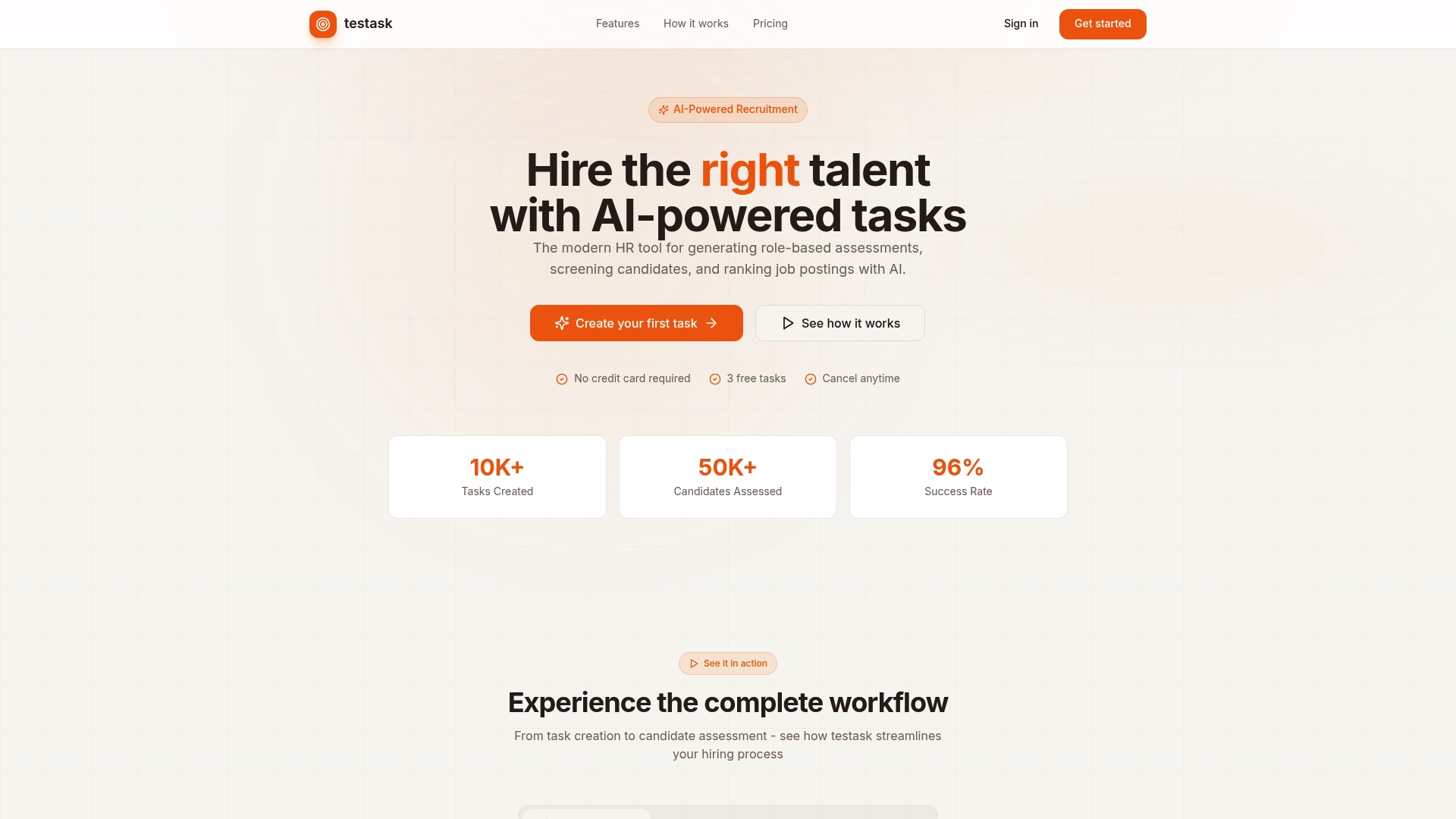
With Testask, you can build role-specific assessments that target the exact dimensions your hiring process needs, from learning agility to technical problem-solving. The platform supports multi-modal evaluation and structured review workflows, so your team scores candidates consistently and makes decisions backed by data. Visit Testask to see how evidence-based assessment works in practice and request a free trial for your team.
FAQ
Why measure candidate potential rather than experience?
Experience reflects what a candidate has done. Potential predicts what they can do next. Structured assessments of learning velocity and adaptability are stronger predictors of future performance than job titles or years in a field.
What are the most reliable candidate potential assessment techniques?
Structured interviews, work-sample tasks, and job knowledge tests consistently outperform unstructured interviews and resume screening. Combining these formats into a multi-modal sequence raises predictive accuracy significantly.
How do you reduce bias when evaluating candidate potential?
Require each evaluator to submit independent written scores before any group debrief. This prevents the first speaker from anchoring the entire team’s judgment and produces fairer, more defensible results.
When in the hiring process should you run a potential assessment?
Run assessments after initial qualification screening but before interviews. This placement focuses recruiter time on candidates who have already cleared minimum requirements and uses assessment data to structure the interview.
How do you know if your assessment tool is actually working?
Audit assessment scores against six-month performance ratings and retention data. A correlation below 0.3 between scores and outcomes means the tool is not predicting job success for that role and needs to be replaced or reconfigured.