Candidate Ranking Procedure: 2026 HR Guide
Candidate Ranking Procedure: 2026 HR Guide

A candidate ranking procedure is the systematic process of scoring and ordering job applicants from most to least qualified based on how well they meet defined job requirements. Done correctly, it replaces gut-feel hiring with a documented, defensible method that holds up to scrutiny. Federal agencies, EEOC guidelines, and composite scoring models have shaped how this process works today. HR professionals who build a structured applicant evaluation process consistently make faster, fairer, and more accurate hiring decisions.
What are the core components of a candidate ranking procedure?
A candidate ranking procedure depends on clearly defined criteria applied consistently across every applicant. The most common factors include skills match, experience relevance, education level, job stability, location logistics, and cultural fit. Each factor gets a numeric weight that reflects its importance to the role.
Scoring scales typically run from 0–100 points per factor. Technical skills might carry 40% of the total score, relevant experience 35%, education 15%, and other factors the remaining 10%. Those weighted scores combine into a single composite number that ranks every applicant on the same scale.

The weight assigned to each factor should change by role. A senior software engineer role demands a heavier weight on technical skills than a client-facing sales position, where communication and relationship-building matter more. Defining must-have criteria separately from nice-to-have criteria prevents low-priority factors from distorting the final ranking.
Pro Tip: Involve hiring managers before you review a single resume. Ask them to assign weights to each criterion independently, then compare results. Disagreements reveal hidden assumptions about the role before they contaminate your rankings.
| Criterion | Typical weight range | Assessment method |
|---|---|---|
| Technical skills | 30%–45% | Skills test, portfolio review |
| Relevant experience | 25%–40% | Resume screen, structured interview |
| Education | 10%–20% | Resume screen |
| Cultural fit | 5%–15% | Behavioral interview |
| Location and logistics | 5%–10% | Application questionnaire |
Composite scoring models combining multiple assessment types show higher validity than single-method evaluations. That means a ranking built on a skills test plus a structured interview predicts job success better than either method alone.
How to design a multi-stage candidate ranking process
A multi-stage process filters candidates through sequential hurdles, moving from low-cost screeners to high-investment assessments. This approach concentrates your team’s time on candidates who have already proven basic eligibility.
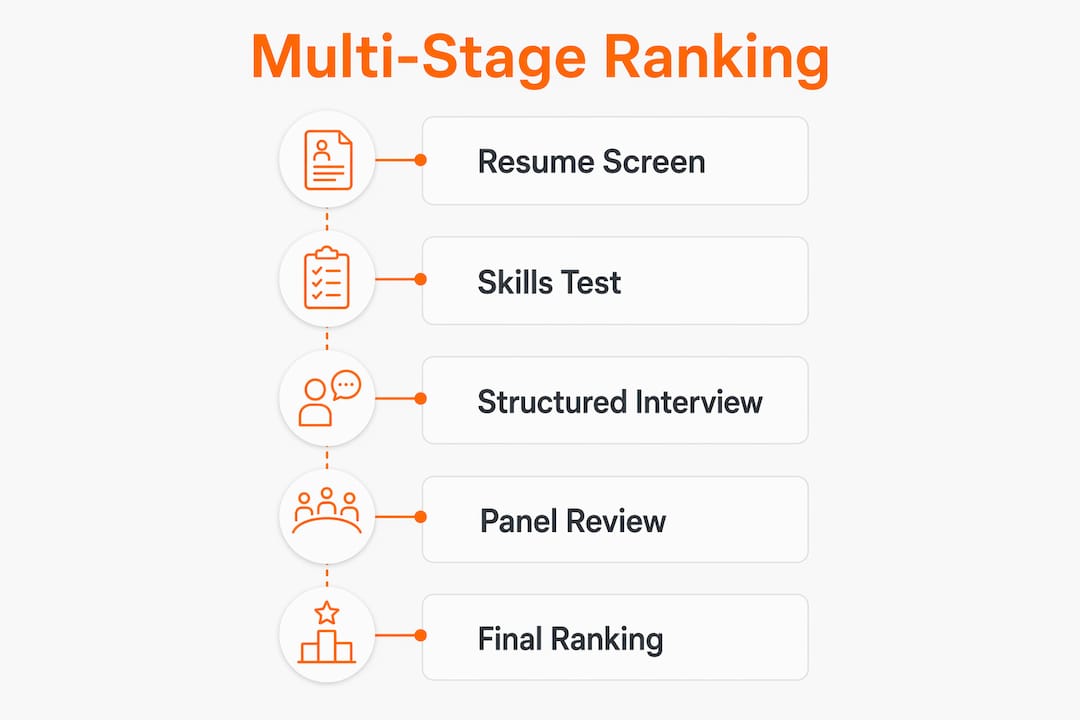
The multi-hurdle approach requires candidates to pass each stage before advancing. A candidate who fails the resume screen never reaches the cognitive test. A candidate who scores below the interview threshold never reaches the final panel. Each gate protects the time of everyone downstream.
Here is a practical sequence for building a multi-stage ranking process:
- Define the job criteria and weights. Write the scoring rubric before reviewing any application. Criteria set after reviewing resumes absorb bias from the first candidates you read.
- Run an initial resume screen. Score each resume against must-have qualifications only. Reject applicants who miss mandatory requirements. Advance everyone who clears the threshold.
- Deploy an automated questionnaire or skills test. Use a short, role-specific assessment to score candidates on technical or functional competencies. This stage handles volume efficiently.
- Administer a structured cognitive or work-sample test. Candidates who pass the questionnaire receive a deeper assessment. Work samples and cognitive tests add strong criterion-related validity to the ranking.
- Conduct structured interviews. Use the same questions and a standardized scoring rubric for every candidate. Score responses immediately after each interview, before the next one begins.
- Compile composite scores and produce a ranked list. Aggregate scores from all stages using the pre-defined weights. The ranked list drives your selection decision.
- Document every score and decision. Maintain records that explain why each candidate advanced or was eliminated. Documentation is your defense if a hiring decision is ever challenged.
Pro Tip: Use multi-stage screening steps to separate resume-available qualifications from interaction-dependent skills. Evaluate communication ability in the interview, not on the resume. Mixing stage-specific criteria wastes resources and introduces bias.
The resource benefit is real. Expensive assessments like structured interviews and panel reviews reach only the candidates who have already cleared cheaper filters. That keeps your cost-per-hire lower without sacrificing the quality of your final ranked pool.
What are best practices for fairness and compliance in candidate ranking?
Fairness in candidate ranking starts before you read the first application. Defining evaluation criteria before candidate review produces consistent, comparable, and justifiable ratings. Criteria set mid-process absorb the characteristics of candidates already reviewed.
Standardized scoring rubrics and structured interviews are the two most reliable tools for consistency. A rubric defines what a “3 out of 5” answer looks like for a specific question. Without that anchor, two interviewers scoring the same response will produce different numbers.
Key compliance requirements for any scored selection procedure:
- EEOC Uniform Guidelines compliance. Scored selection procedures are legally treated as tests for employers with 15 or more employees. That means adverse impact analysis and full documentation of criteria and weighting are required.
- Adverse impact analysis. Compare selection rates across demographic groups. A significant disparity triggers a review of whether the scoring criteria are job-related and consistent with business necessity.
- Documented criteria and weights. Record the criteria, weights, and scoring rubric used for each role before the process begins. This documentation protects your organization and demonstrates merit-based decision-making.
- Stage-appropriate criteria. Separating criteria by stage reduces bias and preserves resources. Resume screens should use only qualifications visible on a resume. Interaction-dependent skills belong in the interview stage.
Pro Tip: Before finalizing your ranked list, ask your hiring committee two questions: “Why are we excluding this candidate?” and “Do we have enough information to justify that decision?” Self-questioning minimizes undue subjective influence and catches bias before it affects the outcome.
Recent federal hiring guidance reinforces these practices. Merit-based, transparent, and documented ranking procedures are the standard that agencies and private employers alike are moving toward.
How has the 2025 “Rule of Many” changed merit-based hiring?
The Rule of Many replaces the federal government’s long-standing Rule of Three, which required hiring managers to select from only the top three candidates on a ranked list. That constraint created a real problem: when multiple candidates score within fractions of a point of each other, limiting selection to three names is arbitrary.
Federal agencies now use numerical ranking systems that allow broader selections from the top of the candidate pool. Applicants receive scores augmented for veterans’ preference, organized in rank order. Hiring managers can select from a wider group without re-ranking the entire pool.
The practical benefits of the Rule of Many include:
- Broader candidate pools. Managers are no longer forced to choose from three names when five or six candidates score nearly identically.
- Finer distinctions in qualifications. Numerical scores reveal meaningful differences between candidates that a simple top-three list obscures.
- Greater selection flexibility. Agencies can account for mission needs, team composition, and specific skill gaps without violating merit principles.
- Preserved rank order. The transition from Rule of Three eases manager restrictions while keeping the ranked pool intact. No candidate is arbitrarily elevated above a higher-scoring peer.
The Rule of Many aligns directly with composite scoring frameworks used in private-sector hiring. Both approaches recognize that a single ranked list with numerical scores gives decision-makers more information than a binary pass/fail cutoff. Private-sector HR professionals can apply the same logic: produce a full ranked pool, then select from the top tier rather than locking in a rigid top-three rule.
Key Takeaways
A structured candidate ranking procedure built on weighted composite scores, sequential assessment stages, and documented criteria produces more defensible and accurate hiring decisions than unstructured review.
| Point | Details |
|---|---|
| Define criteria first | Set scoring weights and rubrics before reviewing any application to prevent bias. |
| Use composite scoring | Combine skills tests, structured interviews, and work samples for higher predictive validity. |
| Apply multi-stage filtering | Move candidates through sequential hurdles to protect time and concentrate resources. |
| Document for compliance | EEOC guidelines require adverse impact analysis and full documentation for scored procedures. |
| Adopt Rule of Many logic | Rank by numerical score and select from the top tier rather than a rigid top-three cutoff. |
Why most ranking procedures fail before the interview starts
The biggest flaw I see in candidate ranking is not the scoring formula. It is the timing. Teams build their criteria after they have already read twenty resumes. By then, the rubric reflects the candidates they have seen, not the job they need to fill. That is not a ranking procedure. That is post-hoc rationalization dressed up in numbers.
The second failure is treating the ranked list as the final answer rather than a starting point. A composite score tells you who performed best on the criteria you measured. It does not tell you whether you measured the right things. I have seen technically perfect ranking systems produce mediocre hires because the criteria were copied from a job description written three years earlier for a different team.
The third issue is the gap between HR and hiring managers. HR builds the rubric. The hiring manager runs the interview. If the manager does not understand why the criteria are weighted the way they are, they will override the ranking with their own judgment. That is not always wrong, but it is always undocumented. Undocumented overrides are where legal exposure lives.
The fix is not more technology. It is more conversation before the process starts. Calibrate criteria with the hiring manager. Explain the weighting logic. Get their sign-off on the rubric. When the ranked list arrives, they will trust it because they helped build it. That buy-in is worth more than any scoring algorithm.
— Pavel
How Testask helps you build a reliable ranking process
Putting a structured ranking procedure into practice requires the right infrastructure. Testask gives HR professionals and hiring managers the tools to configure scoring criteria, build multi-stage assessment pipelines, and review candidate submissions with AI-assisted analysis.
With Testask, you can generate tailored test tasks for any role, score submissions against pre-defined rubrics, and collaborate with your hiring team on a single platform. The result is a ranked candidate pool built on consistent, documented criteria rather than scattered notes and competing opinions. Teams that use structured evaluation frameworks reduce time-to-hire and improve the quality of their final selections. Testask makes that structure accessible without adding administrative overhead. Visit testask.org to see how it fits your hiring workflow.
FAQ
What is a candidate ranking procedure?
A candidate ranking procedure is a systematic method of scoring and ordering job applicants based on how well they meet defined role criteria. It uses weighted composite scores to produce a ranked list that guides selection decisions.
How do you create a fair scoring rubric for ranking candidates?
Define your criteria and weights before reviewing any applications, then anchor each score level with a concrete behavioral description. This approach reduces subjective judgment and produces comparable ratings across all candidates.
What is the difference between the Rule of Three and the Rule of Many?
The Rule of Three limited hiring managers to selecting from the top three candidates on a ranked list. The Rule of Many allows selection from a broader top-tier pool using numerical scores, giving managers more flexibility when candidates score closely together.
How many assessment stages should a candidate ranking process include?
Most effective processes use three to four stages: an initial resume screen, a skills or questionnaire assessment, a structured interview, and a final composite scoring review. Each stage eliminates candidates who do not meet the threshold before advancing to the next.
Are scored candidate ranking procedures subject to legal requirements?
Scored selection procedures are treated as tests under EEOC Uniform Guidelines for employers with 15 or more employees. Organizations must conduct adverse impact analysis and document their criteria, weights, and scoring methods for each role.