Why Agile Recruiting Wins: A Guide for HR Teams
Why Agile Recruiting Wins: A Guide for HR Teams

Agile recruiting is a talent acquisition methodology that applies proven agile principles, including sprints, cross-functional sourcing pods, and continuous feedback loops, to make hiring more adaptable and aligned with real business needs. The standard industry term is “agile talent acquisition,” and it borrows directly from software development frameworks like Scrum and Kanban. Why agile recruiting outperforms traditional methods comes down to one core fact: agile recruiting is not faster hiring. It is better alignment between what the business needs and who actually gets hired. Speed is a byproduct, not the goal.
How does agile recruiting differ from traditional hiring methods?
Traditional recruiting runs in a straight line. A role opens, a job description gets written, candidates move through fixed stages, and a decision gets made weeks or months later. The problem is that business needs shift during that cycle, and the original job description becomes outdated before anyone gets hired.
Agile recruiting treats job requirements as hypotheses to be refined continuously. Instead of locking in a fixed description at the start, hiring teams revisit and update criteria based on candidate feedback, market signals, and evolving team needs. This single shift eliminates a massive source of rework: the late-stage reset where a hiring manager rejects every finalist because the role has changed.
The structural differences are significant:
- Linear pipeline vs. iterative sprints. Traditional hiring uses long, sequential stages. Agile hiring uses short, time-boxed cycles called sprints, typically one to two weeks, with defined goals and clear decision points at each end.
- Siloed handoffs vs. cross-functional pods. Traditional recruiting passes candidates between HR, recruiters, and hiring managers in sequence. Agile pods bring all three together from day one, working in parallel.
- Fixed role definitions vs. living documents. Traditional job descriptions stay static. Agile teams update them after each sprint based on what they learn.
- Reactive decisions vs. structured checkpoints. Traditional hiring relies on individual judgment at the end of a long process. Agile recruiting introduces defined alignment checkpoints that convert individual bias into a controlled business outcome.
Pro Tip: Before your first agile sprint, document your current role definition and mark every assumption. Those assumptions become your first hypotheses to test.
The result of these structural changes is less misalignment and less rework. When recruiters, HR professionals, and hiring managers operate as a unified pod rather than a relay team, the candidate who reaches the final stage actually fits the role as it exists today, not as it was imagined three months ago.
What are the main benefits of agile recruiting?
The benefits of agile recruiting are operational, financial, and cultural. They compound over time as teams build better habits and clearer communication.
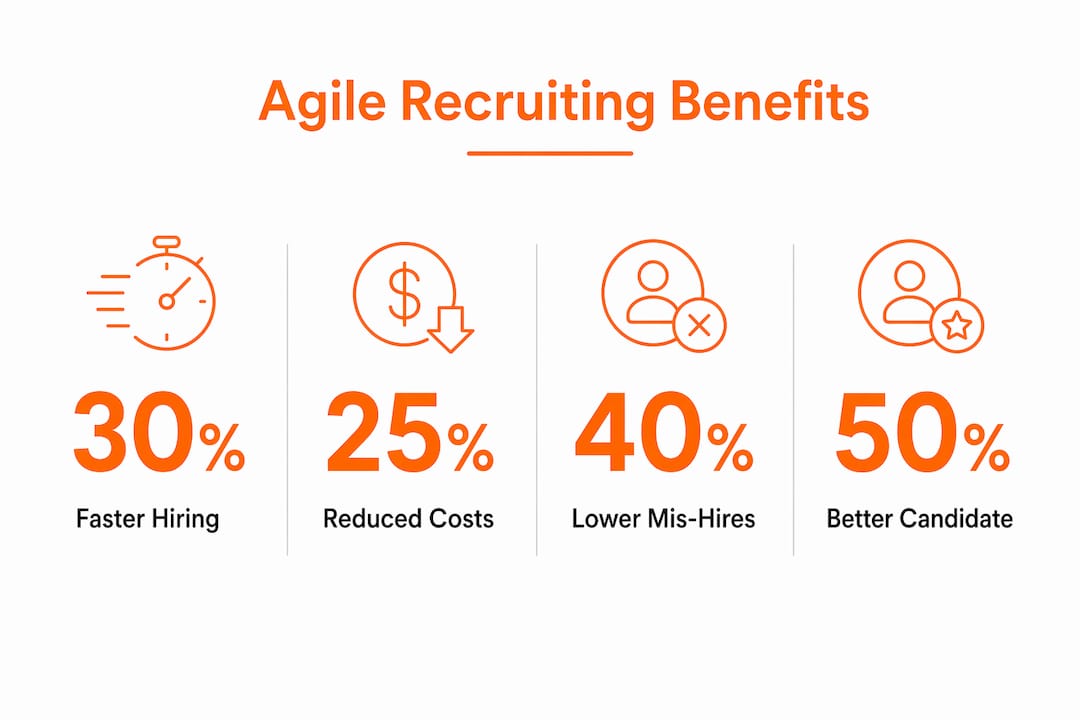
Faster time-to-fill on critical roles
Agile recruiting models reduce time-to-fill critical roles from months to days by using small, cross-functional pods and short sprint cycles. That compression happens because decisions get made at the end of each sprint rather than accumulating into one high-stakes final meeting. Hiring managers stay engaged throughout, so there are no bottlenecks waiting for approvals.

Lower recruitment costs
Agile talent acquisition lowers total recruitment costs by reducing agency fees and mis-hiring expenses through better quality hires upfront. When role requirements are continuously refined, the candidates who reach the offer stage are genuinely qualified. That reduces the expensive cycle of rejecting finalists and restarting searches.
Better candidate experience
Candidates in agile processes receive faster, more consistent communication. Because the pod owns the entire process, no candidate falls through a handoff gap. Transparency about timelines and criteria builds trust, which matters for competitive roles where top candidates have multiple offers.
Reduced mis-hiring risk
Agile methodologies with standardized evaluation and continuous feedback significantly reduce the risk of mis-hiring by addressing evolving role requirements early. Mis-hires are expensive in both direct costs and team disruption. Catching a misaligned requirement in sprint two is far cheaper than discovering it after an offer is accepted.
Improved hiring quality over time
Each sprint generates data: which sourcing channels produced the best candidates, which criteria predicted success, which interview questions revealed the most. Agile teams build a smarter screening process with every cycle. Traditional hiring discards that institutional knowledge when a role closes.
How do agile hiring teams operate day-to-day?
The day-to-day reality of an agile hiring process is more structured than most HR professionals expect. It is not a free-for-all of constant change. It is a disciplined rhythm of short cycles, clear ownership, and deliberate reflection.
Mastercard’s agile hiring approach illustrates this well. The company used cross-disciplinary pods and two-week sprints to create a globally aligned, faster, and more consistent recruitment process. The key was not technology. It was structure and shared ownership.
A typical agile hiring team operates like this:
- Form the pod. Assemble a small group: one recruiter, one HR business partner, and the hiring manager. Each person has a defined role and attends every sprint ceremony.
- Set sprint goals. At the start of each sprint, the pod agrees on a specific outcome. Examples include “source 20 qualified candidates from engineering communities” or “complete first-round interviews with 10 finalists.”
- Run daily standups. A 15-minute daily check-in keeps everyone aligned. Each person answers: what did I do yesterday, what will I do today, and what is blocking me?
- Refine the backlog. The hiring manager, acting as a talent advisor rather than a delegator, reviews the candidate pipeline and reprioritizes based on what the team has learned. Hiring managers become talent advisors involved daily in sprint planning rather than passive approvers at the end.
- Hold a sprint review. At the end of each sprint, the pod reviews outcomes against goals, adjusts criteria, and plans the next cycle.
- Run a retrospective. The team identifies what worked, what did not, and what to change. This is where the collaborative hiring process improves with every iteration.
Pro Tip: Keep sprint goals narrow and measurable. “Find great candidates” is not a sprint goal. “Complete structured interviews with 8 candidates for the senior engineer role by Friday” is.
This rhythm creates predictability. Hiring managers know exactly when they need to be involved and for how long. Recruiters know when decisions will be made. Candidates get faster responses because the pod is actively working the pipeline every day, not waiting for a weekly review meeting.
What challenges might HR face when implementing agile recruiting?
Adopting agile recruitment methods requires real behavioral change, and that is where most implementations stall. The process changes are straightforward. The cultural changes are harder.
The most common challenges HR teams face include:
- Hiring manager resistance. Traditional recruiting lets hiring managers delegate and wait. Agile recruiting requires daily involvement. Many managers initially push back because they see it as added work rather than shared ownership.
- Misunderstanding the goal. Teams often adopt agile recruiting expecting speed above all else. When they realize the primary goal is alignment, not urgency, some lose motivation. Framing the change correctly from the start prevents this.
- Evolving role definitions creating candidate confusion. When criteria shift mid-process, candidates can feel misled. Clear communication about what is changing and why protects the candidate experience and your employer brand.
- Leadership buy-in gaps. Without executive support, agile recruiting stays a pilot that never scales. Leaders need to understand that agile recruiting transforms hiring into a controlled, predictable risk-management function, not just a faster version of what already exists.
The most effective solution is to start small with MVPs and expand once the model proves itself. Pick one high-priority role, form one pod, run two sprints, and measure the outcomes. That pilot creates proof points that make the cultural argument for you. Candidates who go through an agile process also tend to give better feedback, which helps build internal support for expanding the model.
For candidates navigating iterative hiring cycles, tools that help them present skills clearly, like AI-optimized CV tools, can reduce friction on both sides of the process.
Key Takeaways
Agile recruiting improves hiring outcomes by replacing fixed pipelines with iterative sprints, cross-functional pods, and structured decision checkpoints that keep hiring aligned with real business needs.
| Point | Details |
|---|---|
| Alignment over speed | The primary goal of agile recruiting is better alignment, not faster hiring. Speed follows naturally. |
| Cross-functional pods | Bringing HR, recruiters, and hiring managers together from day one eliminates costly handoff gaps. |
| Iterative role definitions | Treating job requirements as hypotheses reduces late-stage resets and mis-hiring risk. |
| Sprint structure creates predictability | Short, time-boxed cycles with defined goals give all stakeholders clear expectations and faster decisions. |
| Start with a pilot | Running one agile sprint on a high-priority role builds proof points and earns leadership buy-in before scaling. |
The real reason agile recruiting matters more than most HR teams realize
Most conversations about agile recruiting focus on speed. That framing is wrong, and it sets teams up for disappointment. I have seen HR teams adopt sprint cycles and daily standups, then declare the model a failure because time-to-fill only dropped by a week. They measured the wrong thing.
The actual value of agile recruiting is risk management. Without structured decision points and shared ownership, hiring decisions rely heavily on individual judgment, which increases variability and risk. Agile recruiting does not just make hiring faster. It makes hiring outcomes more predictable and more defensible. That matters enormously when a bad hire costs a company six to nine months of that employee’s salary in replacement costs alone.
The behavioral shift is the hardest part and the most important part. When a hiring manager stops delegating and starts advising, the entire dynamic of the recruiting relationship changes. Recruiters stop being order-takers and start being strategic partners. That shift does not come from installing new software. It comes from redesigning how people work together. The teams that get this right treat agile recruiting as a continuous improvement process for their entire talent function, not a one-time process fix.
My honest advice: do not wait for perfect conditions to start. Pick your hardest open role, form a pod this week, and run one sprint. The discomfort of the first retrospective, where everyone admits what went wrong, is exactly where the learning happens.
— Pavel
Testask supports agile recruiting with AI-powered assessment
Agile recruiting depends on fast, accurate candidate evaluation at every sprint stage. Testask is an AI-powered recruitment assessment platform that helps HR teams and hiring managers create tailored test tasks, evaluate candidate submissions, and collaborate on reviews without slowing down the sprint cycle.
When your pod needs to assess 15 candidates before Friday’s sprint review, Testask generates role-specific assessments and delivers AI-assisted analysis so your team makes decisions based on evidence, not gut feel. That kind of structured evaluation fits directly into the iterative, feedback-driven rhythm that makes agile hiring work. Visit Testask to see how AI-powered assessment integrates with your agile hiring process.
FAQ
What is agile recruiting?
Agile recruiting is a talent acquisition methodology that applies agile principles, such as sprints, cross-functional pods, and continuous feedback, to make hiring more adaptive and aligned with business needs.
Why use agile recruiting instead of traditional hiring?
Traditional hiring uses fixed, linear pipelines that become misaligned as business needs change. Agile recruiting uses iterative cycles and shared ownership to keep hiring decisions current and accurate.
What are the main benefits of agile recruiting?
The core benefits of agile recruiting include faster time-to-fill on critical roles, lower mis-hiring risk, reduced recruitment costs, and a better candidate experience through consistent communication.
How long does an agile recruiting sprint typically last?
Most agile hiring sprints run one to two weeks, with defined goals set at the start and a review meeting at the end to assess outcomes and adjust criteria.
How do you start implementing agile recruitment methods?
Start with a single high-priority role, form a small pod of one recruiter, one HR business partner, and the hiring manager, then run two sprints before evaluating results and expanding the model.
Recommended
- Build an effective recruitment checklist for HR success | Testask Blog | testask
- How to improve recruitment: proven steps for better hiring | Testask Blog | testask
- Recruitment Trends in 2026: What HR Leaders Must Know | Testask Blog | testask
- Hiring process best practices: proven steps for better talent | Testask Blog | testask