What Is Objective Hiring? A 2026 Guide for HR Teams
What Is Objective Hiring? A 2026 Guide for HR Teams

Objective hiring is defined as the practice of evaluating candidates using predefined, job-relevant criteria applied consistently across every applicant. The industry term for this practice is structured hiring, and the two phrases describe the same core method. Structured interviews carry a criterion-related validity of 0.51, compared to roughly 0.38 for unstructured approaches. That gap means structured methods predict on-the-job performance meaningfully better. Organizations that understand what is objective hiring and apply it consistently gain a measurable advantage in both selection quality and legal defensibility. Google re:Work, the UK government, and the Equal Employment Opportunity Commission (EEOC) all endorse structured, criteria-based evaluation as the standard for fair recruitment.
What is objective hiring and what are its core components?
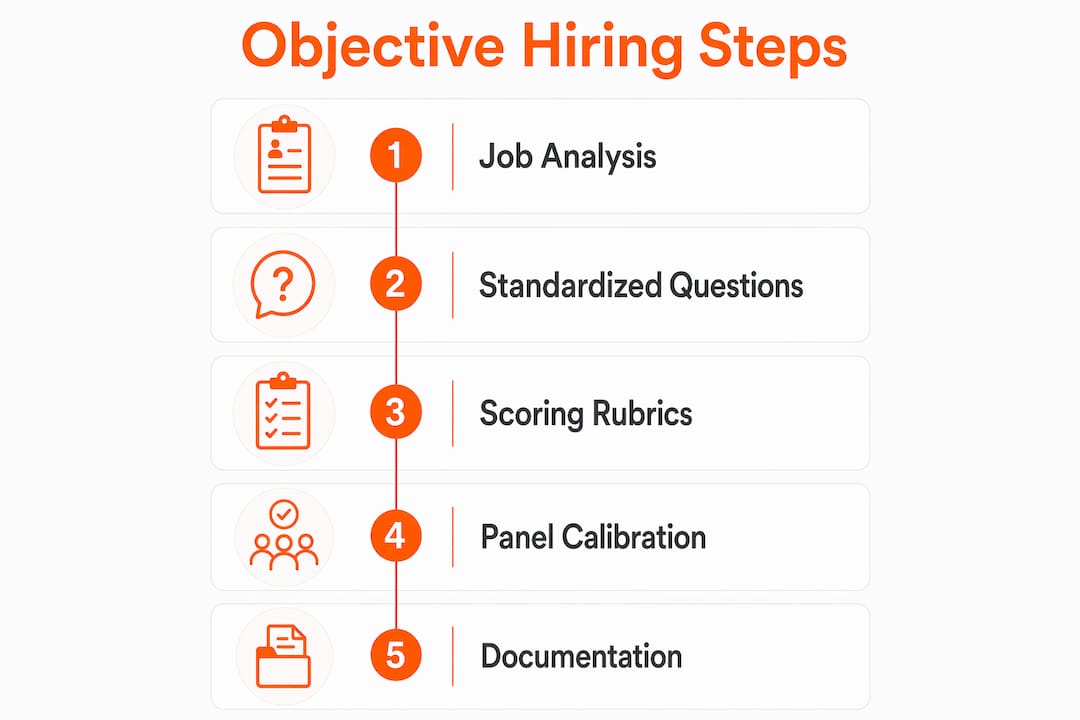
An objective hiring process rests on four building blocks: job analysis, standardized questions, scoring rubrics, and diverse panels. Each element removes a specific source of subjectivity from the decision.
Job analysis and KSAOs
Every objective process starts with a formal job analysis that identifies the knowledge, skills, abilities, and other characteristics (KSAOs) the role requires. Without this step, interviewers default to gut feeling. A well-defined KSAO profile gives every evaluator the same target to assess.

Standardized questions and behavioral anchors
Behavioral and situational questions ask candidates to describe past actions or respond to realistic scenarios. These question types produce comparable answers across candidates. Behaviorally anchored rating scales (BARS) then translate those answers into numeric scores tied to specific performance levels, which reduces anchoring bias and keeps evaluators calibrated.
Scoring rubrics and documentation
A scoring rubric defines what a “1,” “3,” or “5” looks like for each KSAO. Rubrics force interviewers to justify scores with evidence rather than impressions. Comprehensive documentation creates a paper trail that supports compliance reviews and internal audits.
Panel composition
UK government guidance mandates at least two-person panels with gender and ethnic diversity for balanced decision-making. A single interviewer carries all of their own biases into the room. A mixed panel distributes that risk across multiple perspectives.
- Define KSAOs before writing a single interview question.
- Build a fixed question bank so every candidate answers the same set.
- Attach a BARS rubric to each question before interviews begin.
- Recruit panel members from different functions, genders, and backgrounds.
- Train every panelist on scoring before the first interview.
Pro Tip: Run a calibration session where all panelists score the same practice answer independently, then compare scores. Disagreements reveal rubric gaps before they affect real candidates.
How does objective hiring improve fairness and reduce bias?
Structured hiring reduces bias by removing the conditions that allow it to thrive. Unstructured conversations let interviewers follow their instincts, which often means favoring candidates who remind them of themselves. That pattern is called similarity bias, and it compounds over time into systemic inequity.
Structured methods lower the bias effect of applicant characteristics such as sex, which helps reduce gender pay gaps over time. The mechanism is straightforward: when every candidate answers the same questions and is scored against the same rubric, demographic characteristics become less visible as decision inputs.
The halo effect is another common distortion. An interviewer who is impressed by a candidate’s first answer unconsciously rates all subsequent answers higher. Rubric-based scoring breaks this pattern by requiring a fresh evaluation for each question.
Blind recruitment adds another layer of protection. Removing names, photos, and graduation years from applications reduces the chance that demographic signals influence early screening decisions. AI-assisted anonymization tools automate this step, enabling competency-based evaluation from the first touchpoint.
Candidate experience also improves under structured conditions. Research from Google re:Work shows that candidates report 35% higher satisfaction when rejected from a structured process compared to an unstructured one. That finding matters because rejected candidates talk. A fair process protects your employer brand even when the answer is no.
- Identify which biases your current process is most exposed to (similarity, halo, confirmation).
- Map each bias to the process stage where it most often appears.
- Apply a structural fix at that stage: blind screening, BARS scoring, or panel review.
- Collect post-interview feedback from candidates to detect experience gaps.
- Review demographic hiring data quarterly to spot adverse impact trends early.
What practical strategies can HR implement for objective hiring in 2026?
Building an objective hiring process requires upfront work, but the return is faster, more consistent decisions. The steps below apply whether you are building from scratch or improving an existing process.
- Write a job requirements document first. List every KSAO the role demands, ranked by importance. This document drives every downstream decision, from sourcing to final scoring.
- Create a standardized interview guide. The guide should include the question bank, time allocations, and scoring rubrics. Every interviewer uses the same document. Deviation from the guide reintroduces subjectivity.
- Train interviewers before each hiring cycle. Training is not a one-time event. Ongoing calibration sessions are critical to maintaining consistent application of objective criteria across evaluators.
- Use technology to enforce structure. Platforms that support bias-free hiring workflows can automate question delivery, collect scores in real time, and flag when evaluators skip rubric steps.
- Conduct post-hire validation. Compare interview scores to six-month performance reviews. If high scorers are not outperforming low scorers, your rubric needs recalibration.
Pro Tip: Assign one panelist the role of “process monitor” in each interview. Their job is to flag any question that deviates from the guide or any scoring that happens without rubric reference. This single role catches most process drift before it becomes a pattern.
AI tools add meaningful capacity here. Anonymization features strip identifying information from resumes before they reach reviewers. Structured workflow tools prompt evaluators to complete every rubric field before submitting a score. For HR teams managing high-volume hiring, these capabilities reduce the manual effort of maintaining consistency. Resources like Way of Work also offer frameworks for building structured hiring workflows that align with modern HR practice.
How does objective hiring align with legal and compliance standards?
The EEOC’s Uniform Guidelines on Employee Selection Procedures (UGESP) require that selection tools demonstrate job-relatedness. Objective hiring satisfies this requirement by design. Every question links to a KSAO, and every KSAO links to the job analysis. That chain of evidence is what courts and regulators look for.
Structured hiring better meets UGESP guidelines for content and criterion validity, creating defensible records that unstructured processes cannot match. Unstructured interviews produce inconsistent data that is difficult to defend under adverse impact scrutiny.
| Compliance factor | Structured hiring | Unstructured hiring |
|---|---|---|
| Job-relatedness documentation | Explicit KSAO linkage | Rarely documented |
| Criterion validity | 0.51 (research-supported) | ~0.38 |
| Adverse impact risk | Lower, with panel diversity | Higher |
| Legal defensibility | Strong paper trail | Weak or absent |
| UGESP alignment | Meets content and criterion standards | Often non-compliant |
Adverse impact analysis compares selection rates across demographic groups. If a protected group is selected at less than 80% of the rate of the highest-selected group, the EEOC’s four-fifths rule flags a potential problem. Structured hiring reduces this risk by tying decisions to job-relevant scores rather than interviewer impressions.
Documentation is the final safeguard. Every score sheet, rubric, and panel note should be retained for a minimum period consistent with your jurisdiction’s employment records requirements. These records demonstrate that decisions were made on legitimate, job-related grounds.
Key takeaways
Objective hiring, built on structured interviews, BARS rubrics, and diverse panels, is the most defensible and predictively valid approach to candidate selection available to HR teams today.
| Point | Details |
|---|---|
| Structured interviews outperform unstructured ones | Criterion-related validity of 0.51 versus 0.38 means better prediction of job performance. |
| KSAOs anchor every decision | Define knowledge, skills, abilities, and other characteristics before writing any interview question. |
| Diverse panels reduce individual bias | At least two panelists with varied backgrounds distribute subjective risk across multiple perspectives. |
| Documentation creates legal protection | Retained score sheets and rubrics demonstrate job-related decision-making under EEOC scrutiny. |
| Calibration keeps the process honest | Regular training sessions prevent score drift and maintain consistency across hiring cycles. |
Where gut feeling still gets in the way
I have watched well-designed objective hiring processes collapse in the debrief room. The rubrics were solid. The questions were behavioral. The panel was diverse. Then one senior leader said, “I just didn’t get a good feeling about her,” and the scores were quietly reinterpreted.
That experience taught me something the research confirms but rarely states plainly: human judgment remains essential, but it also remains the primary threat to objectivity. Tools reduce bias. They do not eliminate it. The real work is cultural, not technical.
The organizations that get objective hiring right treat it as a discipline, not a checklist. They debrief after every hire. They ask whether the process held up under pressure. They reward panelists who flag process violations rather than penalizing them for slowing things down.
Candidate transparency is also underrated. When candidates understand how they will be evaluated, they perform more authentically. That produces better data for your rubric and a better experience for them. A diversity hiring checklist is a useful starting point, but the real test is whether your team applies it consistently when the pressure is on.
The uncomfortable truth is that most hiring processes are only as objective as the people running them. Technology and structure create the conditions for fairness. Commitment and accountability make it real.
— Pavel
How Testask helps you build a structured hiring process
HR teams that want to put objective hiring into practice need more than a framework. They need tools that enforce structure at every step.
Testask is an AI-powered recruitment assessment platform that helps you create tailored test tasks, collect candidate submissions, and evaluate responses against consistent scoring criteria. Anonymized candidate views reduce the influence of demographic signals during screening. Collaborative review features let your panel score independently before comparing results, which mirrors best-practice panel methodology. If you are ready to move from ad hoc interviews to a structured hiring workflow, Testask gives your team the infrastructure to do it at scale.
FAQ
What is objective hiring in simple terms?
Objective hiring is the practice of evaluating every candidate against the same predefined, job-relevant criteria using structured questions and scoring rubrics. The goal is to base decisions on evidence rather than impressions.
How does structured interviewing reduce bias?
Structured interviews require every candidate to answer the same questions, scored against the same rubric, which limits the influence of similarity bias, the halo effect, and other common distortions.
What is the EEOC’s role in fair hiring?
The EEOC’s Uniform Guidelines on Employee Selection Procedures require that selection tools demonstrate job-relatedness and content validity. Structured hiring satisfies these requirements by linking every question to a documented KSAO.
How many people should be on an objective hiring panel?
UK government guidance recommends at least two panelists with gender and ethnic diversity. Multiple evaluators distribute subjective risk and produce more balanced scoring outcomes.
Does objective hiring improve the candidate experience?
Candidates who go through structured processes report 35% higher satisfaction when rejected compared to unstructured approaches, according to Google re:Work research. A fair, transparent process protects your employer brand regardless of the outcome.
Recommended
- What Is Unbiased Recruitment? A Guide for HR Teams | Testask Blog | testask
- Best Hiring Practices 2026: What HR Teams Need to Know | Testask Blog | testask
- What Is Hiring Analytics? A Guide for HR Teams | Testask Blog | testask
- What Is Hiring Efficiency? A Guide for HR Leaders | Testask Blog | testask