What Is Unbiased Recruitment? A Guide for HR Teams
What Is Unbiased Recruitment? A Guide for HR Teams

Unbiased recruitment is the practice of evaluating candidates strictly on job-relevant skills, experience, and potential, excluding any influence from personal characteristics like gender, race, age, or background. The industry standard term for this approach is “fair and structured hiring,” though HR professionals increasingly use “unbiased recruitment” to describe the same set of practices. Organizations using structured unbiased interview methods see 40% lower turnover and 28% higher revenue compared to traditional hiring. That gap is not a coincidence. It reflects what happens when hiring decisions are grounded in evidence rather than instinct. The EEOC and SHRM both identify unconscious bias as one of the most persistent barriers to equitable hiring, and the data backs them up.
What is unbiased recruitment, and why does it matter?
Unbiased recruitment is defined as a hiring process where every candidate is assessed against the same job-relevant criteria, with personal identity factors removed from the evaluation. The goal is not to ignore who a person is. The goal is to make sure those factors do not influence whether they get hired.
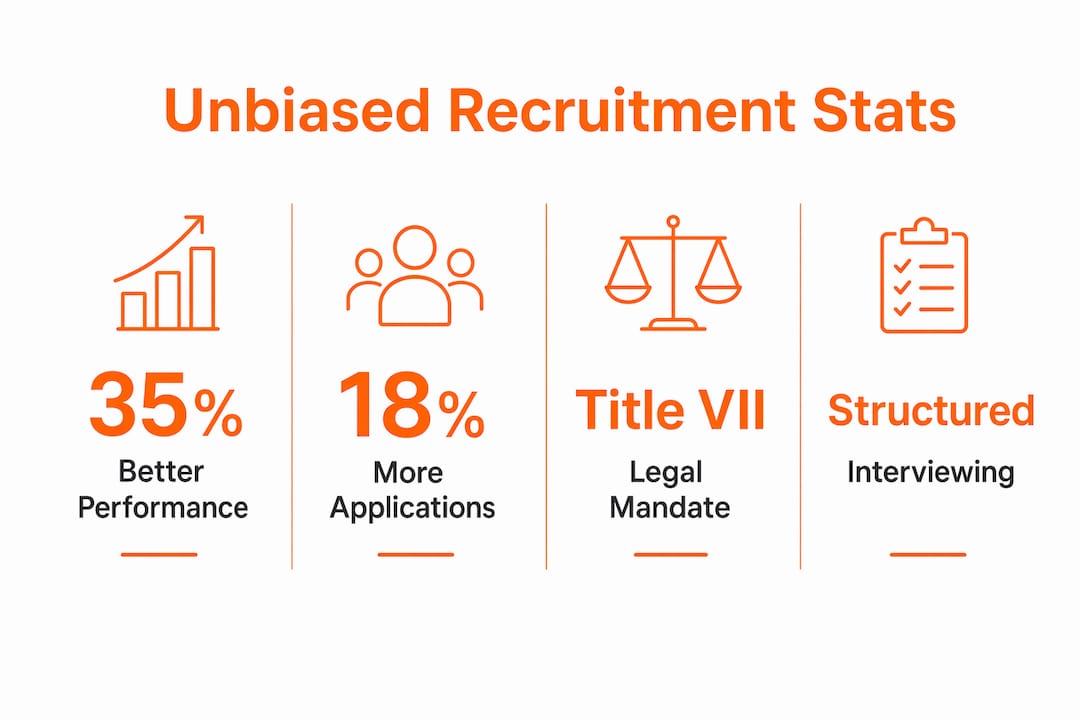
The business case is clear. Companies practicing inclusive hiring are 35% more likely to outperform competitors, and employees in those environments report triple the happiness and engagement. That kind of culture lift does not happen by accident. It requires deliberate process design at every stage of recruitment.

The definition of unbiased recruitment also carries legal weight. The EEOC enforces Title VII of the Civil Rights Act, which prohibits employment discrimination based on race, color, religion, sex, and national origin. SHRM guidelines reinforce this by recommending structured, documented hiring processes that can withstand legal scrutiny. For HR professionals, unbiased hiring practices are both a performance strategy and a compliance requirement.
One more number worth knowing: skills-based evaluation increases applications from underrepresented groups by 18%. That means fairer processes do not just improve quality of hire. They expand your talent pool.
How does unconscious bias affect hiring decisions?
Unconscious bias is a judgment made automatically, without deliberate reasoning, based on mental shortcuts shaped by culture, experience, and exposure. Every hiring manager carries these shortcuts. The problem is not that they exist. The problem is that most hiring processes do nothing to counteract them.
CIPD research found that 63% of interviews contain biased questions. That figure means the majority of hiring conversations are shaped by something other than job performance criteria. The most common forms of unconscious bias in recruitment include:
- Affinity bias: Favoring candidates who share your background, alma mater, or communication style.
- Confirmation bias: Forming an early impression and then seeking evidence to confirm it rather than challenge it.
- Gender bias: Associating certain roles or leadership qualities with a specific gender.
- Halo effect: Letting one strong attribute, like a prestigious employer, overshadow weaknesses in other areas.
- Attribution bias: Crediting a candidate’s success to luck rather than skill when they do not fit the expected profile.
The psychological mechanism behind most of these biases is the same: snap judgments made in the first few minutes of an interview or CV review. Research consistently shows that interviewers form strong impressions within the first 90 seconds. Everything after that tends to be rationalization.
Pro Tip: Record your first impression of a candidate immediately after reviewing their CV, then revisit it after the structured interview. If your view changed significantly, that gap is where bias was operating.
What are the core methods for fair candidate assessment?
Structured hiring is the most evidence-backed approach to reducing bias. Google’s structured interviewing program demonstrates that standardizing questions, scoring, and interviewer training improves both fairness and predictive validity. The difference in predictive accuracy is significant: unstructured interviews have validity coefficients around 0.25, while structured interviews reach approximately 0.5. That means structured interviews are roughly twice as predictive of job performance.
The core methods HR professionals use to achieve unbiased recruitment include:
- Structured interviews: Every candidate answers the same questions in the same order. Interviewers score responses against a predefined rubric before discussing candidates as a group.
- Behaviorally anchored rating scales (BARS): These scoring guides define what a strong, average, or weak answer looks like for each question. They remove subjectivity from scoring.
- Work sample tests: Candidates complete a task that mirrors actual job responsibilities. This is the most direct measure of job-relevant skill.
- Blind CV screening: Personal identifiers like name, age, and address are removed before reviewers assess qualifications.
- Diverse hiring panels: Including interviewers from different backgrounds reduces the influence of any single person’s biases.
Blind recruitment deserves a closer look because it is often misunderstood. Anonymizing CVs can increase interview chances by 15% for underrepresented candidates. However, blind recruitment is not a universal fix. It can conflict with targeted diversity outreach programs that explicitly aim to attract candidates from specific groups. You need to decide which goal takes priority at each stage of your process.
Pro Tip: Use blind screening for initial CV review, then switch to structured interviews with diverse panels for later stages. This captures the benefits of both approaches without sacrificing targeted outreach.
For a deeper look at how anonymized methods work in practice, the practical HR guide to blind recruitment covers the tradeoffs in detail.
Can AI support or undermine unbiased hiring?
AI-assisted screening offers real advantages for consistency. Automated tools apply the same criteria to every application, removing the fatigue and mood variation that affect human reviewers. When configured correctly, AI can flag candidates who meet job-relevant criteria without ever processing demographic information.
The risk is that AI can also encode historical bias. AI tools trained on historical hiring data may penalize employment gaps, non-traditional career paths, or unconventional educational backgrounds. These patterns disproportionately affect underrepresented groups. An AI system that learned from a historically homogeneous workforce will replicate that homogeneity unless actively corrected.
Best practices for ethical AI use in recruitment include:
- Audit AI outputs regularly: Compare acceptance rates across demographic groups to identify patterns that suggest bias.
- Separate screening criteria from demographic proxies: Remove zip codes, school names, and graduation years from AI inputs where they correlate with protected characteristics.
- Maintain human oversight: No AI decision should be final without a human review step, particularly for candidate rejections.
- Document your AI criteria: EEOC guidance requires that selection procedures be job-related and consistent with business necessity.
The impact of AI on hiring bias is a growing area of research, and the consensus is clear: AI is a tool, not a solution. It requires the same scrutiny you would apply to any other hiring method.
How to implement unbiased recruitment in your organization
Building unbiased hiring practices into your workflow requires changes at the process level, not just the mindset level. Good intentions do not override a poorly designed process.
- Audit your job descriptions. Remove gendered language, unnecessary degree requirements, and vague qualifiers like “culture fit.” Tools like Textio identify biased language patterns in job postings. Replace subjective descriptors with specific, measurable competencies.
- Train interviewers on structured interviewing. Effective structured interviews require detailed interviewer training, behaviorally anchored rating scales, and calibration sessions among evaluators. One-time bias awareness training is not sufficient. Calibration must happen before each hiring cycle.
- Standardize your scoring process. Every interviewer scores candidates independently before any group discussion. This prevents the first speaker from anchoring the group’s judgment.
- Build diverse hiring panels. A panel with varied backgrounds, seniority levels, and functions catches blind spots that a homogeneous group will miss.
- Track your recruitment data. Monitor application-to-interview rates, offer rates, and acceptance rates by demographic group. Patterns in this data reveal where bias is entering your process.
The skills-based hiring approach is one of the most direct ways to shift from credential-based to performance-based evaluation. Pairing it with a structured interview checklist gives your hiring team a repeatable, defensible process.
Pro Tip: Run a quarterly audit of your last 20 hiring decisions. Map each decision back to the scoring rubric. If the rubric scores and the final decision diverge regularly, your process has a gap that needs fixing.
Key Takeaways
Unbiased recruitment requires structured processes, trained interviewers, and regular data audits to consistently produce fair and accurate hiring decisions.
| Point | Details |
|---|---|
| Define criteria before screening | Set job-relevant competencies before reviewing any applications to prevent post-hoc rationalization. |
| Structured interviews double accuracy | Structured interviews have roughly twice the predictive validity of unstructured ones, per validated research. |
| Blind screening has limits | Anonymizing CVs helps at the screening stage but can conflict with targeted diversity outreach programs. |
| AI requires active oversight | AI tools trained on historical data can encode bias and must be audited regularly for demographic patterns. |
| Data tracking closes the loop | Monitoring offer and acceptance rates by group is the only reliable way to confirm your process is working. |
The part of unbiased hiring most organizations skip
After working with HR teams across industries, the pattern I see most often is this: organizations invest in bias training, update their job descriptions, and then stop. They treat unbiased recruitment as a one-time project rather than an ongoing system.
The uncomfortable truth is that bias re-enters processes through calibration drift. Interviewers who were trained six months ago start reverting to intuition. Scoring rubrics get applied inconsistently. New hiring managers join without proper onboarding. The structure erodes quietly, and no one notices until the data shows a problem.
The other thing I have observed is that structured processes feel uncomfortable to experienced interviewers at first. Asking the same questions in the same order feels mechanical. Some interviewers resist it because they believe their judgment is reliable. The research says otherwise. Confirmation bias is the most common trap in hiring, and structured interviews are the primary defense against it precisely because they force objective assessment before any group discussion happens.
My honest recommendation: treat your hiring process like a product. Version it, test it, and update it based on data. The organizations that sustain unbiased hiring over time are the ones that build review cycles into their calendar, not just their onboarding decks.
— Pavel
How Testask supports structured, bias-free hiring
Reducing bias in hiring requires more than good intentions. It requires tools that enforce consistency at scale.
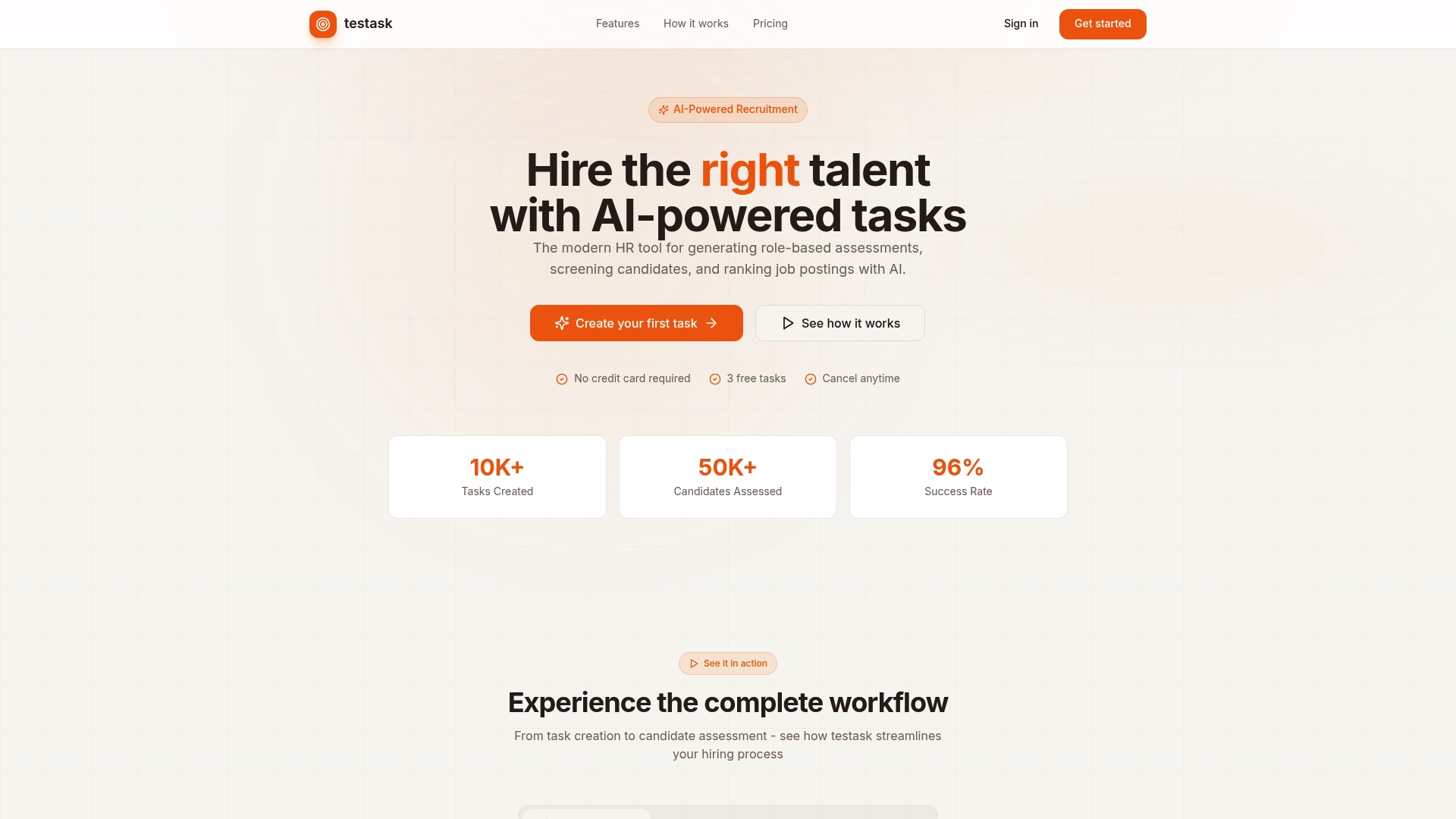
Testask is an AI-powered recruitment assessment platform that helps HR teams create tailored test tasks, evaluate candidate submissions against standardized criteria, and collaborate on reviews with structured scoring. Every candidate completes the same assessment under the same conditions, which removes the inconsistency that lets bias in. The platform’s AI-assisted analysis flags performance patterns across submissions, so your team spends less time on manual review and more time on high-quality decisions. If you are building a bias-free hiring process and need a tool that enforces structure at the screening stage, Testask is built for exactly that.
FAQ
What is the definition of unbiased recruitment?
Unbiased recruitment is the practice of evaluating candidates solely on job-relevant skills, experience, and potential, without influence from personal characteristics like gender, race, or age. It relies on structured processes, standardized criteria, and consistent scoring to produce fair hiring decisions.
Why is unbiased recruitment important for organizations?
Unbiased recruitment directly improves business performance. Companies using inclusive hiring practices are 35% more likely to outperform competitors and report significantly higher employee engagement.
What is the most effective method for reducing bias in interviews?
Structured interviewing is the most evidence-backed method. It standardizes questions, scoring rubrics, and interviewer training, producing validity coefficients roughly twice those of unstructured interviews.
Does blind recruitment eliminate hiring bias?
Blind recruitment reduces bias at the CV screening stage by removing personal identifiers, and can increase interview chances for underrepresented candidates by 15%. However, it does not address bias in interviews and can conflict with targeted diversity outreach programs.
How can HR teams monitor whether their hiring process is truly unbiased?
Track application-to-interview rates, offer rates, and acceptance rates by demographic group over time. Consistent disparities in these metrics indicate where bias is entering the process and where corrective action is needed.