What Is Human Resource Management? A Complete Guide
What Is Human Resource Management? A Complete Guide

What is human resource management?
Human resource management, commonly called HRM, is the strategic management of people across every stage of the employee lifecycle to drive organizational success. It covers recruitment, onboarding, training, performance evaluation, compensation, and offboarding. The goal is not simply to fill roles and process paperwork. HRM aligns workforce practices with business objectives so that the right people are doing the right work at the right time.
A common point of confusion: HR and HRM are not the same thing. HR refers to the department or the staff handling people-related tasks, while HRM is the broader strategic process and philosophy guiding how those tasks get done. Think of HR as the team and HRM as the playbook.
The key elements of HRM include:
- Recruitment and selection: Attracting, screening, and hiring qualified candidates
- Training and development: Building employee skills and career growth
- Performance management: Setting expectations, evaluating output, and giving feedback
- Compensation and benefits: Designing pay structures, health plans, and incentive programs
- Legal and regulatory compliance: Keeping the organization aligned with labor law
- Employee relations: Resolving conflicts, managing morale, and supporting workplace culture
Why human resource management matters for your organization
HRM is not a support function. It is a driver of organizational performance. When HR practices are well-designed, they directly affect productivity, retention, and the company’s ability to compete for talent.

Consider compliance alone. Legal and ethical responsibilities are foundational pillars of HRM regardless of company size. A single discrimination lawsuit or wage violation can cost far more than a year’s worth of HR investment. HRM protects the organization by building systems that prevent those problems before they surface.
The impact on employee engagement is equally concrete. High engagement correlates with lower turnover, fewer absences, and stronger customer satisfaction scores. HR teams that invest in onboarding, recognition programs, and clear career paths tend to retain talent longer than those that treat people management as an afterthought.
Key reasons HRM matters:
- Productivity: Structured performance management keeps employees focused and accountable
- Retention: Competitive compensation and development opportunities reduce costly turnover
- Compliance: Proactive HR policies reduce legal exposure across hiring, pay, and workplace safety
- Culture: HR shapes the norms, values, and behaviors that define how work actually gets done
- Risk management: HR identifies workforce risks, from skill gaps to succession gaps, before they become crises
Stat to know: The U.S. Bureau of Labor Statistics projects HR manager roles will grow steadily through the decade, reflecting how central people management has become to organizational strategy.
What are the core functions of human resource management?
HRM operates through a set of interconnected functions. Each one addresses a different phase of the employee lifecycle, and none works well in isolation.
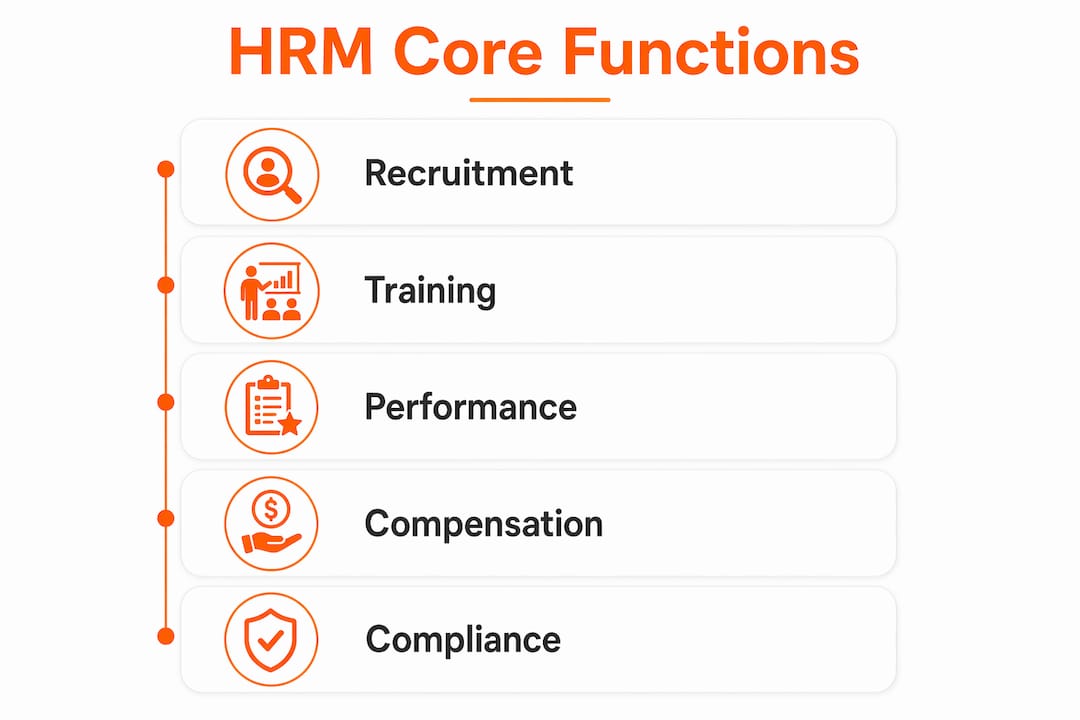
Recruitment and selection is where HRM begins. HR professionals oversee job postings, applicant tracking, interviews, skills assessments, and offer negotiations. The quality of this process determines the quality of the workforce. A weak hiring process creates downstream problems in performance, culture, and retention that are expensive to fix.

Training and development keeps the workforce current and capable. This includes new hire orientation, technical skills training, leadership development programs, and continuing education support. Organizations that invest here tend to see stronger internal promotion rates and lower skill gaps.
Performance management creates the feedback loops employees need to grow. This goes beyond annual reviews. Effective systems include goal setting, regular check-ins, 360-degree feedback, and clear criteria for advancement or corrective action.
Compensation and benefits administration covers base pay, bonuses, health insurance, retirement plans, paid leave, and other perks. HR benchmarks these against market data to stay competitive. Getting this wrong is one of the fastest ways to lose good people.
Legal and regulatory compliance threads through every other function. HR monitors changes to federal and state labor law, including the Fair Labor Standards Act, Title VII of the Civil Rights Act, the Americans with Disabilities Act, and OSHA standards. Staying current is not optional.
Pro Tip: Build a compliance calendar that tracks key regulatory deadlines, annual reporting requirements, and policy review dates. Reactive compliance is always more expensive than proactive compliance.
What skills and responsibilities do HR managers need?
HR managers carry a wide portfolio of responsibilities, and the skills required span both people and data. According to the Bureau of Labor Statistics, HR managers plan, coordinate, and direct administrative functions while also consulting with top executives on strategic planning and talent management.
The most effective HR managers combine these capabilities:
- Strategic thinking: Connecting workforce decisions to business goals, not just filling open roles
- Communication: Translating complex policies into plain language for employees at every level
- Conflict resolution: Mediating disputes between employees or between staff and management fairly and quickly
- Data analysis: Using HR metrics and analytics to measure workforce performance and justify budget decisions
- Workforce planning: Forecasting hiring needs, identifying skill gaps, and building succession plans
- Compliance expertise: Staying current on labor law and applying it consistently across the organization
- Employee advocacy: Representing employee interests while also advancing organizational goals
Small businesses face a particular challenge here. Many lack a dedicated HR department, leaving compliance and people management to owners or generalist staff without specialist training. That gap creates real legal and operational risk.
What career paths and specializations exist in HR?
HR offers a broad range of career trajectories, from generalist roles to deep specializations. Entry-level positions typically include HR assistant, HR coordinator, or recruiting coordinator. From there, professionals can move into HR generalist roles that span multiple functions, or specialize in one area.
Common specializations include:
- Talent acquisition: Focused entirely on sourcing, assessing, and hiring candidates. This role has grown more technical with the rise of applicant tracking systems and skills-based hiring.
- Learning and development (L&D): Designing training programs, e-learning content, and leadership development curricula.
- Compensation and benefits: Benchmarking pay, managing benefits vendors, and designing total rewards packages.
- Labor relations: Negotiating with unions, managing collective bargaining agreements, and handling grievances.
- HR analytics: Using data tools to measure workforce trends, predict turnover, and report on HR program effectiveness.
- HR business partner (HRBP): An embedded strategic role where HR professionals work directly with a specific business unit to align people practices with that unit’s goals.
Emerging roles in HR technology and people analytics are growing fast. Organizations increasingly want HR professionals who can work with workforce data platforms, AI-assisted screening tools, and predictive modeling. Certifications from SHRM (Society for Human Resource Management) or HRCI (HR Certification Institute) accelerate advancement at every level.
How is technology reshaping human resource management?
Technology has moved from a back-office HR tool to a front-line driver of how organizations find, assess, and develop talent. The shift is accelerating.
AI-powered screening tools now handle initial resume review, candidate ranking, and even preliminary skills assessments, cutting the time HR teams spend on early-stage filtering. Platforms like Testask let HR teams generate tailored test tasks, evaluate candidate submissions with AI-assisted analysis, and collaborate on hiring decisions, all within a single workflow. That kind of capability compresses screening timelines and improves consistency across reviewers.
Current trends reshaping HRM:
- AI in recruitment: Automated screening, skills testing, and candidate scoring reduce bias and speed up decisions
- HR analytics: Data-driven decision-making is now a core HR competency, not a specialty skill
- Diversity, equity, and inclusion (DEI): Organizations are building structured programs to measure and improve representation at every level
- Remote and hybrid work: Virtual collaboration tools, digital onboarding, and distributed team management have become standard HR responsibilities
- Human capital management (HCM) platforms: Integrated systems that connect payroll, benefits, performance, and learning data in one place
Stat to know: The BLS projects continued growth in HR management roles, driven in part by the increasing complexity of workforce compliance and the demand for strategic HR leadership.
Pro Tip: When evaluating HR technology, prioritize tools that integrate with your existing systems. A platform that does not connect to your payroll or ATS creates data silos that slow down decisions.
How has HRM evolved into a strategic business partner?
For most of the 20th century, HR was personnel administration. The job was to process paperwork, manage payroll, and handle terminations. Strategic input was not part of the mandate.
That changed as research and business outcomes made the connection between people practices and organizational performance impossible to ignore. Viewing employees as human capital rather than a line-item cost became the defining shift. When organizations started treating workforce investment the same way they treat capital investment, HR’s role at the leadership table became justified by results, not just necessity.
Today, HR business partners sit alongside finance, operations, and marketing leaders to shape company direction. They bring workforce data, talent forecasts, and people risk analysis to decisions that used to be made without them. The most effective HR departments build systems proactively, before problems arise, rather than reacting after the fact. That shift from reactive to proactive is what separates a modern HR function from a legacy personnel office.
A fundamental tension persists, though. HR must simultaneously serve as a strategic partner to leadership and an advocate for employees. When those interests conflict, as they do during layoffs or restructuring, HR has to manage both sides without losing credibility with either.
How did human resource management develop over time?
HRM did not emerge fully formed. Its roots trace to the industrial revolution, when factories needed systems to manage large workforces for the first time. Early “welfare secretaries” in the late 1800s handled worker health and safety, a precursor to modern HR.
The early 20th century brought scientific management, associated with Frederick Winslow Taylor, which treated workers as inputs to be optimized. World War II accelerated the development of personnel departments as organizations needed to rapidly recruit, train, and manage large numbers of employees under pressure.
By the 1970s and 1980s, the field began shifting from personnel management toward a more strategic orientation. The term “human resource management” gained traction as academics and practitioners argued that people were assets to be developed, not costs to be minimized. Business schools began offering dedicated HRM programs, and the profession formalized with certifications and professional associations like SHRM.
The 1990s and 2000s brought HR information systems (HRIS), which digitized record-keeping and reporting. The 2010s introduced people analytics and the integration of behavioral science into HR practice. Today, AI and machine learning are the next layer, changing how organizations source candidates, predict attrition, and personalize development.
What legal and ethical considerations shape HRM?
Legal compliance is not a checkbox. It is the foundation on which every HR practice rests. In the United States, HR professionals must navigate a dense web of federal and state employment law.
Key federal frameworks include:
- Title VII of the Civil Rights Act (1964): Prohibits discrimination based on race, color, religion, sex, or national origin
- Americans with Disabilities Act (ADA): Requires reasonable accommodations for qualified employees with disabilities
- Fair Labor Standards Act (FLSA): Sets minimum wage, overtime rules, and child labor standards
- Family and Medical Leave Act (FMLA): Guarantees eligible employees up to 12 weeks of unpaid, job-protected leave
- Equal Pay Act: Requires equal pay for equal work regardless of gender
- OSHA regulations: Mandate safe working conditions across industries
Beyond legal compliance, ethical HRM requires consistent application of policies, transparent communication, and fair treatment across all employee groups. HR professionals handle sensitive data, including medical records, performance reviews, and compensation details, and are expected to protect that information rigorously.
The ethical dimension also covers how HR handles misconduct investigations, whistleblower protections, and termination procedures. Inconsistent or biased application of discipline is both an ethical failure and a legal liability.
How does HRM shape organizational culture?
Culture is not a poster on the wall. It is the sum of behaviors that get rewarded, tolerated, or corrected every day. HR has more influence over that sum than any other function.
Hiring decisions are culture decisions. When HR defines what “culture fit” means and builds it into the selection process, it determines who enters the organization and who does not. Done well, this builds a coherent, high-performing team. Done poorly, it becomes a proxy for bias that limits diversity and stifles new thinking.
Onboarding is where culture gets transmitted. New employees form lasting impressions of an organization in their first 90 days. HR-designed onboarding programs that communicate values, introduce norms, and connect new hires to colleagues set the tone for how people work together long after orientation ends.
Performance management reinforces culture through what it measures and rewards. An organization that says it values collaboration but only rewards individual output will see collaboration erode. HR’s job is to align the measurement system with the stated values, and to flag it when they diverge.
Which metrics do HR teams use to evaluate performance?
HR metrics convert people management from intuition into evidence. Data-driven decision-making is now a core expectation for HR professionals, not an advanced specialty.
The most widely tracked HR metrics include:
- Time to fill: How long it takes to fill an open role from posting to accepted offer
- Cost per hire: Total recruiting spend divided by the number of hires in a period
- Turnover rate: The percentage of employees who leave in a given timeframe, broken down by voluntary and involuntary
- Retention rate: The inverse of turnover, often tracked by department, tenure, or performance tier
- Absenteeism rate: Unplanned absences as a percentage of scheduled work time
- Training completion rate: The percentage of employees who finish assigned learning programs
- Employee engagement score: Typically measured through surveys, tracking how connected and motivated employees feel
- Offer acceptance rate: The percentage of job offers that candidates accept, a signal of compensation competitiveness and candidate experience
HR teams use these metrics to identify problems early, justify budget requests, and demonstrate the business impact of people programs. A rising turnover rate in a specific department, for example, often signals a management problem that HR can address before it becomes a talent crisis. Tools that connect recruitment assessment data to downstream performance metrics give HR teams a clearer picture of which hiring criteria actually predict success.
Key Takeaways
Human resource management is the strategic process that connects workforce decisions to business outcomes, covering everything from hiring and compliance to culture and analytics.
| Point | Details |
|---|---|
| HRM vs. HR | HR is the department or staff; HRM is the broader strategic process guiding how people are managed. |
| Compliance is foundational | Legal obligations under Title VII, ADA, FLSA, and FMLA apply to every organization regardless of size. |
| Metrics drive decisions | Tracking time to fill, turnover rate, and engagement scores turns people management into evidence-based practice. |
| Technology is reshaping hiring | AI-powered tools now handle screening, skills testing, and candidate scoring, compressing timelines and improving consistency. |
| Culture is an HR output | Hiring criteria, onboarding design, and performance systems collectively determine the behaviors an organization reinforces. |
Testask helps HR teams put skills-based hiring into practice. Generate tailored test tasks, evaluate candidate submissions with AI-assisted analysis, and collaborate with your team on hiring decisions, all in one place. If your current screening process relies too heavily on resumes and gut feel, Testask gives you a faster, more consistent way to assess what candidates can actually do. Explore talent acquisition strategies that pair well with structured assessment to build a hiring process your whole team can trust.
Recommended
- HR Process Automation Explained for HR Leaders | Testask Blog | testask
- What Is Hiring Efficiency? A Guide for HR Leaders | Testask Blog | testask
- The Role of HR Analytics in Workforce Strategy 2026 | Testask Blog | testask
- Build an effective recruitment checklist for HR success | Testask Blog | testask