What Is a Talent Pool? A Guide for HR Recruiters
What Is a Talent Pool? A Guide for HR Recruiters

A talent pool is a structured database of job candidates maintained to meet both immediate and long-term hiring needs, containing information on skills, experience, and cultural fit. Unlike a reactive job posting approach, a talent pool gives HR teams a pre-qualified bench of people to draw from the moment a role opens. Talent acquisition is defined as a long-term, proactive strategy, and the talent pool is its operational foundation. Organizations that build and maintain these databases consistently reduce time-to-hire and lower recruitment costs by keeping top candidates engaged before a vacancy ever appears.
What is a talent pool, and how does it differ from a pipeline?
A talent pool and a talent pipeline are related but distinct concepts, and confusing them leads to poor sourcing strategy. Talent pools are broader than pipelines. They include both active job seekers and passive candidates who are not currently looking but may be open to the right opportunity. A pipeline, by contrast, is a narrower set of candidates who are actively progressing through a specific hiring process toward a near-term hire.
Think of the pool as the reservoir and the pipeline as the channel drawing from it. Your pool might contain hundreds of software engineers across different specializations, experience levels, and locations. Your pipeline for a specific senior backend role might contain eight of them who have been screened and are moving toward an offer.
The practical implication is that qualification data captured early in the pool stage accelerates the screening process later. When a role opens, you are not starting from zero. You already know who has the right skills, who fits the culture, and who expressed interest six months ago. That head start is where the real efficiency gain lives.

Pro Tip: Label candidates in your pool with the date of last contact and their current job status. A passive candidate from 18 months ago may now be actively looking, and a simple tag update can surface them instantly when a role opens.
| Characteristic | Talent pool | Talent pipeline |
|---|---|---|
| Scope | Broad, all potential candidates | Narrow, role-specific candidates |
| Candidate status | Active and passive | Actively progressing toward hire |
| Time horizon | Short and long-term | Near-term hiring focus |
| Primary purpose | Strategic candidate reserve | Filling a specific open role |
How are talent pools composed and categorized?
Talent pools can be internal or external, and understanding that distinction shapes how you build and use them. Internal pools draw from your existing workforce, identifying employees with the potential to move into higher or different roles through succession planning and internal mobility programs. External pools pull from past applicants, employee referrals, sourced professionals, university partnerships, and networking events.
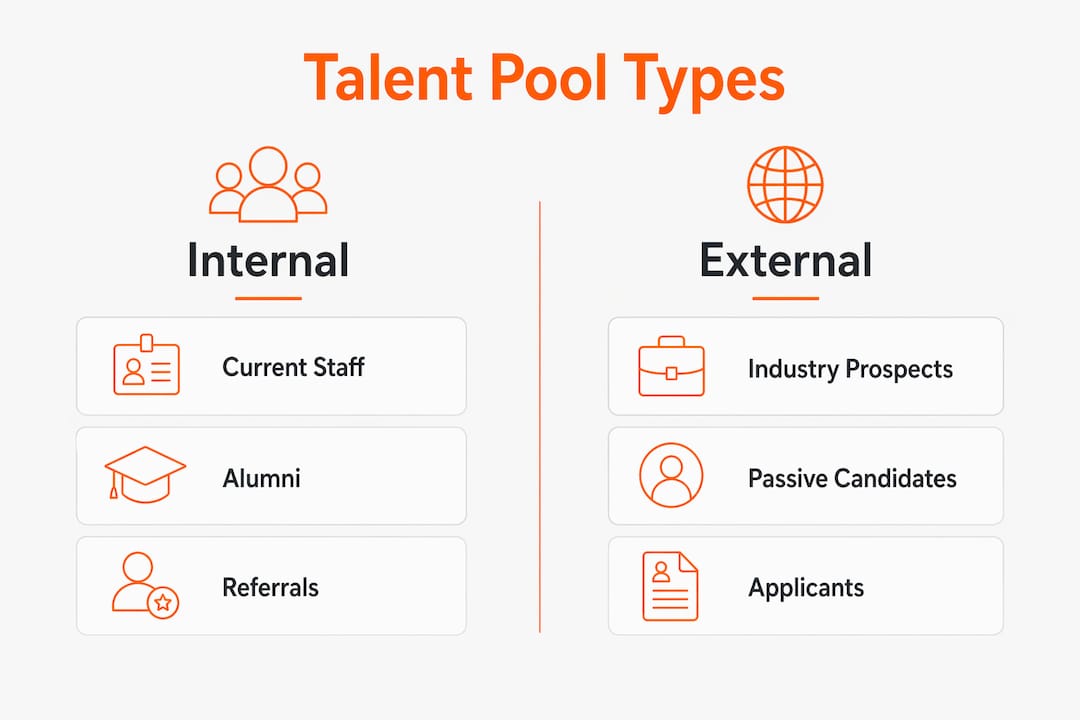
Within those two categories, segmentation is where talent pool management becomes genuinely powerful. Platforms like Oracle Talent Management allow you to categorize candidates by performance ratings, potential scores, and functional areas. A single candidate can belong to multiple pools simultaneously, which prevents you from losing visibility when someone fits more than one future role.
Here is how most mature HR teams segment their external talent pools:
- By skill set: Grouping candidates around specific technical or functional competencies, such as data engineering, financial modeling, or UX research
- By seniority level: Separating individual contributors from managers and executives to match the right candidate to the right role tier
- By engagement status: Flagging warm candidates who have responded to recent outreach versus cold contacts who have not been touched in over a year
- By source: Tracking whether candidates came from referrals, LinkedIn sourcing, job fairs, or inbound applications, since source quality often predicts offer acceptance rates
- By geography or work preference: Noting remote, hybrid, or on-site preferences to avoid wasting time on candidates whose location requirements do not match the role
Multi-membership segmentation is a feature worth prioritizing when evaluating talent management platforms. A candidate who fits both a product manager role and a business analyst role should appear in both pools. Forcing a single-category assignment means you will miss that person when the second role opens.
A talent pool also functions as a diagnostic tool. It reveals skill gaps in your pipeline relative to your workforce plan, showing you where you need to invest more in sourcing before demand spikes.
What are the best practices for building and maintaining a talent pool?
Building a talent pool that actually works requires deliberate design from the start. A disorganized database of names and resumes is not a talent pool. It is a liability that wastes recruiter time and produces inconsistent results. The following steps reflect how high-performing HR teams approach hiring process best practices for pool construction.
-
Define the roles and skills you are building toward. Start with your workforce plan. Identify the roles most likely to open in the next 6 to 18 months and map the competencies each requires. This gives your sourcing effort a clear target instead of a vague mandate to “find good people.”
-
Diversify your sourcing channels. Referrals produce high-quality candidates with faster ramp times, but they alone create homogeneous pools. Combine referrals with LinkedIn Recruiter searches, university recruiting programs, professional associations, and industry events to build depth and diversity.
-
Capture structured data at the point of entry. Every candidate entering your pool should have a consistent record: skills assessed, role fit noted, source tracked, and last contact date logged. Unstructured notes are nearly impossible to search at scale.
-
Segment immediately. Do not wait until a role opens to organize your pool. Apply tags and categories as candidates enter so your database is always query-ready.
-
Engage candidates on a regular cadence. A talent pool decays without communication. Candidates take other jobs, change their preferences, or simply forget you exist. Quarterly touchpoints, whether a personalized email, a relevant article, or a brief check-in call, keep your pool warm and your brand top of mind.
-
Audit and clean your pool at least twice a year. Remove candidates who have explicitly opted out, update records for those who have changed roles, and re-engage anyone who has gone cold. A clean pool is a fast pool.
Pro Tip: Use a brief skills assessment at the point of sourcing, before a role is even open. Candidates who complete a short task demonstrate genuine interest and give you verified competency data rather than just a resume claim.
A well-maintained talent pool shortens time-to-hire and reduces recruitment costs by keeping a ready stream of pre-qualified candidates available. That efficiency compounds over time. The longer you maintain the pool, the richer the data and the faster your response to new openings.
How does technology improve talent pool management?
Technology transforms a talent pool from a static spreadsheet into a dynamic, searchable, and self-improving system. Applicant Tracking Systems like Greenhouse, Lever, and Workday Recruiting organize candidate data with smart search, automated workflows, and integration with job boards and HRIS platforms. They allow recruiters to filter thousands of records in seconds by skill, location, availability, or last contact date.
AI adds another layer of capability on top of ATS infrastructure. AI-driven talent matching identifies the best-fit candidates from your pool for a new role faster and more accurately than manual review. These systems analyze job descriptions, compare them against candidate profiles, and surface ranked shortlists within minutes. For high-volume hiring, that speed is not a convenience. It is a competitive advantage.
Predictive analytics takes the technology stack further by anticipating hiring needs before they become urgent. By analyzing historical hiring patterns, attrition rates, and business growth signals, predictive tools flag which roles are likely to open in the next quarter and which segments of your talent pool are most relevant. This shifts recruiting from reactive to genuinely proactive.
For teams focused on AI talent matching, the integration between pool data and assessment platforms is where precision hiring becomes possible. When candidates in your pool have completed structured skill assessments, AI can match verified competency data to role requirements rather than relying on resume keywords alone. That distinction produces better hires with fewer rounds of screening.
Recruitment software options range from enterprise ATS platforms to lightweight tools built for smaller teams, so the right choice depends on your pool size, hiring volume, and budget. The non-negotiable features are searchability, tagging, automated communication, and integration with your existing HR stack.
Key takeaways
A talent pool is only as valuable as the structure, data quality, and engagement strategy behind it. Teams that treat their pool as a living system rather than a static list consistently outperform those that rely on reactive job posting alone.
| Point | Details |
|---|---|
| Core definition | A talent pool is a structured candidate database covering skills, fit, and engagement status for current and future roles. |
| Pool vs. pipeline | Pools are broad reserves of active and passive candidates; pipelines are role-specific and near-term focused. |
| Internal and external | Effective pools combine current employees for succession with external sourced candidates, referrals, and past applicants. |
| Segmentation matters | Categorizing by skill, seniority, and engagement status makes pools searchable and query-ready when roles open. |
| Technology multiplies value | ATS platforms and AI matching convert pool data into ranked shortlists, cutting time-to-hire and improving hire quality. |
Why most talent pools fail before they start
Most talent pools I have seen fail for the same reason: they are built reactively. A role opens, a recruiter scrambles to pull names together, calls it a talent pool, and moves on. Six months later, no one has touched those records, half the candidates have taken other jobs, and the “pool” is just a folder of stale resumes.
The teams that get real value from talent pools treat them as a continuous program, not a project. They assign ownership, set engagement calendars, and review pool health metrics quarterly. They also resist the temptation to make pools too broad. A pool of 5,000 loosely tagged candidates is harder to use than a pool of 400 well-segmented, recently engaged ones.
The other mistake I see consistently is separating the talent pool from skills verification. A name and a resume tell you what someone claims. A completed assessment tells you what they can actually do. When you combine pool management with structured talent assessment practices, you build a database of verified capability, not just stated experience. That is the version of a talent pool that actually accelerates hiring.
The future of talent pools is not bigger databases. It is smarter ones. Teams that invest in segmentation, regular engagement, and AI-assisted matching will consistently outpace those still posting and praying every time a role opens.
— Pavel
Build a stronger talent pool with Testask
Testask is an AI-powered recruitment assessment platform built for HR teams that want verified candidate data, not just resumes. When you integrate Testask into your talent pool strategy, every candidate who enters your pool can complete a tailored skills assessment, giving you real competency data alongside their profile. AI-assisted analysis ranks submissions and surfaces the strongest fits automatically, so when a role opens, your shortlist is ready in hours rather than days. Explore how Testask helps recruiting teams build talent pools that are faster to search, easier to trust, and built to scale.
FAQ
What is a talent pool in HR?
A talent pool is a structured database of candidates that includes skills, experience, and cultural fit data, maintained to support both immediate and future hiring needs. It includes active job seekers and passive candidates who may be open to opportunities over time.
How does a talent pool differ from a talent pipeline?
A talent pool is a broad reserve of all potential candidates, while a talent pipeline is a narrower group of candidates actively progressing toward a specific hire. Pools feed pipelines rather than replacing them.
What are the main benefits of a talent pool?
The primary benefits are reduced time-to-hire and lower recruitment costs, since pre-qualified candidates are already identified and engaged before a role opens. Teams with active pools spend less time sourcing from scratch and more time evaluating ready candidates.
Can a candidate belong to more than one talent pool?
Yes. Multi-membership segmentation allows a single candidate to appear in multiple pools simultaneously, which is critical when someone’s skills align with more than one future role. Forcing single-category assignment causes recruiters to miss qualified candidates when secondary roles open.
What technology is used to manage talent pools?
Applicant Tracking Systems like Greenhouse, Lever, and Workday Recruiting are the primary tools, combined with AI matching and predictive analytics layers. These systems automate search, tagging, candidate communication, and shortlist generation to keep pools current and query-ready. You can also explore talent acquisition tips for integrating these tools into a broader hiring strategy.
Recommended
- Talent Assessment: Build Efficient, Predictive Hiring Systems | Testask Blog | testask
- AI talent matching: revolutionize recruitment in 2026 | Testask Blog | testask
- Talent acquisition strategies for smarter hiring in 2026 | Testask Blog | testask
- Talent reviews: frameworks, pitfalls, and winning strategies | Testask Blog | testask