Structured Interview Scorecards: Templates and Best Practices
Structured Interview Scorecards: Templates and Best Practices

A structured interview scorecard is a standardized form that captures competency ratings, behavioral evidence, and a final hiring recommendation for every candidate who goes through the same interview. Your immediate next step: pick a four-to-eight competency template, fill in behavioral anchors for each rating point, and run a 30-minute calibration session with your panel before the first interview.
Structured interviews using standardized rubrics increase predictive validity for job performance and reduce demographic differences compared with unstructured interviews, according to Google re:Work. The scorecard is the instrument that makes that predictive power real.
Three signals tell you scorecards are worth the setup time:
- Google re:Work documents that behaviorally-anchored rubrics raise validity and reduce bias in hiring decisions.
- EEOC recordkeeping guidance means your scorecards double as compliant hiring documentation when stored correctly.
- Testask gives your team a ready-made template library and AI-assisted evidence drafting so you can skip the blank-page problem entirely.
Pro Tip: Run your first calibration session before any live interviews, not after. Score two or three example responses independently, reveal scores simultaneously, and align on what a “3” versus a “4” looks like. That 30-minute investment prevents weeks of inconsistent data.
Key Takeaways
Structured interview scorecards raise hiring quality only when behavioral anchors, evidence capture, and scores-first debrief rules are enforced consistently across every panel.
| Point | Details |
|---|---|
| Keep scorecards short | Cap competencies at 4–8 and target under 3 minutes to complete; longer cards are abandoned. |
| Write behavioral anchors | Each rating point needs observable behavior, not abstract labels, to produce reliable scores. |
| Score before you discuss | Collect all panel scores in writing before any verbal recommendation to prevent anchoring bias. |
| Retain for compliance | Store scorecards by requisition under EEOC recordkeeping guidelines; use job-relevant criteria only. |
| Use Testask to scale | Testask centralizes templates, auto-drafts evidence, and enforces scores-first submission for panels. |
Table of Contents
- What do structured interview scorecards actually contain?
- How do scorecards make structured interviews more predictive?
- Pros, cons, and the pitfalls that quietly kill scorecard programs
- How to build a structured interview scorecard, step by step
- Template examples: one-screen, standard, and technical scorecards
- How to apply scorecards in panels, calibration, and U.S. legal compliance
- Why the research supports anchored scorecards
- What I’ve seen go wrong in week one of scorecard programs
- Testask speeds up structured hiring without the setup overhead
- Sources
What do structured interview scorecards actually contain?
Every scorecard, regardless of format, needs the same core fields. Miss one and you either lose defensibility or create a form nobody finishes.
Core fields every scorecard must include:
- Role and interview purpose (job title, interview stage, interview type: behavioral, technical, or hybrid)
- Competencies (4–8 per card; more than 8 and completion rates drop sharply)
- Behavioral anchors for each rating point (what observable behavior earns a 1, 3, or 5)
- Rating scale (1–4 or 1–5, with each point defined)
- Evidence field (one line per competency for a direct quote or concrete example)
- Final recommendation (Strong Hire / Hire / No Hire / Strong No Hire)
- Metadata (interviewer name, date, interview type, candidate name)
Per Greenhouse’s scorecard guidance, a practical baseline also includes role qualifications, interpersonal skills, technical skills, and space for non-required attributes.
Format options and time-to-complete targets
| Format | Best for | Time to complete |
|---|---|---|
| One-screen card (4 competencies) | High-volume roles, phone screens | Under 2 minutes |
| Standard card (6–8 competencies) | Mid-level and senior roles | 2–3 minutes |
| ATS-integrated scorecard | Teams using Greenhouse, Lever, or Workday | Under 3 minutes |
| Spreadsheet (shared tab) | Small teams without an ATS | 2–4 minutes |
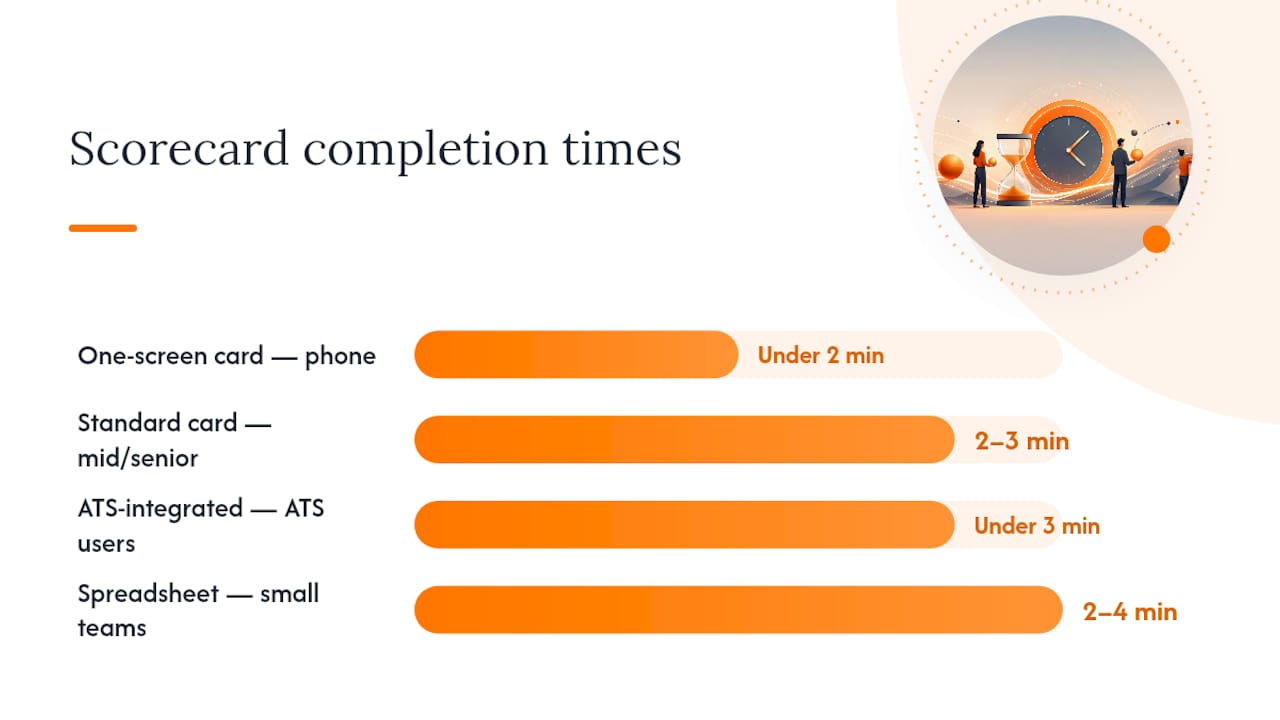
Keep the card to one screen. ClarityHire’s adoption research shows that long, prose-heavy 12-dimension cards are often abandoned after a few candidates, while one-screen cards that take under three minutes complete far more consistently. Shorter is not a compromise; it is the design goal.
How do scorecards make structured interviews more predictive?
Scorecards are the measurement instrument that makes structured interviews both predictive and legally defensible. Without a scorecard, a structured interview is just a consistent set of questions with no consistent way to record what you heard.
The core mechanisms work together:
- Same questions for every candidate removes the variable of interviewer curiosity and keeps comparisons valid.
- Anchored rubrics convert subjective impressions into observable-behavior ratings, which is what drives interrater reliability.
- Evidence capture forces interviewers to note the specific response that justified a score, not just a gut feeling.
- Independent scoring before discussion prevents the loudest voice in the room from anchoring everyone else’s ratings.
Meta-analytic personnel-selection research by Oh, Postlethwaite, and Schmidt consistently places structured interviews among the highest-validity interview methods when proper rubrics and calibration are used. The OPM structured-interview guide translates that research into practical question design, rubric development, and calibration steps that both public and private employers can follow.
Validity signal: Google re:Work reports that structured assessments with behaviorally-anchored rating scales are more predictive of job performance than unstructured interviews, and they also improve candidate satisfaction among rejected applicants, who feel the process was fair.
Pros, cons, and the pitfalls that quietly kill scorecard programs
Scorecards deliver real benefits, but only when implemented with discipline. Here is an honest accounting of both sides.
Pros:
- Consistency across interviewers and interview rounds, so you can compare candidates on the same criteria.
- Higher predictive validity when anchors are behavioral and evidence is captured per competency.
- Legal defensibility because you have documented, job-relevant criteria for every decision.
- Faster debriefs because panel members arrive with scores already recorded, not vague impressions.
- Better candidate experience for rejected applicants, who perceive structured processes as fairer.
Cons and risks:
- Poor anchors create false precision. A 1–5 scale with no behavioral definitions is just an opinion dressed as data.
- Form fatigue sets in quickly if the card runs longer than one screen or asks for prose on every competency.
- Anchoring in debriefs happens when one interviewer shares their recommendation before others submit scores, pulling everyone toward that position.
- Sloppy evidence capture turns the scorecard into a number with no story behind it, which is nearly useless in a hiring dispute.
Tactical mitigations:
- Cap competencies at eight and keep the card to one screen.
- Require at least one evidence line per competency before a score can be submitted.
- Collect all scores before any verbal recommendation is shared in the debrief.
- Run a short calibration exercise every time you open a new role or add a new interviewer.
Pro Tip: Pair your scorecard program with bias-reduction practices from the start. Scorecards reduce bias structurally, but only when interviewers understand why the rules exist. A five-minute explainer at onboarding makes a measurable difference in compliance.
How to build a structured interview scorecard, step by step
Step 1: Define 4–8 role-critical competencies
Start with the intake document or job description. Identify the behaviors that actually predict success in the role, not a generic list of virtues. For a mid-level account executive, that might be: discovery questioning, objection handling, pipeline discipline, and cross-functional communication. Four competencies. One screen. Done.
Step 2: Write behavioral anchors for each rating point
Anchors are the difference between a scorecard and a survey. For each competency, write what a candidate actually says or does at each rating level. Use the AIHR guidance on behaviorally-anchored rating scales as a reference: each numeric point should correspond to observable behavior, not an abstract label like “meets expectations.”

Sample anchors for “Discovery Questioning” (1–5 scale):
| Rating | Behavioral anchor |
|---|---|
| 1 | Asks only surface-level questions; does not probe beyond the candidate’s first answer. |
| 2 | Asks one or two follow-up questions but misses key gaps in the candidate’s reasoning. |
| 3 | Asks targeted follow-ups and uncovers at least one non-obvious detail about the situation. |
| 4 | Probes systematically; surfaces root causes and quantifies impact without prompting. |
| 5 | Demonstrates a clear mental model; asks questions that reveal strategic thinking and anticipate objections. |
Step 3: Choose and define your rating scale
A 1–4 scale forces a decision (no neutral midpoint). A 1–5 scale gives more granularity and is the more common standard in U.S. hiring. Either works if every point is anchored. Avoid 1–10 scales; the added granularity is rarely meaningful and increases inconsistency.
Step 4: Set weighting and aggregation rules
- Decide whether all competencies carry equal weight or whether some are must-pass criteria.
- For panel interviews, average each interviewer’s scores per competency, then sum the weighted competency averages for a total.
- Set a pass bar before the first interview, not after you see the scores.
- Document the pass bar in the scorecard template so it is visible to every panel member.
Step 5: Run a pilot and calibration session
- Draft the template and share it with two or three interviewers.
- Score two example responses independently using the anchors.
- Reveal scores simultaneously and discuss any gap greater than one point.
- Adjust anchor language where the gap reveals ambiguity.
- Lock the template before the first live interview.
For a practical interviewer checklist to run alongside this process, Testask’s hiring manager guide covers the operational logistics that complement scorecard design.
Template examples: one-screen, standard, and technical scorecards
Template 1: One-screen card (4 competencies, phone screen)
Best for high-volume roles or early-stage screens. Complete in under two minutes.
Fields: Role, candidate name, interviewer, date, interview stage.
Final recommendation: Strong Hire / Hire / No Hire / Strong No Hire
Template 2: Standard card (6 competencies, mid-level role)
Add two competencies for roles where technical depth or leadership matters.
Additional competencies to consider: stakeholder management, data-driven decision-making, or team leadership, depending on the role.
Filled example: mid-level software engineer, system design loop
| Competency | Rating (1–5) | Evidence |
|---|---|---|
| System design fundamentals | 4 | Correctly identified trade-offs between consistency and availability; referenced CAP theorem unprompted. |
| Problem decomposition | 3 | Broke the problem into components but missed the caching layer until prompted. |
| Communication under ambiguity | 4 | Asked two clarifying questions before designing; explained reasoning at each step. |
| Code quality and testing | 3 | Wrote working code but did not add edge-case tests without a follow-up prompt. |
| Collaboration signals | 4 | Described a specific disagreement with a senior engineer and how they resolved it. |
Final recommendation: Hire. Strong on design and communication; testing discipline is a coaching opportunity, not a blocker.
A numeric rating without an evidence line is effectively an opinion, per Metaview’s scorecard guidance. The evidence field is what converts a score into a defensible hiring decision.
For additional interview assessment examples across different roles and seniority levels, Testask’s resource library includes templates you can adapt directly.
How to apply scorecards in panels, calibration, and U.S. legal compliance
The non-negotiable operational rules
- Submit scores before any verbal recommendation. If interviewers name “Hire” or “No Hire” first, they often backfill numeric scores to justify that stance, creating confirmation bias in your data.
- Disclose panel scores only after everyone has submitted. Reveal simultaneously in the debrief, not one at a time.
- Chase missing scorecards within 24 hours. Scores submitted days later are reconstructed from memory, not observation.
Calibration format
A 30-minute pre-hire calibration session works like this:
- Share two or three example candidate responses (real or anonymized).
- Each panel member scores independently using the anchors.
- Reveal scores simultaneously.
- Discuss any gap greater than one point and align on anchor interpretation.
- Set the pass bar as a group and document it in the template.
SHRM’s structured-interviewing guidance recommends pairing scorecards with interviewer training to reduce bias and improve consistency. Calibration is that training, made practical.
U.S. legal and recordkeeping considerations
EEOC recordkeeping requirements mean that scorecards can serve as compliant hiring documentation when designed around job-relevant criteria and stored according to your company’s retention policy. Three rules keep you on the right side:
- Use only job-relevant competencies. Anchors tied to observable work behavior are defensible; anchors tied to personality traits or cultural fit without behavioral definition are not.
- Retain scorecards as part of the hiring record. Most U.S. employers retain hiring documentation for at least one year under EEOC guidelines; check your legal counsel for your specific retention period.
- Avoid protected-class criteria. Review anchor language for any wording that could correlate with age, gender, race, or disability status.
Pro Tip: Integrate your scorecard storage with your ATS or a shared drive folder named by requisition ID. When a candidate files a complaint, you want to retrieve every scorecard for that role in under five minutes, not five days. Pairing scorecards with a candidate database makes that retrieval straightforward.
Why the research supports anchored scorecards
The evidence base for structured, anchored scorecards is one of the most consistent in personnel-selection research.
Research summary: Structured interviews with anchored rubrics raise both predictive validity and interrater reliability compared with unstructured interviews. The effect holds across industries, job levels, and panel sizes when calibration is used.
Key sources and what each contributes:
- Oh, Postlethwaite, and Schmidt (2012): Meta-analytic evidence that structured interviews are among the highest-validity selection methods, with strong interrater agreement when anchors are used.
- Google re:Work: Practical evidence that standardized rubrics increase predictive validity and reduce demographic differences; also documents improved candidate satisfaction.
- OPM structured-interview guide: Federal-level procedural guidance on question design, rubric development, and calibration, applicable to both public and private employers.
- HBR: Argues that a hiring scorecard forces clarity about what “good” looks like and reduces subjective drift during hiring debates, which is the practical mechanism behind the validity gains.
- EEOC: U.S. compliance framework for retaining hiring documentation, including scorecards as part of a defensible record.
For deeper reading on applying behavioral anchors and getting interviewers to score consistently, Testask’s interview evaluation guide covers the practical side of anchor-writing and calibration in detail.
What I’ve seen go wrong in week one of scorecard programs
Most scorecard programs fail not in design but in the first two weeks of use. The template looks great. The anchors are solid. Then the first debrief happens and someone says “I thought she was a strong hire” before anyone has submitted scores, and the entire panel’s numbers shift toward that view.

The fix is procedural, not technical. Collect scores in writing before the debrief starts. Every time. No exceptions. That single rule eliminates more bias than any anchor refinement.
The second most common failure is competency overload. Teams draft a 10-competency card because the role is complex, then watch completion rates collapse after three candidates. Cut to six. If you need more coverage, run two separate interview loops with different scorecards, each focused on a distinct competency cluster.
Testask addresses both failure modes directly. Its template library keeps cards short and role-specific, and its AI-assisted evidence drafting helps interviewers populate the evidence field from interview notes rather than leaving it blank. For teams running panel interviews, the platform’s collaboration tools let every panelist submit scores independently before the debrief view opens, which enforces the scores-first rule without relying on interviewer discipline alone.
Testask speeds up structured hiring without the setup overhead
Building a scorecard program from scratch takes time most hiring teams do not have. Testask gives you a template library, AI-assisted evidence drafting, and panel analytics in one platform, so you can run a calibrated, compliant structured hiring process without building every piece yourself.
Where Testask fits into the workflow you just read about:
- Template library: Pre-built scorecards for common roles, customizable to your competency set in minutes.
- AI-assisted evidence drafting: Testask auto-drafts evidence lines from interview notes or transcripts, so interviewers spend time reviewing, not writing from scratch.
- Panel score tracking: Every panelist submits scores independently; the platform reveals aggregated results only after all submissions are in, enforcing the scores-first rule automatically.
- Retention and compliance: Scorecards are stored by requisition, searchable, and exportable for EEOC recordkeeping purposes.
Ready to run your first calibrated scorecard session? Start with Testask and have a role-specific template live before your next interview.
Sources
- A guide to structured interviewing for better hiring practices - Google re:Work
- Structured Interviews guide | OPM
- Recordkeeping requirements | EEOC
- Biz
- A scorecard for making better hiring decisions | HBR