Interview Evaluation Tips for HR Pros: 2026 Guide
Interview Evaluation Tips for HR Pros: 2026 Guide

Interview evaluation is the structured process of assessing candidates against defined criteria during and after an interview to produce objective, comparable hiring decisions. The most effective interview evaluation tips center on three practices: standardized questions, behaviorally anchored rubrics, and independent scoring before group discussion. Without these, hiring decisions drift toward gut feeling, which research from Google re:Work identifies as the primary driver of bias and poor predictive validity. HR professionals and hiring managers who apply structured methods consistently make faster, fairer, and more defensible hiring decisions.
1. Interview evaluation tips start with structured questions
Structured interviews use the same predetermined questions for every candidate, scored against a standardized rubric. That consistency is what makes candidate comparison valid. When interviewers improvise questions, they create incomparable data sets. One candidate gets a softball; another gets a curveball. The result is a hiring decision based on conversation quality rather than job-relevant competency.
Structured interview rubrics with behaviorally anchored rating scales provide higher predictive validity and fairness than unstructured interviews. That finding means your question set is not just a courtesy to candidates. It is the foundation of a legally defensible and accurate process.
Building a strong question set requires mapping each question to a specific competency the role demands. Develop three to five questions per competency, then select the best one or two for the actual interview. Keep predetermined follow-up prompts ready so interviewers can probe depth without going off script.
- Map every question to a named competency (e.g., “conflict resolution,” “data analysis”).
- Write follow-up prompts in advance so interviewers do not improvise probes.
- Review and refresh question sets at least once per year to reflect role changes.
- Share the question set with all panel members before the interview, not during it.
Pro Tip: Use one-way video interviews for early screening rounds. Every candidate answers the same questions in the same format, which enforces consistency at scale before a single live interview takes place.
2. How to design behaviorally anchored rubrics for fair scoring
A behaviorally anchored rating scale, or BARS, converts vague traits into observable, scorable behaviors. “Good communication” means nothing to three different interviewers. “Candidate explained a complex technical concept using a clear analogy and confirmed understanding with a follow-up question” means the same thing to all three.

Rubric scores should correspond with specific observable behaviors rather than vague labels like “average” or “good.” A 1-to-5 scale works well when each number maps to a concrete example of what that answer looks like. A score of 1 might read: “Candidate could not describe a relevant example.” A score of 5 might read: “Candidate described a specific situation, named measurable outcomes, and connected the lesson to this role.”
Build your rubrics before any candidate enters the room. Rubrics constructed before evaluating any candidate prevent subconscious standard shifting that favors preferred applicants. If you write the rubric after meeting a strong candidate, you will unconsciously define “excellent” as whatever that person said.
Follow this sequence to build a usable rubric:
- List the competencies the role requires (aim for four to six).
- Write one interview question per competency.
- Draft three anchor descriptions per competency: poor, acceptable, and strong.
- Assign numeric values (1, 3, and 5) to each anchor.
- Hold a calibration meeting where all interviewers score a sample answer independently, then compare.
Calibration meetings before and after interviews align interviewer expectations and scoring consistency. That alignment is what prevents one interviewer’s “3” from being another’s “5.”
Pro Tip: Define your rubric anchors during the job requisition phase, not after you have already started scheduling interviews. The earlier you build the rubric, the more objective your entire process becomes.
3. Note-taking and independent scoring reduce groupthink
The most common panel interview failure is not bias in the rubric. It is bias in the debrief room. When a senior leader speaks first, everyone else adjusts their scores upward. That is seniority anchoring, and it destroys the value of having a panel in the first place.
Independent scoring before panel discussions reduces groupthink and social conformity bias. Each interviewer must submit a completed scorecard before the debrief begins. No exceptions. The debrief then becomes a conversation about score discrepancies, not a consensus-building exercise that erases individual judgment.
Note-taking during the interview is the raw material for that independent score. Delay in scoring risks halo effect bias, where a strong early answer skews perception of all subsequent responses. Write notes immediately after each answer, not at the end of the interview.
- Assign each panel member one or two competencies to evaluate, not the full rubric.
- Use a shared digital form so scores are locked before the debrief begins.
- Require written justification for every score, not just a number.
- Flag score gaps of two or more points for mandatory discussion in the debrief.
Technology that supports asynchronous review, such as platforms that collect scorecards before enabling group discussion, removes the structural conditions that produce groupthink. Testask enables collaborative review workflows where team members submit evaluations independently before comparing results.
4. Evaluating hard skills and soft skills together
Technical competency gets candidates into the interview. Soft skills determine whether they succeed in the role. Evaluating only one dimension produces incomplete data and leads to hires who can do the job technically but fail on the team.
Behavioral questions assess past achievements, while hypothetical questions evaluate how candidates respond to novel challenges. Use both types in every interview. A behavioral question for problem-solving might be: “Tell me about a time you had to solve a problem with incomplete information.” A hypothetical version: “If you inherited a project that was three weeks behind schedule, what would you do in the first 48 hours?”
Soft skills to assess in every interview include:
- Communication: Does the candidate explain ideas clearly and adjust their language for the audience?
- Collaboration: Can they describe a specific example of resolving a team conflict?
- Problem-solving: Do they structure their thinking before jumping to a solution?
- Adaptability: Have they changed course based on new information, and can they articulate why?
One distinction worth making is “culture add” versus “culture fit.” Culture fit asks whether a candidate matches your existing team. Culture add asks what perspective or skill they bring that the team currently lacks. Evaluating for culture add produces more diverse, higher-performing teams over time. Build one rubric question specifically around this concept.
5. Common mistakes in candidate assessment and how to fix them
The most damaging evaluation errors are not dramatic. They are quiet and structural. Vague criteria, inconsistent scales, and skipped notes accumulate into hiring decisions that cannot be explained or defended.
Well-designed evaluation forms reduce unconscious bias, enable data-driven decisions, and speed up the interview process. Poor form design does the opposite. The most common design failures are criteria that overlap (rating “communication” and “presentation skills” separately when they measure the same behavior), rating scales that differ across interviewers, and forms with no space for written notes.
- Vague criteria: Replace “strong leader” with “demonstrated ability to align a team around a shared goal under time pressure.”
- Inconsistent scales: Standardize all rubrics to the same numeric range across every role and every panel.
- Halo and horn effects: Require interviewers to score each competency separately before forming an overall impression.
- Skipped follow-ups: Write follow-up prompts into the interview guide so interviewers cannot skip them under time pressure.
- No bias check: Active bias checks during debrief, such as asking “Are we excluding this candidate for a job-irrelevant reason?”, catch unconscious exclusion before it becomes a decision.
Interviewer training is not optional. Even experienced hiring managers benefit from a 60-minute calibration session before a new hiring cycle begins. Pair that training with a well-designed interview evaluation form and the error rate drops significantly.
6. Using AI-assisted tools to support evaluation at scale
AI tools in interview evaluation work best as support layers, not decision-makers. AI-generated interview summaries can assist reviewers by highlighting key candidate answers, but they should support, not replace, human judgment. The distinction matters legally and practically.
Where AI adds genuine value is in consistency enforcement and time savings. Structured interview practices already save approximately 40 minutes per interview through better preparation and question consistency. AI tools that auto-generate question sets, flag incomplete scorecards, or summarize candidate responses extend those time savings further.
The right approach is to use AI for the administrative and organizational layers of evaluation: generating question banks, collecting and organizing scorecards, and surfacing score discrepancies for human review. Keep the actual scoring and the final hiring decision with the human panel. That boundary protects both the quality of the decision and the organization’s legal standing.
Testask’s AI-powered platform supports this model directly. It helps HR teams generate tailored assessment tasks, collect structured candidate responses, and review submissions collaboratively, with AI analysis that informs rather than overrides human judgment. You can explore assessment examples for HR pros to see how this works in practice.
Key takeaways
Structured interviews, behaviorally anchored rubrics, and independent scoring are the three non-negotiable foundations of objective candidate evaluation.
| Point | Details |
|---|---|
| Use structured questions | Apply the same question set to every candidate to produce comparable, defensible data. |
| Build rubrics before interviewing | Define behavioral anchors before meeting candidates to prevent standard shifting. |
| Score independently first | Require individual scorecards before any group debrief to eliminate seniority anchoring. |
| Assess hard and soft skills | Use both behavioral and hypothetical questions to capture the full candidate picture. |
| Fix form design errors | Standardize scales, clarify criteria, and require written notes to reduce bias and gaps. |
What I have learned from watching teams get evaluation wrong
Most hiring teams I have worked with believe they are more objective than they actually are. They use rubrics, they hold debriefs, and they still end up hiring the person who “felt right” in the room. The rubric becomes a post-hoc justification rather than a decision tool.
The fix is not a better rubric. It is a better process around the rubric. Independent scoring before discussion is the single change that produces the most immediate improvement. When I have seen teams implement it, the debrief conversation changes completely. Instead of “I thought she was great,” the conversation becomes “You gave her a 2 on problem-solving and I gave her a 4. Let’s talk about why.” That is a productive disagreement. It produces better decisions.
The other thing I have seen teams consistently underinvest in is interviewer training. A 45-minute calibration session before a hiring cycle costs almost nothing and prevents months of downstream problems. Treating evaluation as a skill, rather than an instinct, is the mindset shift that separates high-performing hiring teams from average ones.
AI tools are genuinely useful here, but only when the human process is already sound. An AI summary of a bad interview is still a bad interview. Get the structure right first, then use technology to scale it.
— Pavel
Testask helps your team evaluate candidates with confidence
Hiring decisions are only as good as the evaluation process behind them. Testask gives HR teams and hiring managers the tools to build structured assessments, collect candidate responses in a consistent format, and review submissions collaboratively with AI-assisted analysis.
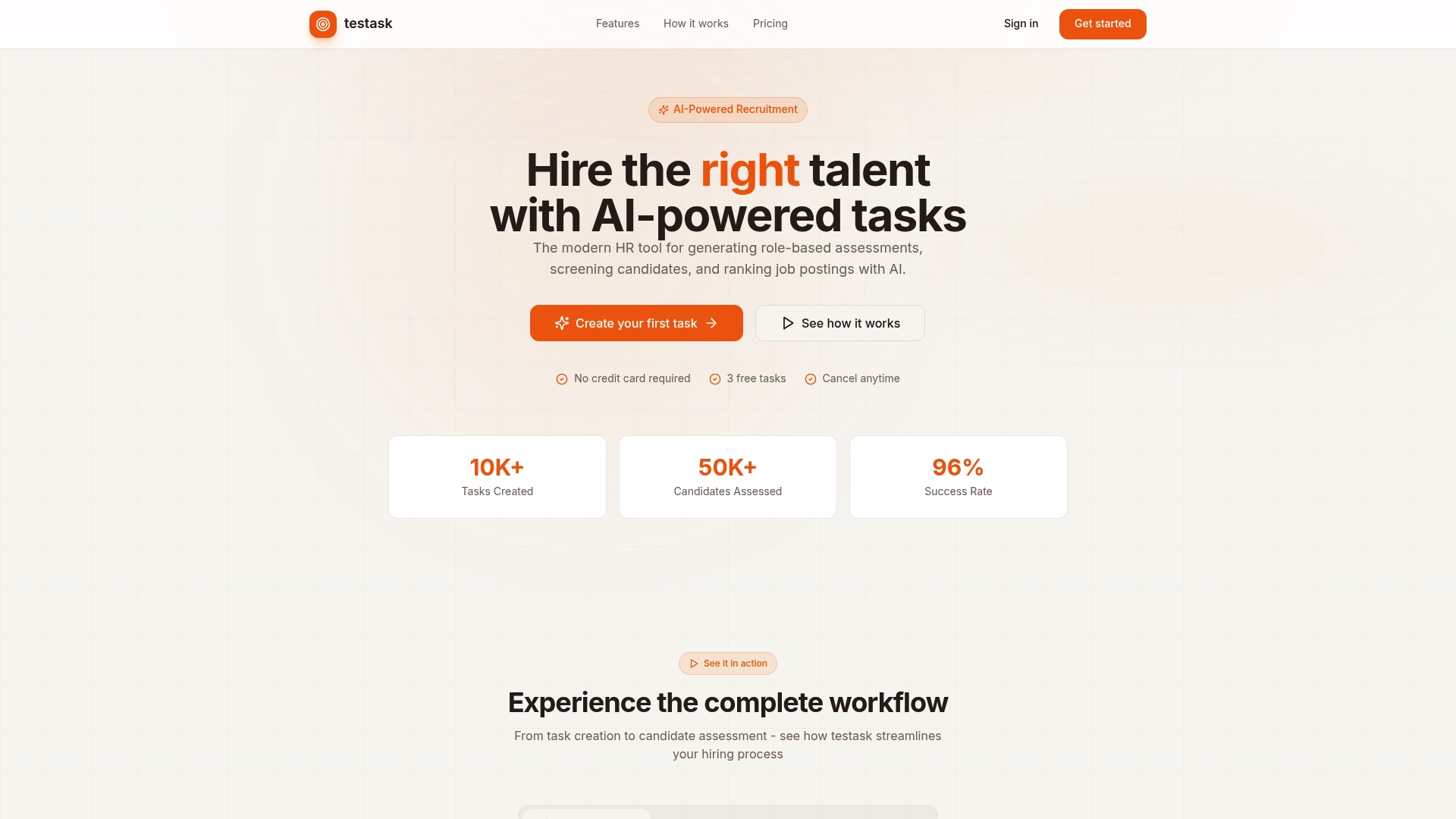
With Testask, you can generate tailored test tasks for any role, score submissions against defined criteria, and compare candidates side by side, all in one platform. Your team can assess candidates faster without sacrificing the rigor that good hiring requires. Visit Testask to see how structured evaluation works in practice and start building a process your whole team can trust.
FAQ
What is interview evaluation?
Interview evaluation is the structured process of scoring candidates against predefined criteria during and after an interview. It uses rubrics, standardized questions, and independent scoring to produce objective, comparable hiring decisions.
How do you score interview answers fairly?
Use a behaviorally anchored rating scale where each numeric score maps to a specific observable behavior. Score each competency independently before forming an overall impression of the candidate.
What is a structured interview?
A structured interview applies the same predetermined questions and scoring rubric to every candidate for a role. Research from Google re:Work confirms that structured interviews produce higher predictive validity and reduce interviewer bias compared to unstructured formats.
How do you reduce bias in candidate evaluation?
Require interviewers to score candidates independently before any group discussion, use rubrics built before the interview begins, and run active bias checks during debriefs by asking whether any exclusion is based on a job-irrelevant factor.
What soft skills should you evaluate in an interview?
Prioritize communication clarity, collaboration under conflict, structured problem-solving, and adaptability to new information. Use behavioral questions to assess past examples and hypothetical questions to evaluate responses to novel situations.
Recommended
- HR Interview Checklist for Hiring Managers: 2026 | Testask Blog | testask
- Examples of Interview Assessments for HR Pros in 2026 | Testask Blog | testask
- Best Hiring Practices 2026: What HR Teams Need to Know | Testask Blog | testask
- What Is Objective Hiring? A 2026 Guide for HR Teams | Testask Blog | testask