Screening Checklist Guide for Smarter Hiring in 2026
Screening Checklist Guide for Smarter Hiring in 2026

A screening checklist is defined as a structured evaluation tool that standardizes how hiring managers assess candidates against job-specific criteria before advancing them through the hiring pipeline. Without one, evaluations drift toward gut instinct, inconsistent criteria, and decisions that are difficult to defend in an audit. This screening checklist guide covers the core components, development steps, implementation best practices, and common pitfalls every HR professional needs to know. The goal is a repeatable process that produces fair, documented, and defensible hiring decisions every time.
What is a screening checklist guide and why does it matter?
A screening checklist guide is the framework that turns a job description into a set of observable, measurable criteria your team applies consistently to every candidate. The word “screening” in HR refers to the formal process of filtering applicants before interviews, and a checklist is the tool that keeps that process honest. Without a written guide, two recruiters on the same team can reach opposite conclusions about the same resume.
The business case is straightforward. Consistent checklist use reduces unconscious bias and keeps evaluations focused on job-relevant criteria, which promotes equitable treatment across your entire applicant pool. Equity is not just an ethical goal. It is a legal requirement under Equal Employment Opportunity regulations, and a checklist creates the paper trail that proves compliance.

Documentation is the other critical function. Every screening decision must be recorded, including minimum qualification checks, salary expectation confirmations, and assessment results, all logged within your applicant tracking system. That record protects your organization if a rejected candidate files a complaint.
What are the essential components of an effective screening checklist?
An effective checklist answers four questions about every candidate: Are they eligible? Do they match the core responsibilities? Do they have the must-have skills? Is there a clear justification for the next step? Observable, job-related criteria replace vague qualities like “culture fit” or “strong communicator,” which are impossible to measure consistently.
The core components of a well-built checklist for screening include:
- Minimum qualifications: Degree, license, years of experience, or certifications required by the role
- Disqualifiers: Factors that automatically remove a candidate from consideration, such as inability to meet legal work authorization requirements. For roles requiring employment authorization verification, services like I-9 verification can confirm eligibility before advancing candidates further
- Must-have skills: Specific technical or functional competencies tied directly to the job
- Success signals: Indicators from the candidate’s background that predict strong performance in the first 6–12 months
- Defined next steps: A clear decision tree: advance, hold, or decline, with a required reason logged for each
Each component must map back to the job description. If a criterion cannot be traced to a specific job requirement, remove it. Criteria without a job-related basis create legal exposure and add noise to your evaluation.
Pro Tip: Write each checklist item as a yes-or-no question. “Does the candidate have three or more years of B2B sales experience?” is auditable. “Does the candidate seem experienced?” is not.
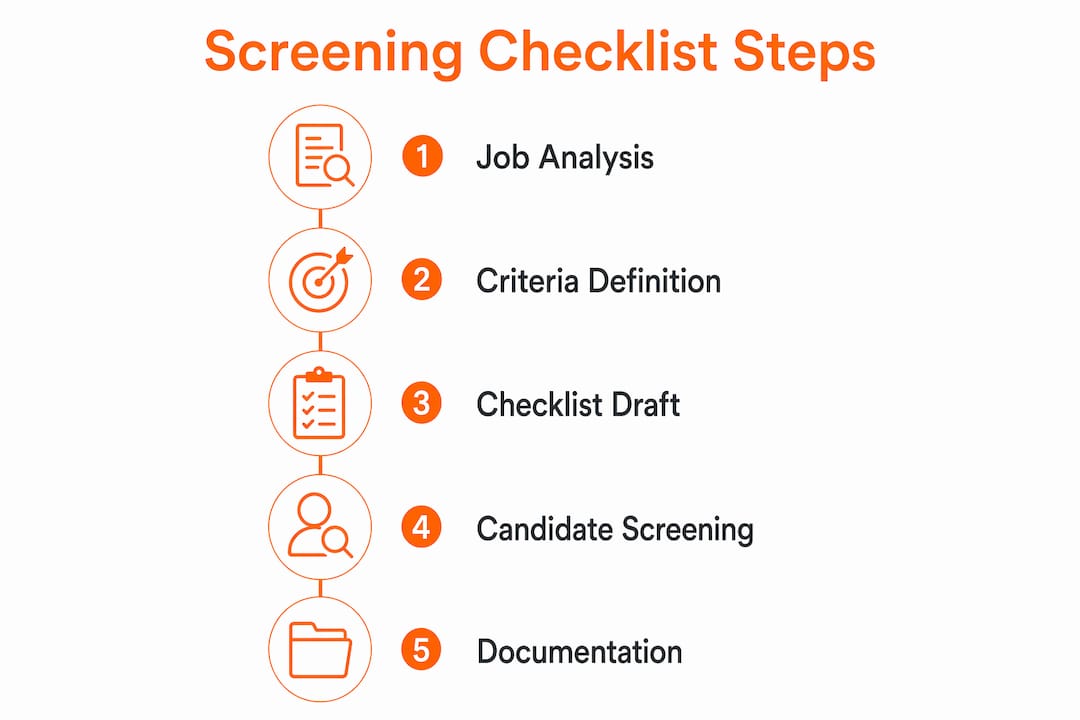
How do you develop a customized screening checklist for your role?
Building a checklist that actually works starts before you write a single question. The inputs come from a structured job analysis, not just a job posting. A job posting is marketing. A job analysis is the operational truth about what the role requires.
Follow these steps to build a checklist tailored to your organization:
- Conduct a job analysis. Interview the hiring manager and top performers in the role. Identify the three to five tasks that consume most of the role’s time and the skills those tasks require.
- Identify must-haves and disqualifiers. Separate requirements from preferences. A must-have is a skill or qualification without which the candidate cannot do the job. A disqualifier is a condition that makes the hire impossible or inadvisable.
- Define success outcomes. Specify the outcomes expected in the first 6–12 months. Checklist questions should probe whether the candidate has done comparable work before.
- Translate requirements into observable criteria. Convert each must-have into a question you can answer from a resume or a short phone screen. “Has the candidate managed a team of five or more?” is observable. “Is the candidate a leader?” is not.
- Involve key stakeholders. Share the draft checklist with the hiring manager, a senior team member, and your legal or compliance team. Each group catches different gaps.
- Align with company values. Add one or two criteria that reflect how your organization works, such as remote collaboration experience or comfort with a specific methodology, but only if those criteria are genuinely required for success.
Pro Tip: Run your draft checklist against the last three hires in the role. If the checklist would have screened out a top performer, revise it before using it live.
What are the best practices for implementing screening checklists in hiring?
The checklist only works if every member of the hiring team uses it the same way, every time. Inconsistent application is the most common reason checklists fail. One recruiter applies every criterion strictly while another treats them as suggestions, and the result is a process that is neither fair nor defensible.
Integrate the checklist at every stage of the screening workflow:
- Resume review: Apply minimum qualification and disqualifier checks before reading the full resume. This saves time and prevents the halo effect from a strong resume layout.
- Phone screen: A 15- to 30-minute phone screen verifies information from the resume and assesses communication skills. Use the checklist to guide the call and document responses immediately after.
- Skills assessment: Attach the checklist criteria to any test task or work sample so evaluators score against the same standard.
- Interview handoff: Pass the completed checklist to the interview panel so they know what has already been verified and what still needs probing.
Candidate communication is a non-negotiable part of the process. Poor communication during screening damages candidate experience and your employer reputation. Set a response timeline in your checklist, such as acknowledging receipt within 48 hours and sending a decision within five business days of each stage.
Applicant Tracking Systems reduce errors and audit risk when used for disposition coding and notes. Log the checklist outcome for every candidate, not just the ones you advance. That complete record is what protects you in an EEO review.
What common challenges arise with screening checklists?
The most common failure is vague criteria. When a checklist item reads “strong analytical skills,” every evaluator interprets it differently. The fix is specificity: replace vague traits with observable evidence, such as “has built or interpreted financial models in a previous role.”
Other challenges hiring managers regularly face include:
- Inconsistent application across the team: One recruiter uses the checklist for every candidate; another skips it when pressed for time. Solve this by making checklist completion a required field in your ATS before a candidate can be moved to the next stage.
- Criteria that drift over time: A checklist built for a role two years ago may not reflect what the role requires today. Continuous refinement based on hiring outcomes and recruiter feedback keeps the checklist accurate.
- Candidate communication delays: Slow or absent feedback after screening is one of the top reasons candidates withdraw from processes. Build a communication checkpoint into the checklist itself so it cannot be skipped.
- Overloaded checklists: A checklist with 25 criteria becomes a burden, not a tool. Keep it to the eight to twelve items that genuinely predict success and compliance.
The underlying principle is that a checklist should make decisions easier, not harder. If your team is avoiding it, the checklist is probably too long, too vague, or not integrated into the tools they already use.
How can technology improve your screening checklist process?
Digital tools change what a checklist can do. A paper checklist captures a decision. A checklist integrated into an ATS or an AI-powered platform captures a decision, timestamps it, links it to the candidate record, and flags missing fields before the stage closes.
| Feature category | Manual checklist | ATS-integrated checklist | AI-assisted screening platform |
|---|---|---|---|
| Documentation | Recruiter-dependent | Automated and timestamped | Automated with structured analysis |
| Consistency | Varies by user | Enforced by required fields | Enforced with scoring benchmarks |
| Bias risk | High without training | Moderate | Lower with oversight |
| Audit readiness | Low | High | High |
| Speed | Slow | Moderate | Fast |
AI-powered screening tools filter applicants against checklist criteria efficiently, but they require human oversight to avoid perpetuating bias embedded in historical hiring data. The right approach balances automation with human judgment at every decision point.
Testask applies this balance directly. The platform lets HR teams build tailored screening assessments tied to checklist criteria, evaluate submissions with AI-assisted analysis, and collaborate on reviews before making a final call. The result is a documented, consistent process that scales without sacrificing fairness.
Key Takeaways
A well-built screening checklist is the single most effective tool for producing consistent, compliant, and defensible hiring decisions across your entire team.
| Point | Details |
|---|---|
| Define observable criteria | Replace vague traits with yes-or-no questions tied directly to job requirements. |
| Document every decision | Log checklist outcomes for every candidate in your ATS to maintain audit-ready records. |
| Integrate at every stage | Apply the checklist at resume review, phone screen, assessment, and interview handoff. |
| Communicate on a schedule | Set response timelines in the checklist to protect your employer brand. |
| Refine continuously | Review checklist accuracy after each hiring cycle using recruiter feedback and outcome data. |
Why most screening checklists fail before they’re ever used
The checklists I see fail most often are not bad because of what they contain. They fail because of how they were built. Someone in HR drafted them alone, in an afternoon, by copying the job description into a list. The hiring manager never saw it. The legal team never reviewed it. And the recruiters who were supposed to use it had no input, so they treated it as optional paperwork.
The counterintuitive truth is that the process of building the checklist matters as much as the checklist itself. When you pull a hiring manager into a room and ask them to define what “success in the first six months” actually looks like, you often discover that the job description does not reflect the real job. That conversation is where the real screening criteria live.
The other mistake I see constantly is treating the checklist as finished. Hiring needs change. A role that required deep Excel skills two years ago may now require Python. If you are not reviewing your checklists after every three to five hires, you are screening against yesterday’s requirements. The best HR teams I have worked with treat their checklists as living documents, not filed templates.
One more thing: candidate experience is a checklist item, not an afterthought. Build communication checkpoints directly into the checklist. If your process does not force a response to candidates within a defined window, it will not happen consistently. And inconsistent communication costs you candidates and reputation in equal measure.
— Pavel
Build better hiring processes with Testask
Testask gives HR professionals and hiring managers the tools to put this guide into practice. The platform supports building effective recruitment checklists with structured templates, AI-assisted candidate evaluation, and collaborative review workflows that keep your entire team aligned.
Every checklist you build in Testask connects directly to candidate submissions, so your documentation is automatic and your decisions are traceable. Whether you are screening for a single role or managing a high-volume pipeline, Testask keeps your process consistent, fair, and audit-ready. Visit testask.org to see how the platform supports your full screening workflow from first application to final decision.
FAQ
What is a screening checklist in hiring?
A screening checklist is a structured list of job-related criteria used to evaluate candidates consistently before advancing them to interviews. It covers minimum qualifications, disqualifiers, must-have skills, and defined next steps.
How do you create a screening checklist for a job?
Start with a job analysis to identify must-have skills and disqualifiers, then translate each requirement into an observable yes-or-no question. Involve the hiring manager and legal team before finalizing the checklist.
Why is documentation important in candidate screening?
Documentation creates an auditable record of every hiring decision, which is required for compliance with Equal Employment Opportunity regulations. Logging outcomes in an ATS reduces errors and protects your organization during reviews.
How does AI help with screening checklists?
AI-powered platforms filter candidates against checklist criteria faster than manual review, but human oversight is required to prevent bias. The best results come from combining AI analysis with recruiter judgment at each decision point.
How often should a screening checklist be updated?
Review your checklist after every three to five hires using recruiter feedback and outcome data. Continuous refinement keeps criteria aligned with current role requirements and hiring standards.
Recommended
- Screening process best practices: smarter, fairer hiring steps | Testask Blog | testask
- Best Hiring Practices 2026: What HR Teams Need to Know | Testask Blog | testask
- Build an effective recruitment checklist for HR success | Testask Blog | testask
- How to Assess Candidates: A 2026 Hiring Guide | Testask Blog | testask