Interviewer Calibration: A Practical Guide for Hiring Teams
Interviewer Calibration: A Practical Guide for Hiring Teams

Interviewer calibration is the repeatable process that makes different interviewers score the same candidate the same way. If your panel disagrees wildly after every debrief, calibration is the fix. Start this week with three steps: schedule a short pre-role calibration before interviews begin; pull one recent recorded interview and have two interviewers score it independently; publish a one-page rubric for the open role before the next candidate enters the pipeline. The scorecard templates, meeting agenda, and metrics report you need are all in the sections below.
Key Takeaways
Disciplined interviewer calibration, built on shared rubrics, blind scoring, and quarterly analytics reviews, is the most direct lever for reducing hiring variance and improving offer acceptance.
| Point | Details |
|---|---|
| Start with a pre-role session | Run a 30–45 minute calibration before interviews begin to align the panel on anchor definitions. |
| Use blind scoring every time | Interviewers commit scores independently before any discussion to eliminate anchoring bias. |
| Track Cohen’s kappa | Move inter-rater agreement from ~0.2–0.3 toward 0.5 as calibration matures to confirm real progress. |
| Review analytics quarterly | Flag any interviewer whose average score deviates ±0.5 from the panel mean and recalibrate. |
| Testask automates the process | Testask’s shared scorecards, double-scoring workflows, and analytics dashboard replace manual tracking for distributed teams. |
Table of Contents
- What does interviewer calibration actually mean?
- Why calibration matters more than most teams realize
- Which metrics and reports reveal interviewer variance?
- How do you design scorecards that actually support calibration?
- How to run an interviewer calibration meeting, step by step
- Common calibration mistakes and how to avoid them
- Copy-ready templates and checklists for your next session
- What I’ve learned rolling out calibration at scale
- Testask makes calibration faster for distributed hiring teams
- Sources
What does interviewer calibration actually mean?
Calibration is the deliberate practice of aligning interviewers on what each score level means so that different people reach consistent assessments of the same evidence. In operational terms, the recruiter or hiring manager owns the process: they set the scoring standard before interviews start, run structured debrief sessions, and use analytics to detect when the bar drifts.
The term has two related but distinct meanings. Operationally, calibration is a meeting and governance practice: you align people. Statistically, calibration describes how well a score predicts an actual outcome. Academic research on scorecard calibration methods shows that post-processing techniques like Platt scaling and isotonic regression can improve how reliably scores map to real hiring decisions without disrupting rank order. Both meanings matter: the operational work produces the data; the statistical lens tells you whether that data is trustworthy.
Three calibration levels build on each other:
- Initial training calibration: Interviewers complete structured training before they conduct a single interview. Google requires formal training before employees are eligible to interview and finds that feedback submitted within 24–48 hours is significantly higher in quality than later submissions.
- Debrief calibration: Each post-interview debrief functions as a micro-calibration. Interviewers share scores independently before discussing, then reconcile differences against the rubric.
- Analytics-driven recalibration: Quarterly reviews of score distributions, standard deviation, and inter-rater agreement catch bar drift before it distorts hiring decisions.
Why calibration matters more than most teams realize
Inconsistent scoring is not just an inconvenience. It produces false negatives on strong candidates, false positives on weak ones, and a candidate experience that feels arbitrary. SHRM’s 2025 recruiting benchmarks link pipeline timing and candidate expectations directly to the need for consistent interviewer experiences, suggesting that calibration supports funnel health and offer acceptance.
The benefits of a disciplined calibration program include:
- Higher inter-rater reliability: Structured panels with shared rubrics and calibration exercises achieve measurably higher agreement than unstructured interviews.
- Fairer candidate treatment: When every interviewer uses the same anchors, scoring reflects evidence rather than personal style or unconscious bias.
- Fewer panel-driven errors: Calibrated panels reduce both false negatives (rejecting strong candidates) and false positives (advancing weak ones).
- Faster decisions: Debriefs move quickly when interviewers share a common scoring language.
- Stronger employer brand: Candidates who experience a consistent, professional process are more likely to accept offers and recommend your company.
One anonymized case tracked by the Candidate Experience Institute found that disciplined calibration correlated with a 12% increase in offer acceptance after six months. That is a concrete funnel metric leadership can act on.
Calibration and compliance go hand in hand. Inconsistent scoring creates EEO exposure: if one interviewer systematically scores a protected group lower, and no calibration process catches it, the organization carries legal risk. Calibration does not replace EEO training, but it creates the audit trail that demonstrates structured, defensible decision-making.
KPIs to track if you need to justify investment to leadership: offer acceptance rate by role, stage-to-stage conversion, Cohen’s kappa (inter-rater agreement), and score distribution convergence across interviewers over time.
Which metrics and reports reveal interviewer variance?
You cannot fix what you cannot see. Build or request this report from your ATS or interview-intelligence tool:
| Column | What it measures | How to interpret it |
|---|---|---|
| Interviewer | Name or ID | Segment all other metrics by this field |
| Avg score (per competency) | Mean rating given across all interviews | Outliers above or below the panel average signal leniency or harshness |
| Std deviation | Spread of scores for one interviewer | High std dev means inconsistent scoring, not just a tough grader |
| Interview count | Number of interviews scored | Low counts make other metrics unreliable; flag for more data |
| Median score | Middle value, less sensitive to outliers | Compare to avg score; a large gap suggests extreme ratings |
| Hire rate from scores | % of high-scored candidates who received offers | High avg score + low hire rate = leniency without hire quality |
| Leniency/harshness flag | Automated flag when avg score is ±0.5 from panel mean | Triggers a calibration conversation, not a performance review |
| Last calibration date | Date of most recent calibration session | Interviewers uncalibrated for 90+ days should be recalibrated before next role |
Beyond the table, three visualizations are most useful. Score distribution histograms show whether an interviewer clusters scores at 3 or skews toward 5. Heatmaps of competency versus interviewer reveal whether one person consistently underscores communication while another underscores technical depth. Trend lines for average score over time expose bar drift: if the team’s average score for a role climbs steadily over eight weeks without a change in candidate quality, the bar is moving.
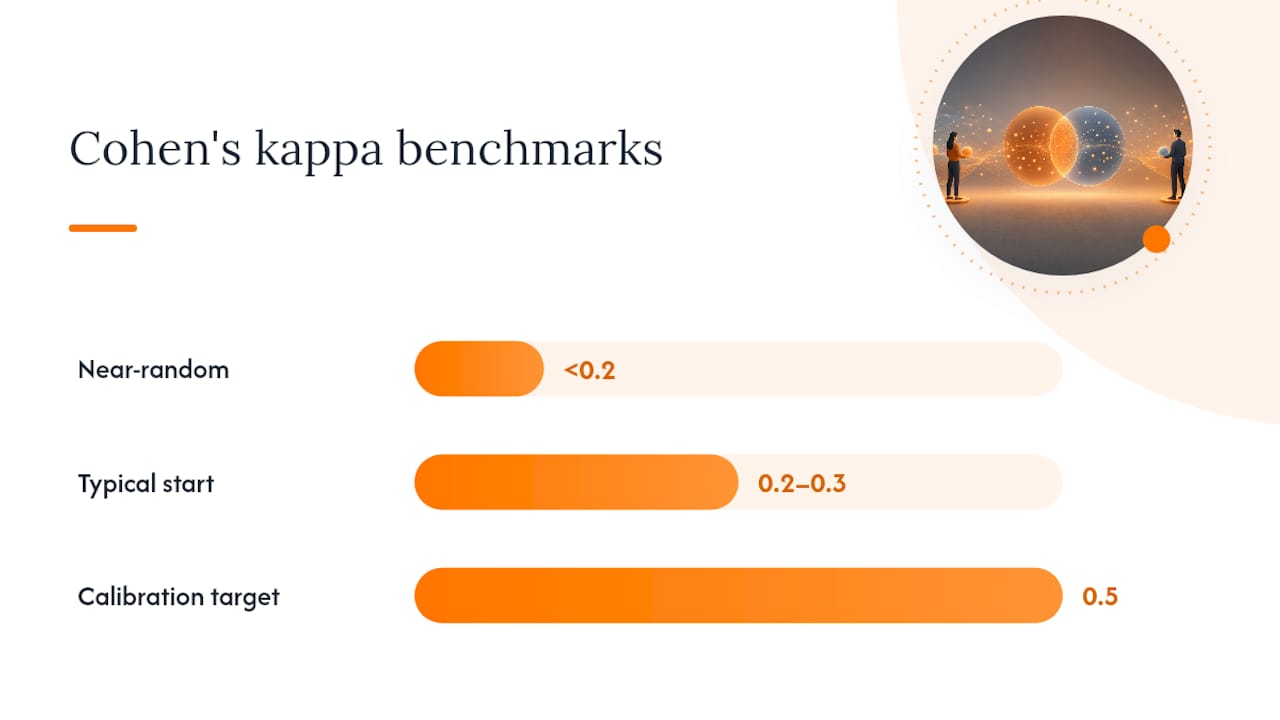
Many teams aim to move Cohen’s kappa from roughly 0.2–0.3 toward 0.5 as calibration matures. A kappa below 0.2 is near-random agreement. Reaching 0.5 means your panel is making meaningfully consistent judgments.
How do you design scorecards that actually support calibration?
A scorecard without behavioral anchors is just a number. The anchor is what makes calibration possible: it gives every interviewer the same observable standard to compare against.
Here is a sample scorecard structure for a single competency:
| Field | Description |
|---|---|
| Competency | Problem Solving |
| Score 1 (Does not meet) | Candidate described a problem but could not explain their reasoning or the outcome |
| Score 3 (Meets expectations) | Candidate walked through a structured approach, identified trade-offs, and reached a defensible conclusion |
| Score 4 (Exceeds) | Candidate identified a non-obvious constraint, adjusted their approach mid-answer, and quantified the result |
| Score 5 (Exceptional) | Candidate demonstrated the above AND proactively considered second-order effects or stakeholder impact |
| Evidence notes | Verbatim quote or paraphrase from the candidate’s answer, time-stamped |
| Behavioral anchor example | “Tell me about a time you had to solve a problem with incomplete information” |
For a role like a senior analyst, a score of 3 on problem solving might look like: “Candidate described a data gap in a quarterly report, built a proxy metric, and explained the limitation to stakeholders.” A 4 adds: “Candidate anticipated the proxy’s failure mode before being asked and proposed a validation check.” A 5 adds: “Candidate described redesigning the data collection process to prevent the gap recurrence, with buy-in from engineering.”
That specificity is what makes calibration tractable. For interview assessment design, role-specific anchors outperform generic ones every time.
Pro Tip: Use past hires and non-hires as anchor cases. Pull two or three real interview notes from your files, one for a candidate who became a top performer and one who struggled, and use those as the concrete reference points for a 5 and a 2. Keep the language observable and role-specific, not trait-based.
How to run an interviewer calibration meeting, step by step
A well-run calibration session takes 45 minutes and produces a one-page rubric the whole panel uses. Here is a repeatable agenda:
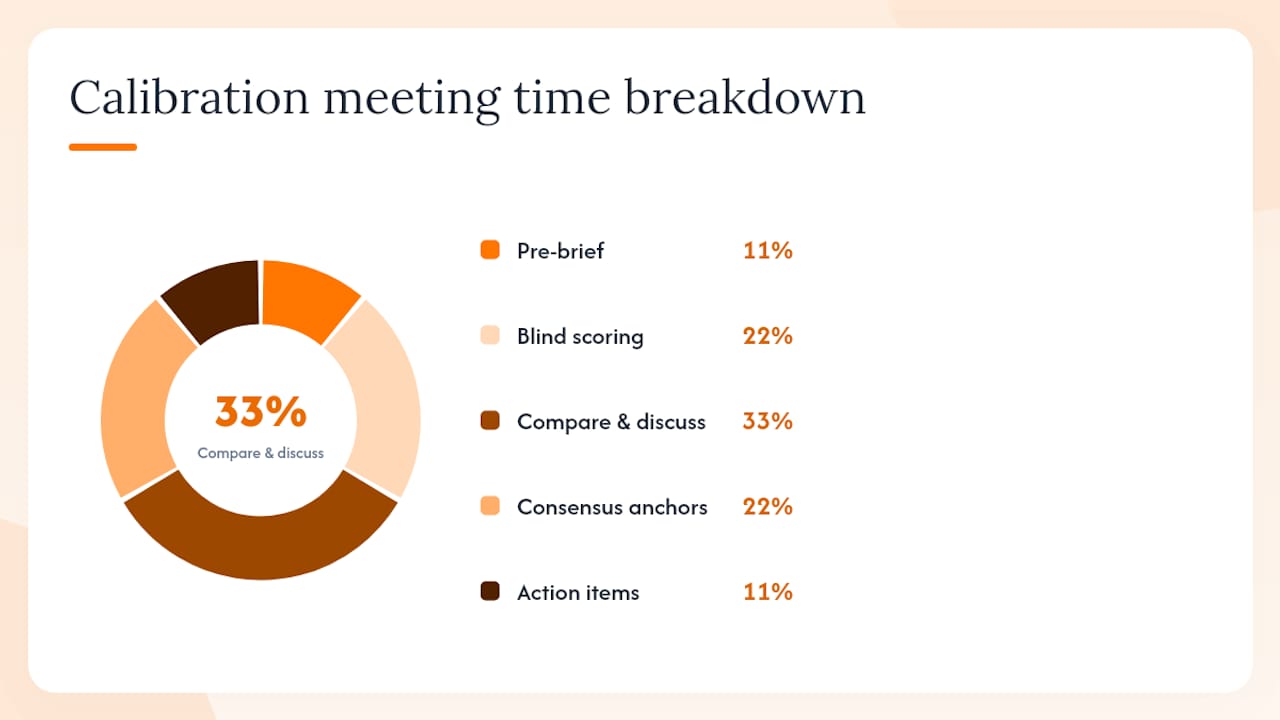
- Pre-brief (5 minutes). The facilitator shares the role’s 3–5 competencies and the current rubric draft. No scores are discussed yet.
- Blind scoring (10 minutes). Each interviewer independently scores a recorded interview or a written transcript. No discussion until everyone has committed a score in writing.
- Compare and discuss (15 minutes). Scores are revealed simultaneously. The facilitator notes gaps of 2 or more points and asks each interviewer to cite the specific evidence behind their rating.
- Consensus on anchors (10 minutes). The group agrees on what a 3 versus a 4 looks like for this role. The scribe updates the rubric in real time.
- Action items (5 minutes). Assign recheck dates, flag any interviewer who needs targeted retraining, and confirm the rubric is saved and distributed.
Participant roles:
- Facilitator (recruiter or HR lead): Runs the agenda, enforces blind scoring, redirects opinion to evidence.
- Hiring manager: Owns the bar definition; resolves anchor disputes with business context.
- Interviewers: Score independently, cite evidence, flag rubric gaps they encounter in the field.
- Scribe: Documents anchor decisions and action items; updates the calibration report after the session.
Three exercises cover most calibration needs. Use blind scoring of a recorded interview at the start of a new role to establish the baseline. Run re-scoring of a borderline candidate when the panel disagrees sharply after a real debrief. Apply double-scoring of live notes monthly to detect bar drift between formal sessions. Feedback submitted within 24–48 hours is significantly higher in quality, so build the double-scoring step into the debrief workflow, not a separate meeting.
Follow-up actions after every session: update the rubric document, assign any targeted retraining, record outcomes in the calibration report with the session date and participants, and set a recheck date for the next session (typically 30 days for active roles, 90 days for lower-volume hiring).
Common calibration mistakes and how to avoid them
Bar drift is the most common and least visible problem. When interviewers score candidates without a recent calibration anchor, the bar shifts gradually. A team that started the quarter hiring at a 4/5 standard may be effectively hiring at a 3/5 by week eight. The fix is periodic re-scoring of known anchor cases: pull a recorded interview from a confirmed top performer and have the current panel score it. If scores have dropped, recalibrate before the next hire.
Anchoring bias occurs when the first interviewer’s score influences everyone else’s. Blind scoring eliminates this. Never share scores before everyone has committed independently.
Seniority bias is subtler. Senior interviewers’ opinions carry social weight in debriefs, which can suppress legitimate disagreement from junior panel members. The facilitator’s job is to ask junior interviewers to share their scores and evidence first, then invite the senior interviewer to respond.
Loose rubrics undermine calibration before it starts. A rubric that says “strong communicator” without observable examples gives interviewers nothing to align on. Every anchor must describe a behavior, not a trait.
Mitigation checklist:
- Require calibration before any interviewer conducts a solo interview.
- Run analytics reviews quarterly; flag any interviewer whose average score deviates by ±0.5 from the panel mean.
- Set a threshold rule: if Cohen’s kappa falls below 0.3 for a role, pause hiring and recalibrate.
- Integrate calibration records into your ATS so every hiring decision has a documented calibration date.
Calibration is not a substitute for EEO training. Both are required. Calibration creates structured, auditable scoring; EEO training addresses the legal framework and unconscious bias at the individual level. Run them together, not as alternatives. For bias-free assessment design, structured rubrics and legal compliance training reinforce each other.
Copy-ready templates and checklists for your next session
Use these artifacts directly in your process.
Calibration session checklist:
- Confirm competencies and rubric draft are shared 24 hours before the session.
- Distribute the recording or transcript; instruct interviewers not to discuss it beforehand.
- Open with blind scoring: everyone writes scores before anyone speaks.
- Reveal scores simultaneously; note any gap of 2+ points.
- For each gap, ask: “What specific evidence drove your rating?”
- Update anchor language in the rubric based on the discussion.
- Assign recheck date and document participants, scores, and anchor decisions.
- Distribute the updated rubric to all interviewers before the next candidate enters the pipeline.
Sample scorecard (4 competencies):
Facilitation script highlights:
- To redirect opinion to evidence: “That’s a useful observation. What did the candidate actually say or do that led you to that score?”
- To defuse a heated disagreement: “We have a 2-point gap here. Let’s each read our evidence notes aloud before we try to resolve it.”
- To close anchor consensus: “Based on what we’ve heard, can we agree that a 4 on this competency requires the candidate to have done X and Y? Anyone see it differently?”
Interviewer training courses covering STAR/CAR frameworks, structured rubrics, and bias-mitigation techniques prepare interviewers to participate effectively in these sessions. Pair formal training with your calibration program for the fastest ramp. For a complete employee assessment checklist that integrates these steps into a broader hiring workflow, the linked resource covers the full sequence.
Pro Tip: When integrating these templates with an ATS or assessment platform, store the calibration report alongside the role’s scorecard so every hiring decision has a documented calibration date. This creates an audit trail that supports both EEO compliance and continuous improvement.
What I’ve learned rolling out calibration at scale
Most teams treat calibration as a one-time fix. They run a session before a high-stakes hire, feel good about it, and move on. Six months later, the bar has drifted and the panel is back to disagreeing in debriefs. The teams that sustain calibration treat it as governance, not an event. They build the debrief micro-calibration into every hiring workflow, run the analytics review quarterly, and use anchor cases as a living library that grows with each cohort of hires.
The fastest way to start: pick one active role this week, pull one recorded interview, and run a 30-minute blind scoring session with your panel. You will learn more about your team’s scoring variance in that half hour than in months of debrief meetings. From there, the talent calibration guide on the Testask blog walks through multi-interviewer scenarios with practical case examples.
Testask makes calibration faster for distributed hiring teams
Calibration at scale requires shared infrastructure. Testask gives HR teams and hiring managers a single platform to build structured scorecards, collect independent scores before debrief, and run interviewer analytics that flag leniency, harshness, and bar drift automatically.
For distributed teams or high-volume roles, manual calibration processes break down fast. Testask’s double-scoring workflow collects each interviewer’s ratings independently before revealing the panel’s scores, eliminating anchoring bias without requiring a separate meeting. The analytics dashboard surfaces score distribution, standard deviation, and inter-rater agreement by interviewer and by competency, so you can see drift before it affects a hire. Facilitation notes and calibration session records attach directly to the role, giving you the audit trail compliance teams need.
When to use a platform versus a manual process:
- Use a platform when you have more than three interviewers per role, distributed or remote panels, or auditability requirements.
- Use a manual process for small teams running fewer than five hires per quarter, with a single co-located panel.
Start a free trial at Testask and run your first calibrated scorecard before your next interview cycle begins.
Sources
- Interviewer Calibration Sessions: The Missing Practice That Turns Inconsistent Panels Into Reliable Assessors
- What is Calibration in Interviewing? Definition & Meaning | SocialTalent
- Effective interviewer training for better candidate experiences - Google re:Work
- Calibration methods and their impact on scorecard predictions (academic article)
- Interviewer training for hiring managers | Coursera
- 2025 recruiting benchmarking | SHRM