What Is Talent Calibration? A Guide for HR Teams
What Is Talent Calibration? A Guide for HR Teams

Talent calibration is defined as a structured, collaborative process where managers and HR leaders align performance and potential ratings against a shared standard to ensure consistency and reduce bias. Unlike a standard performance review, calibration brings multiple decision-makers into the same room to challenge assumptions and build a shared picture of employee contribution. The result is a talent assessment that reflects company-wide standards rather than one manager’s perspective. For HR professionals and hiring managers, understanding talent calibration is the foundation of fair, meritocratic workforce decisions.
What is talent calibration and why does it matter?
Talent calibration is a structured, collaborative session where managers and HR align performance and potential ratings against a shared yardstick to ensure consistency, reduce bias, and turn subjective opinions into strategic talent insights. The industry term you will see in HR governance frameworks is “calibration session” or “talent review calibration.” Both phrases describe the same practice: a facilitated group discussion that converts individual manager ratings into a consistent, organization-wide view of talent.
The importance of talent calibration goes beyond fairness. Without it, two employees with identical performance records can receive wildly different ratings simply because their managers interpret the rubric differently. That inconsistency corrupts compensation decisions, promotion pipelines, and succession plans. Calibration closes that gap by making rating standards explicit and shared.

Calibration also separates performance from potential. These are two distinct dimensions, and conflating them leads to poor talent decisions. A high performer in their current role is not automatically a high-potential candidate for a senior position. Calibration sessions force that distinction into the open, producing cleaner data for workforce planning.
How does the talent calibration process work?
The talent calibration process runs in three phases: preparation, live session, and post-calibration action. Each phase has defined inputs, outputs, and ownership roles.
Phase 1: Pre-work and data preparation
Managers gather performance data, collect evidence of employee contributions, and submit their preliminary ratings before the session. Assessment data submitted at least three business days before the live session prevents unproductive opinion-sharing during the meeting itself. Pre-work quality directly determines meeting effectiveness. A manager who arrives with vague impressions rather than documented evidence slows the entire group down.
Phase 2: Live calibration session
HR facilitates a group discussion where managers present their ratings and the group challenges or validates them. The session focuses on outliers: employees rated at the high or low ends of the performance and potential spectrum. Standard performers are handled through summary reporting or asynchronous review, which keeps the session efficient and scalable. GitLab’s calibration model uses level-by-level sessions to maintain confidentiality and efficiency across a large, distributed workforce.
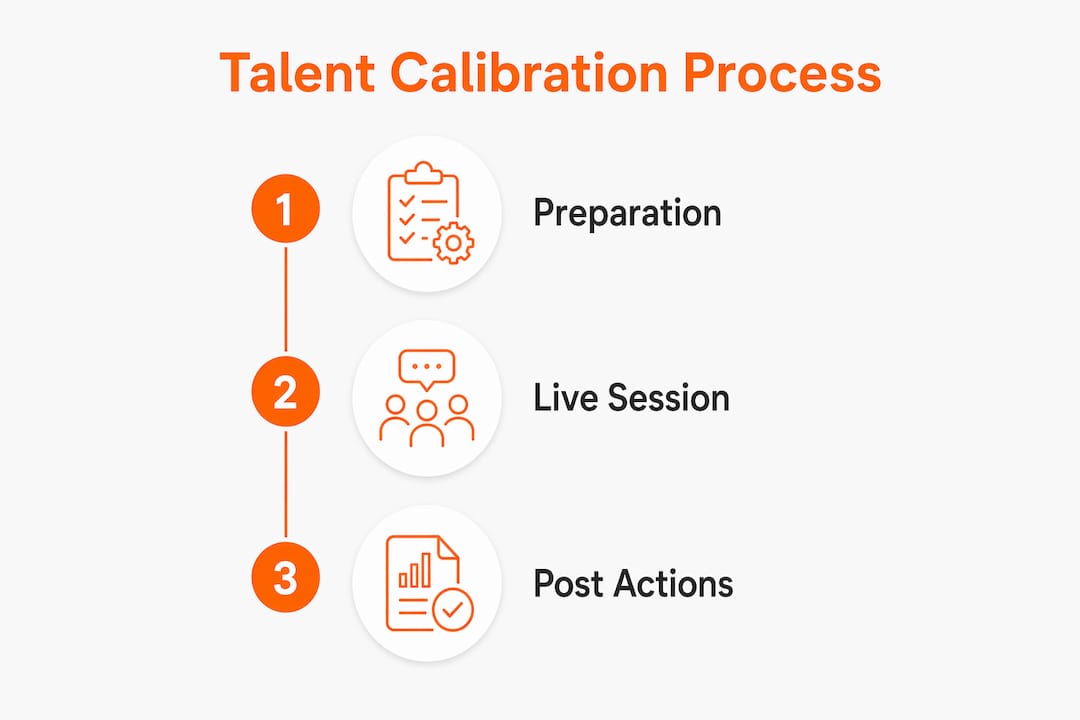
Phase 3: Post-calibration actions
HR updates talent systems with finalized ratings, creates individual development plans, and audits the results for fairness. This phase also includes reviewing diversity metrics to catch any disproportionate patterns in low ratings across gender or minority groups.
Pro Tip: Assign a named HR Business Partner as the session owner before scheduling any calibration meeting. Sessions without clear ownership drift into discussion without decisions.
How does calibration reduce bias and improve fairness?
Calibration reduces bias by replacing a single manager’s judgment with a multi-manager review. Cross-departmental feedback broadens assessment beyond one direct manager’s opinion, producing a more complete view of employee contribution. That breadth matters because individual managers carry individual blind spots.
The structural features of a well-run calibration session actively counter common rating errors:
- Absolute rubrics over relative comparisons. Managers rate employees against defined performance criteria, not against each other. This prevents the “big fish in a small pond” effect where a strong performer in a weak team gets inflated ratings.
- Separation of performance and potential. Treating these as distinct dimensions prevents the halo effect, where strong current performance is mistakenly read as future leadership potential.
- Skilled facilitation. Clear ground rules, objective evidence, and skilled facilitation are required to keep discussions on track and prevent dominant voices from skewing outcomes.
- Post-session diversity audits. Reviewing rating distributions by gender, ethnicity, and tenure after calibration catches systemic bias that individual managers may not notice in isolation.
Post-calibration audits must include reviewing diversity metrics to prevent disproportionate low ratings for women or minority groups. That audit step is not optional. It is the mechanism that makes calibration a compliance tool, not just a management exercise.
Pro Tip: Before your next calibration session, review your talent assessment practices to identify where rating inconsistencies typically originate. Fixing the upstream data quality problem makes the calibration session itself far more productive.
What are the common pitfalls in talent calibration?
Most calibration failures trace back to three root causes, and each one is avoidable with the right structure.
Over-calibrating. Running calibration sessions too frequently, or for too many employees at once, creates meeting fatigue and delays decisions. The biggest failure points include over-calibrating causing delays, token governance without ownership, and executive override damaging fairness perceptions. Calibration should be a focused, periodic event tied to performance cycles, not a standing weekly meeting.
Token governance. Some organizations set up calibration processes on paper but assign no real ownership. HR Business Partners and executive sponsors must have defined roles and authority. Without that, calibration becomes a box-checking exercise that produces no real alignment.
The manager protection reflex. Managers often resist recalibration of their direct reports, reading it as personal criticism. Successful sessions reframe calibration as collaborative standards alignment rather than a critique of individual management judgment. That framing shift changes the room’s dynamic entirely.
Weak pre-work. Managers’ failure to submit high-quality, evidence-backed justifications is the single biggest reason calibration meetings become inefficient. When managers arrive with opinions instead of data, the group spends meeting time reconstructing facts rather than making decisions.
Misunderstanding the purpose. Calibration is not about forced bell curves but about challenging assumptions, identifying patterns, and creating a shared understanding of excellence in a business context. Treating it as a ranking game produces exactly the kind of political maneuvering that calibration is designed to prevent.
Pro Tip: Limit live session discussion to employees rated in the top 15% and bottom 15% of your performance distribution. Handle the middle 70% through written summaries. This single rule cuts average session time significantly without sacrificing decision quality.
How does calibration inform hiring, promotions, and succession planning?
Calibrated talent data feeds directly into the decisions that shape your workforce. The table below maps calibration outputs to specific HR decisions.
| Calibration output | HR decision it supports |
|---|---|
| Finalized performance ratings | Compensation adjustments and merit increases |
| High-potential identification | Promotion decisions and leadership pipelines |
| Skill gap analysis | Learning and development investment priorities |
| Succession readiness scores | Succession planning and role coverage mapping |
| Diversity audit results | Equity reviews and inclusive hiring targets |
Calibration outputs inform compensation, promotion, succession planning, and high-potential identification, ensuring meritocracy and building employee trust. That trust is not a soft outcome. Employees who believe ratings are fair are more likely to stay, perform, and refer strong candidates.
Calibration also improves hiring quality over time. When HR teams understand what “high performance” actually looks like across departments, they can build skills assessment strategies that screen for those same qualities at the candidate stage. The calibration process becomes a feedback loop: better hiring data sharpens calibration rubrics, and sharper rubrics improve hiring criteria.
For succession planning specifically, calibration identifies employees who are ready for promotion now versus those who need 12–24 months of development. That distinction prevents both premature promotions and talent stagnation. Organizations that run calibration consistently build deeper, more accurate succession pipelines than those relying on ad hoc manager nominations.
Diversity goals also benefit directly. When fairness and transparent calibration drives talent decisions, underrepresented groups receive ratings based on evidence rather than familiarity bias. That shift produces more diverse promotion and succession slates without requiring quota-based interventions.
Key Takeaways
Talent calibration works because it replaces individual manager judgment with a structured, multi-perspective review that produces consistent, evidence-based ratings across the entire organization.
| Point | Details |
|---|---|
| Core definition | Calibration aligns performance and potential ratings across managers using shared standards and facilitated discussion. |
| Pre-work is non-negotiable | Managers must submit evidence-backed ratings at least three business days before the live session. |
| Focus on outliers | Limit live discussion to high and low performers; handle the middle tier through written summaries. |
| Audit for fairness | Post-calibration diversity audits catch systemic bias that individual managers cannot see on their own. |
| Strategic outputs | Calibrated data directly drives compensation, promotions, succession planning, and high-potential development. |
Calibration is the most underused tool in HR’s kit
I have worked with HR teams that run annual performance reviews with real discipline but treat calibration as an afterthought. They schedule it the week after ratings close, give managers two days’ notice, and wonder why the sessions produce nothing useful. The problem is not calibration itself. The problem is treating it as an administrative step rather than a strategic decision-making event.
The sessions that actually change outcomes share one quality: the managers in the room have done the work before they arrive. They bring specific examples, not impressions. They can defend a rating with data, and they are willing to update it when a peer presents a different perspective. That kind of intellectual honesty does not happen by accident. It requires a session culture that frames disagreement as useful, not threatening.
The other thing I would push back on is the idea that calibration is only for large organizations. A 50-person company with three department heads can run a calibration session in 90 minutes and walk away with dramatically better alignment on who is ready for more responsibility. The process scales down just as well as it scales up.
Looking at where calibration is heading in 2026 and beyond, the shift toward continuous feedback cycles is making calibration more frequent and more data-rich. Teams that pair real-time talent review frameworks with periodic calibration sessions are building a much clearer picture of their workforce than those relying on annual snapshots. That combination is where the real competitive advantage lives.
— Pavel
How Testask supports your calibration workflow
Calibration sessions are only as good as the data that feeds them. Testask gives HR teams and hiring managers the tools to generate that data before a single calibration meeting is scheduled.
Testask’s AI-powered assessment platform lets you create tailored test tasks, evaluate candidate and employee submissions with AI-assisted analysis, and share results across your review team in one place. That means your managers arrive at calibration sessions with objective, evidence-backed performance data rather than gut-feel impressions. The platform also supports collaborative review workflows, so multiple evaluators can assess the same submission and surface rating discrepancies before they reach the calibration table. Explore Testask to see how structured assessment data can make your next calibration session faster and more defensible.
FAQ
What is talent calibration in simple terms?
Talent calibration is a structured meeting where multiple managers and HR align on employee performance and potential ratings using shared standards. The goal is consistent, fair evaluations across the entire organization.
How often should calibration sessions be held?
Most organizations run calibration sessions once or twice per year, tied to formal performance review cycles. High-growth teams may run quarterly sessions for specific talent populations such as high-potential employees or promotion candidates.
What is the difference between talent calibration and a performance review?
A performance review is a one-on-one conversation between a manager and an employee. Talent calibration is a group process where managers align their ratings with each other, using a shared rubric to reduce inconsistency and bias.
How does calibration support diversity and inclusion goals?
Post-calibration audits review rating distributions by gender, ethnicity, and tenure to catch disproportionate low ratings. That audit step converts calibration from a management exercise into a measurable equity tool.
What is talent assessment and how does it relate to calibration?
Talent assessment is the process of gathering structured data on employee skills, performance, and potential. Calibration uses that assessment data as its primary input, making assessment quality the single biggest driver of calibration accuracy.
Recommended
- Talent Assessment: Build Efficient, Predictive Hiring Systems | Testask Blog | testask
- Skills Assessment Strategies for HR Teams in 2026 | Testask Blog | testask
- Talent reviews: frameworks, pitfalls, and winning strategies | Testask Blog | testask
- What Is a Talent Pool? A Guide for HR Recruiters | Testask Blog | testask