How to Design Screening Assessments for HR Teams
How to Design Screening Assessments for HR Teams

Design screening assessments by starting with a job analysis, mapping KSAOs to assessment methods, writing and piloting items, then documenting validation evidence before go-live. The OPM Assessment Decision Guide and EEOC employment-test guidance both anchor this sequence in legal defensibility, and platforms like Testask let you execute it without building everything from scratch.
Start here:
- Define the job. Run a job analysis and produce a ranked KSAO list before touching any test content.
- Select and design methods. Match each KSAO to one or two assessment types, write items, and set scoring rules.
- Pilot and validate. Run a small pilot, check reliability and adverse impact, and collect content-validity evidence.
- Implement and monitor. Deploy on a secure platform, track KPIs, and update the assessment when the job changes.
Key Takeaways
Defensible screening assessments require job analysis, validated methods, documented scoring rules, and continuous monitoring after launch.
| Point | Details |
|---|---|
| Start with job analysis | Map KSAOs before selecting any assessment method to ground every design decision in evidence. |
| Match methods to KSAOs | Use work samples for task performance, SJTs for judgment, and cognitive tests for reasoning. |
| Pilot before go-live | Check reliability, item-total correlations, and adverse-impact ratios before any candidate sees the live version. |
| Document everything | Keep job-analysis notes, scoring rubrics, SME sign-offs, and adverse-impact analyses in a versioned compliance pack. |
| Use Testask for execution | Testask supports task generation, submission collection, reviewer workflows, and exportable validation logs in one platform. |
Table of Contents
- How to design screening assessments: start with job analysis and KSAOs
- Which assessment methods match your KSAOs?
- How do you write items, instructions, and accommodations?
- How should you score assessments and set cutoffs?
- How do you pilot and validate before going live?
- What does a good candidate experience look like?
- What should you look for in an assessment platform?
- What records do you need to keep?
- Quick checklist and sample 6-week workflow
- What experienced HR teams get wrong
- Testask makes this process faster and more defensible
- Sources
How to design screening assessments: start with job analysis and KSAOs
The single most common failure in assessment design is picking a test before defining the job. Every valid, defensible assessment traces back to a documented job analysis that identifies the critical tasks and the knowledge, skills, abilities, and other characteristics (KSAOs) those tasks require.
Practical job-analysis checklist:
- Role purpose: one sentence on what the job produces and for whom
- Essential tasks: 8–12 tasks ranked by frequency and criticality (use incumbent interviews and SME panels)
- Success measures: observable performance indicators tied to each task
- KSAOs: prioritized list with a rationale linking each KSAO to at least one essential task
- Reference sources: O*NET occupational data as a starting point, then refine with internal SMEs
The OPM Assessment Decision Guide is explicit: assessment design must begin with job-analysis results, and SMEs must be qualified and documented. That documentation is what makes content-based validation defensible later.
Pro Tip: Run a 90-minute SME workshop with three to five incumbents or supervisors. Ask them to rate each task on frequency and consequence of error, then vote on which KSAOs are truly required at hire versus trainable on the job. The output is a one-page KSAO priority matrix you can hand directly to item writers.
Which assessment methods match your KSAOs?
Once you have a ranked KSAO list, map each critical KSAO to one or two best-fit methods. No single method covers everything, and multi-method approaches improve predictive accuracy while reducing selection errors.
| Method | Best for | Validity signal | Development cost | Subgroup differences |
|---|---|---|---|---|
| Work sample / simulation | Task performance KSAOs | High | High | Moderate |
| Situational judgment test (SJT) | Judgment, interpersonal KSAOs | Moderate–high | Moderate | Low–moderate |
| Cognitive ability test | Reasoning, learning agility | High | Low (off-shelf) | Higher — monitor closely |
| Structured interview | Experience, culture fit | Moderate–high | Low–moderate | Low |
| Personality inventory | Conscientiousness, teamwork | Moderate | Low | Low |
When to use each:
- High-volume screening (100+ applicants): start with a short cognitive or SJT screener to reduce the pool before costlier simulations.
- Specialized or senior roles: lead with a work sample or simulation where the KSAO is directly observable.
- Multiple-hurdle design: apply a minimum threshold at each stage; candidates who clear Stage 1 advance to Stage 2. Use this when volume is high and each stage is inexpensive.
- Combined (weighted composite) scoring: sum weighted scores across methods into one decision score. Better for nuanced roles where no single KSAO is disqualifying.
How do you write items, instructions, and accommodations?
Items must directly sample job content. An item that could appear on a general-knowledge quiz is a red flag; an item that mirrors a real task the role performs is defensible.
Item-development checklist:
- Ground every item in a specific task from the job analysis
- Use neutral, plain language; avoid idioms or culturally specific references
- Keep a consistent format within each section (all multiple-choice, all short-answer)
- Attach a scoring rubric to every open-ended item before piloting
- Have at least two SMEs review each item for job relevance and bias
Instructions and timing. Write instructions in plain language, state the time limit clearly, and explain what happens if a candidate needs more time. Fair time limits come from piloting with a small group and setting the limit at roughly the 90th-percentile completion time.
Accommodations. The ADA limits disability-related inquiries before a conditional job offer; design accessible formats from the start rather than retrofitting them. Offer screen-reader-compatible versions, extended time options, and alternative submission formats as standard choices, not exceptions.

Pro Tip: Place one short transparency sentence at the very top of the assessment: “This task measures [specific skill] because [role reason], and your response will be reviewed by [who].” Candidates who understand why they are being tested complete assessments at higher rates and report fairer perceptions.
How should you score assessments and set cutoffs?
Choose the decision rule before you write items, not after. Retrofitting scoring rules to results is a validity problem and an audit risk.
Setting cutoffs:
- Gather pilot data and calculate score distributions by group.
- Set a criterion-referenced cutoff tied to a minimum acceptable performance level, not an arbitrary percentile.
- Cross-check the cutoff against job-performance data when available (criterion validity).
- Document the rationale in writing, including who approved it and when.
Fairness in scoring:
- Never adjust scores by protected class. The EEOC is clear that score adjustments based on race, sex, or national origin violate Title VII.
- When a cutoff produces adverse impact, evaluate whether a lower cutoff or an alternative method achieves the same business necessity with less disparity.
Documentation HR must keep:
- Scoring rubrics with version dates
- Cutoff rationale memo signed by the hiring lead and an SME
- Any tie-breaker rules (e.g., secondary sort by structured-interview score)
- Records of any score adjustments and their business justification
How do you pilot and validate before going live?
Run a small pilot and complete these checks before any candidate sees the live assessment. Skipping this step is where legal exposure begins.
Statistical checks:
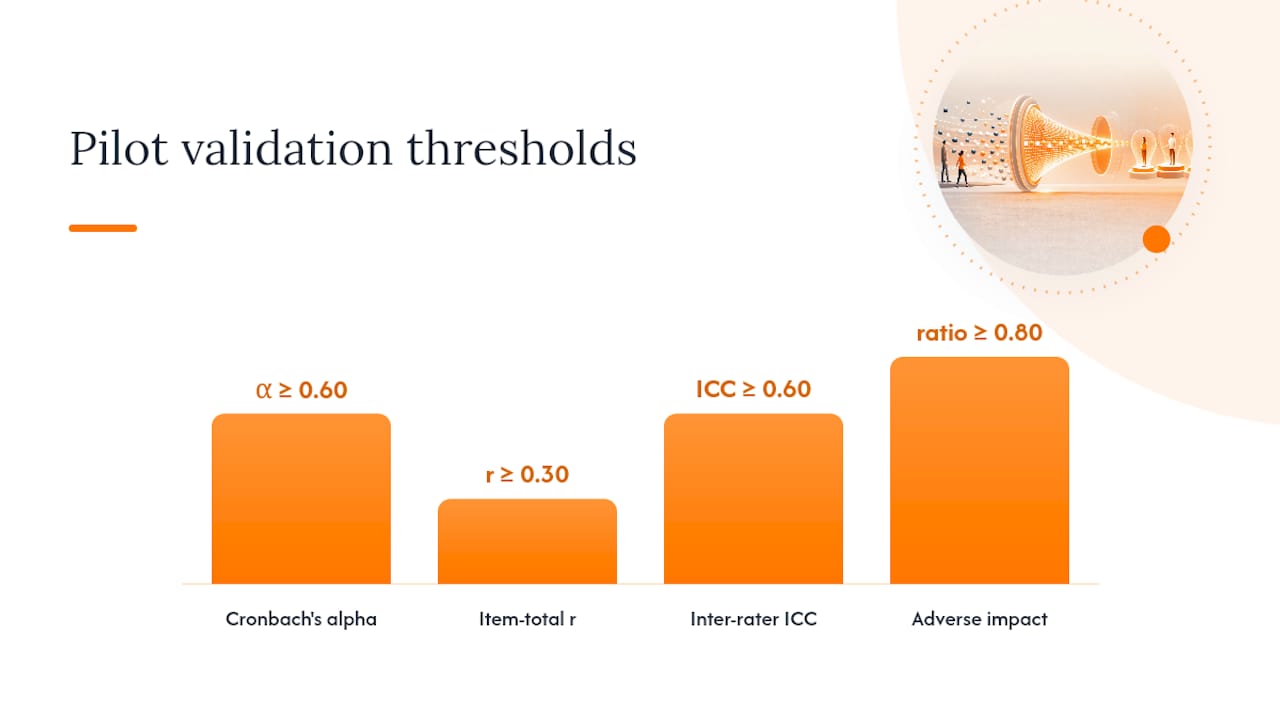
| Check | What it measures | Minimum threshold |
|---|---|---|
| Internal consistency (Cronbach’s alpha) | Item coherence within a section | α ≥ 0.60 |
| Item-total correlation | Each item’s contribution to the total score | r ≥ 0.30 |
| Inter-rater reliability | Consistency across human scorers | ICC ≥ 0.60 |
| Adverse impact (four-fifths rule) | Pass-rate ratio between subgroups | ≥ 0.80 ratio |
Legal anchor: The EEOC requires that employment tests be job-related and consistent with business necessity. Tests that disproportionately exclude protected groups trigger a burden to demonstrate that justification. The APA’s guidance on personnel selection adds that validation design must match the intended use of the test, and content-based validation requires qualified SMEs and a clearly defined content domain.
Adverse impact steps: Compare pass rates between the highest-passing group and each protected group. A ratio below 0.80 (the four-fifths rule) is an initial flag, not an automatic violation, but it requires documented follow-up: review job-relatedness evidence, consider alternative procedures, and consult a measurement specialist if the gap persists.
Pilot data checklist: Aim for at least 30 responses per subgroup for meaningful analysis. Flag demographic data separately from scores. Preserve all pilot records for the compliance pack.
What does a good candidate experience look like?
A clear realistic job preview (RJP) and concise test rationale improve applicant reactions and reduce dropout. Candidates who understand the process perceive it as fairer, which protects your employer brand alongside your legal position.
Communication touchpoints:
- Invitation email: state the assessment purpose, estimated time, and deadline
- Top-of-test message: one sentence explaining what is measured and why (see the Pro Tip in Step 3)
- Time estimate: give a realistic range, not a best-case minimum
- Accommodation instructions: include a direct contact and a clear request process
- Post-decision feedback: a brief, factual note on outcome and, where feasible, one developmental observation
Pro Tip: Send a short “what to expect” message 24 hours before the assessment window opens. Candidates who receive it complete assessments at higher rates and submit fewer support requests, which saves your team time.
For more on building a fair and efficient process, the candidate screening process guide on the Testask blog covers workflow sequencing in detail.
What should you look for in an assessment platform?
Prefer platforms that support secure delivery, accessibility standards, audit trails, and easy export of validation documentation. The platform is not a neutral container; its features directly affect your ability to defend the process.
Vendor-evaluation checklist:
- Customizable item banks and scoring rubrics
- Role-based reviewer workflows (hiring manager, SME, HR lead)
- Audit logs with timestamps for every scoring action
- Candidate-facing transparency tools (instructions, rationale, accommodation requests)
- ATS/HRIS integration and data export for validation analysis
- WCAG-compliant candidate interface and end-to-end encryption
Testask covers these requirements directly: its AI-assisted task generation produces job-related prompts from your KSAO inputs, submission collection is centralized with reviewer workflows built in, and exportable logs give you the audit trail your compliance pack needs. AI tools that reduce time-to-fill work best when the underlying assessment is already valid. Thus, platform efficiency and assessment quality go together.
Pro Tip: Before signing a vendor contract, request a sample data export and confirm it includes candidate ID, item scores, timestamps, and subgroup flags. If the vendor cannot produce that export in a standard format, your validation analysis will be manual and slow.
What records do you need to keep?
Maintain a compliance pack for every assessment covering job analysis, test specifications, scoring rules, pilot results, and adverse-impact checks. The EEOC’s background-check guidance adds FCRA requirements on top: written notices, applicant permission, and adverse-action procedures with required documents when consumer reports factor into a decision.
Required documents:
- Job-analysis notes and KSAO priority matrix
- Item specifications and scoring rubrics (versioned)
- SME sign-off forms with SME qualifications noted
- Pilot report (reliability stats, item analysis, adverse-impact analysis)
- Cutoff rationale memo
- Accommodation records
- Adverse-action notices and FCRA disclosure copies
- Communications templates used in the process
| Document | Recommended retention |
|---|---|
| Job-analysis notes | Life of the assessment + 3 years |
| Pilot data and scoring rules | Life of the assessment + 3 years |
| Adverse-action notices | 1 year (EEOC minimum); 5 years recommended |
| FCRA disclosure and authorization | Duration of employment + 3 years |
| Accommodation records | Duration of employment + 3 years |
Package records in a single folder per assessment version, exportable as PDF and CSV. Name files with the assessment title, version number, and date so auditors can locate them without a guide.
Quick checklist and sample 6-week workflow
Follow this 6-week timeline for a first design-to-implementation cycle, then compress or expand it based on role volume and complexity.
- Week 1: HR lead conducts job analysis; schedules SME workshop; drafts KSAO priority matrix.
- Week 2: SME workshop; finalize KSAO list; select assessment methods; assign item writers.
- Week 3: Write items and scoring rubrics; SME review for job relevance and bias; revise.
- Week 4: Pilot with 30–50 participants; run reliability, item-total, and adverse-impact checks.
- Week 5: Analyze pilot data; adjust cutoffs; finalize scoring rules; complete compliance pack.
- Week 6: Configure platform (Testask task generation, submission collection, reviewer workflows); go live; begin tracking KPIs.
Use data analytics in hiring to monitor these KPIs after launch and flag assessments that drift from baseline.
What experienced HR teams get wrong
HR teams that skip job analysis or validation often pay later in adverse actions, poor hires, and costly redesigns. These are the mistakes worth avoiding before they become problems.
Common pitfalls:
- Buying off-the-shelf tests without validation. A commercially published test still requires evidence that it predicts performance in your specific role. Vendor validity reports cover their norm group, not yours.
- Unclear scoring rules. Rubrics written after scoring begins introduce rater bias and are indefensible in an audit.
- Ignoring applicant reactions. Low completion rates and negative candidate feedback are early signals that the assessment feels irrelevant or unfair.
- Insufficient pilot sample sizes. Thirty responses per subgroup is a floor, not a goal. Smaller pilots produce unreliable adverse-impact estimates.
- Inconsistent administration. Candidates who receive different instructions or different time limits are not taking the same assessment, which undermines validity.
- No SME documentation. SME qualifications must be on file. An undocumented SME panel weakens content-validity claims significantly.
- Treating cutoffs as permanent. Job requirements change. An assessment validated three years ago for a role that has since shifted needs a review.
- Skipping measurement specialists. When internal expertise is limited, a qualified industrial-organizational psychologist can design the validation study, evaluate reliability, and document compliance in a fraction of the time it takes a generalist team.
When problems surface late, the remediation path is the same as the design path: go back to the job analysis, re-examine the KSAO-to-method mapping, and rebuild the documentation. Catching gaps at the pilot stage costs far less than catching them in litigation.
Testask makes this process faster and more defensible
Designing a valid, compliant assessment process takes structure. Testask gives HR teams the tools to move from KSAO inputs to scored submissions without losing the documentation trail that makes the process defensible.
Testask’s AI-assisted task generation produces job-related prompts directly from your KSAO descriptions. Submission collection, collaborative reviewer workflows, and exportable audit logs are built in, so your compliance pack builds itself as candidates complete assessments. Teams that need to screen at volume can batch assessments, assign multiple reviewers, and export scoring data for adverse-impact analysis without switching tools.
- Generate job-related tasks from KSAO inputs in minutes
- Collect, score, and review submissions in one place with full audit logs
Start your first assessment on Testask and see how the platform maps to every step in this guide.
Sources
Every source below is cited in this guide or adds technical depth worth consulting directly.
- Employment Tests and Selection Procedures | U.S. Equal Employment Opportunity Commission
- Assessment Decision Guide | U.S. Office of Personnel Management
- Personnel selection procedures (American Psychological Association)
- TESTING AND ASSESSMENT: AN EMPLOYER’S GUIDE TO GOOD PRACTICES
When to bring in a measurement specialist: if your pilot sample is too small for reliable adverse-impact analysis, if a protected-group disparity appears and you cannot identify a less-adverse alternative, or if the role is high-stakes and the KSAO domain is complex, engage a qualified industrial-organizational psychologist. Vendor documentation alone is not a substitute for an independent validation study in those situations.
Recommended
- Examples of Assessment Tools for HR Teams in 2026 | Testask Blog | testask
- Examples of Interview Assessments for HR Pros in 2026 | Testask Blog | testask
- Skills Assessment Strategies for HR Teams in 2026 | Testask Blog | testask
- Screening tools in hiring: Transform your recruitment efficiency | Testask Blog | testask