Soft Skill Assessment Examples for HR Teams
Soft Skill Assessment Examples for HR Teams

For most hiring decisions, the most effective combination of soft skill assessments starts with a Situational Judgment Test (SJT) paired with a structured behavioral interview using the STAR framework (Situation, Task, Action, Result). Add a short work-sample or test task for roles where output quality matters, and you have a defensible, evidence-based screen for any mid-level hire.
Here is a quick-reference shortlist for HR teams:
- SJTs: Best for early-stage screening at scale; higher predictive validity for situational behavior than personality questionnaires alone
- Structured behavioral interviews (STAR): Best for depth; elicits specific past evidence rather than vague self-ratings
- Work-sample / test tasks: Best for roles with clear deliverables; directly observable output
- Role-play / group exercises: Best for client-facing or leadership roles; reveals real-time interpersonal behavior
- 360-degree feedback: Best for internal promotions and development; surfaces perception gaps between self and observers
- Validated psychometric instruments: Best for developmental profiling; maps stable behavioral traits
- Short self-report surveys: Best for reflection and L&D goal-setting; low cost, high volume
TL;DR for a typical mid-level hire: Run an SJT first to filter at scale, then conduct a structured STAR interview with two trained raters. That two-method combination gives you both breadth and behavioral depth without overloading your timeline.
Table of Contents
- What are soft skill assessments and what should they deliver?
- Which assessment methods should you use, and when?
- Skill-by-skill examples and ready-to-use templates
- How do you design a valid soft-skill assessment?
- How do you combine methods and reduce bias?
- What U.S. legal and ethical issues apply to soft-skill assessments?
- Key Takeaways
- Why most soft-skill assessments fail before they start
- Testask makes it faster to run and score work-sample assessments
- Useful sources and further reading
What are soft skill assessments and what should they deliver?
A soft-skill assessment is a structured process that gathers behavioral evidence of interpersonal and intrapersonal abilities using past situations and role-relevant scenarios, not generic self-ratings. The output HR teams need is specific: behavioral evidence tied to the role, observer ratings against defined anchors, and a developmental roadmap when the goal is growth rather than selection.
When choosing a method, evaluate it against these criteria:
- Role relevance: Does the scenario or prompt reflect actual job demands?
- Behavioral anchors: Are scoring levels defined by observable behaviors, not adjectives?
- Reliability: Would two trained raters score the same response the same way?
- Scalability: Can you run this with 50 candidates or only 5?
- Candidate experience: Does it feel fair and professionally credible?
- Validity: Does it actually predict on-the-job performance for this role?
Two examples of outputs HR teams should expect: a score sheet with behavioral notes per competency (e.g., “Candidate described a specific conflict resolution approach; score: 3/4”), and a development plan that maps low-scoring areas to targeted L&D resources.
Pro Tip: Start with one role and two complementary methods before scaling. A pilot on a single job family lets you calibrate rubrics, train raters, and catch item-clarity problems before they affect dozens of hiring decisions.
Which assessment methods should you use, and when?
The right method depends on what you are trying to measure, at what stage, and with what resources. The table below maps each method to its best use case, validity signal, and resource demand.
| Method | Best stage | Validity signal | Typical time | Cost shape |
|---|---|---|---|---|
| Situational Judgment Test (SJT) | Early screening | High for situational behavior | 20–40 min | Low–medium |
| Structured behavioral interview (STAR) | Mid-stage | High when standardized | 30–45 minutes | Medium |
| Work-sample / test task | Mid-to-final stage | High; direct output | 1–4 hours | Medium |
| Role-play / group exercise | Assessment center | Medium–high | Half to full day | High |
| 360-degree feedback | Development / promotion | Medium | 1–2 weeks | Medium |
| Validated psychometric instrument | Development profiling | Medium for trait mapping | 30 minutes | Low–medium |
| Short self-report survey | L&D reflection | Low–medium | 20 minutes | Low |
Situational judgment tests
SJTs present candidates with realistic workplace scenarios and ask them to select or rank responses, measuring decision-making, prioritization, and interpersonal problem-solving in context. A standard SJT format uses 20–40 items, often multiple-choice or ranking tasks rated from least to most effective. They are harder to game than self-report questionnaires, which makes them particularly useful for high-volume screening.
Example SJT prompt: “A colleague interrupts your presentation with repeated off-topic questions. The audience is losing focus. What do you do? (A) Ignore the questions and continue. (B) Acknowledge the question, note it for follow-up, and redirect. © Ask the colleague to stop. (D) Pause the presentation entirely.”
- Pros: Scalable, objective scoring, low susceptibility to faking
- Cons: Time-intensive to develop well; scenarios can feel artificial if poorly written
Structured behavioral interviews using STAR
Behavioral interviews using the STAR framework elicit past evidence rather than vague self-ratings, which is why they outperform unstructured interviews for predicting performance. The key is standardization: every candidate gets the same questions, scored against the same rubric.
Example STAR question (teamwork): “Tell me about a time you had to collaborate with a team member whose working style was very different from yours. What was the situation, what did you do, and what was the result?”
- Pros: Deep behavioral evidence; adaptable to any competency
- Cons: Susceptible to confirmation bias without trained raters and a fixed rubric
Work-sample and test tasks
A work-sample test asks candidates to complete a realistic job task, such as drafting a client email, analyzing a data set, or responding to a simulated customer complaint. The output is directly observable and role-relevant. For examples of assessment tools that include structured work samples, the scoring rubric should define what “good” looks like at each level before you send the task.
Example task description (communication): “You have received the attached customer complaint email. Draft a response that addresses the customer’s concern, proposes a resolution, and maintains a professional tone. Time limit: 30 minutes.”
- Pros: High face validity; output is concrete and scorable
- Cons: Takes candidate time; requires clear rubric to score consistently
Role-play and group exercises
Assessment center components, including role-plays and group exercises, can run from half a day to a full day and produce multi-rater competency ratings across leadership, communication, and conflict management. They are resource-intensive but yield the richest behavioral data for senior or client-facing roles.
Example role-play prompt (leadership): “You are a team lead. A direct report has missed two consecutive deadlines and seems disengaged. Conduct a five-minute check-in conversation with this employee (played by an assessor).”
- Pros: Rich, real-time behavioral evidence; multi-competency coverage
- Cons: High cost and logistics; assessor training is non-negotiable
360-degree feedback
Triangulating self-report, observer ratings, and behavioral evidence produces more reliable results than any single method. A 360 survey collects ratings from managers, peers, and direct reports against defined competencies, then compares them to the individual’s self-assessment. The gap between self-perception and observer ratings is often the most useful data point.
- Pros: Surfaces blind spots; excellent for development and promotion decisions
- Cons: Requires psychological safety; results can be distorted by relationship dynamics
Validated psychometric instruments
Instruments like the Melbourne Decision-Making Questionnaire or validated integrity scales measure stable behavioral traits. The Multiple Soft Skills Assessment Tool (MSSAT) is one example of a validated short self-report instrument covering interpersonal skills, communication, decision-making style, and moral integrity. Use psychometrics for developmental profiling, not as a standalone selection screen.
- Pros: Scientifically validated; consistent across populations
- Cons: Requires licensed administration; less predictive of situational behavior than SJTs
Short self-report surveys
Mixed-format questionnaires using multiple-choice, Likert scales, and open-ended items work well for L&D reflection and goal-setting. They are low-cost and easy to deploy at scale, but self-ratings are susceptible to social desirability bias, so treat them as a starting point for conversation rather than a hiring filter.
- Pros: Fast, inexpensive, easy to analyze
- Cons: Low predictive validity for selection; candidates can self-rate favorably
Skill-by-skill examples and ready-to-use templates
The prompts below are copy-ready. Adapt the seniority level by adjusting the complexity of the scenario and the scope of the expected response.
Communication
STAR interview question: “Describe a time you had to explain a complex idea to someone with no technical background. How did you approach it, and how did you know it landed?”
SJT scenario outline: A candidate receives two conflicting sets of instructions from different managers before a client call. Options range from ignoring one set to proactively clarifying with both managers before the call.
Work sample: Draft a one-paragraph summary of a technical process for a non-specialist audience. (Provide a two-page technical document as source material.)
Scoring rubric (4-point):
| Score | Behavioral anchor |
|---|---|
| 4 | Tailors language precisely to audience; confirms understanding; no jargon |
| 3 | Adjusts language adequately; minor jargon present; checks comprehension once |
| 2 | Some adjustment but relies on technical terms; limited audience awareness |
| 1 | No adjustment; response is unclear or inaccessible to the target audience |
Teamwork
STAR interview question: “Tell me about a time a team project was at risk of failing. What role did you play, and what did the team accomplish?”
Role-play prompt: Two team members disagree on project priorities. The candidate must facilitate a five-minute resolution conversation between them (played by assessors).
Scoring rubric (3-point):
| Score | Behavioral anchor |
|---|---|
| 3 | Actively listens, acknowledges both perspectives, proposes a workable compromise |
| 2 | Listens but defaults to one perspective; partial resolution |
| 1 | Dismisses one viewpoint; conflict unresolved or escalated |
Problem-solving
STAR interview question: “Walk me through a situation where you identified a process problem no one else had noticed. What did you do, and what changed?”

SJT scenario outline: A candidate discovers a data error in a report that has already been sent to a client. Options range from ignoring it to immediately notifying the client and manager with a correction plan.
Scoring rubric (4-point):
| Score | Behavioral anchor |
|---|---|
| 4 | Identifies root cause; proposes structured solution; considers downstream impact |
| 3 | Identifies problem; proposes solution; limited consideration of broader impact |
| 2 | Identifies problem; solution is reactive rather than structured |
| 1 | Does not identify root cause; response is avoidant or incomplete |
Adaptability
STAR interview question: “Tell me about a time your priorities changed significantly with little warning. How did you handle it, and what was the outcome?”
Work sample: Provide a candidate with a half-completed project brief and tell them the original approach is no longer viable. Ask them to outline a revised plan in 20 minutes.

Scoring rubric (3-point):
| Score | Behavioral anchor |
|---|---|
| 3 | Reframes quickly; identifies key constraints; produces a viable revised plan |
| 2 | Adjusts but requires prompting; plan is partially viable |
| 1 | Resists change; plan does not address the new constraints |
Leadership
STAR interview question: “Describe a time you had to influence a group toward a decision without having formal authority. What approach did you take?”
Role-play prompt: A direct report is underperforming and has become defensive in feedback conversations. The candidate conducts a coaching conversation (assessor plays the report).
Scoring rubric (4-point):
| Score | Behavioral anchor |
|---|---|
| 4 | Opens with curiosity; listens actively; co-creates a development plan; maintains rapport |
| 3 | Delivers feedback clearly; some listening; plan is directive rather than collaborative |
| 2 | Feedback is vague; limited listening; no clear next steps |
| 1 | Feedback is critical without support; conversation is unproductive |
Skill-to-method fit summary:
| Skill | Best primary method | Why |
|---|---|---|
| Communication | Work sample | Output is directly observable and scorable |
| Teamwork | Role-play / STAR interview | Reveals real-time and retrospective behavior |
| Problem-solving | SJT + STAR interview | Tests both situational judgment and past evidence |
| Adaptability | Work sample + STAR interview | Combines real-time response with behavioral history |
| Leadership | Role-play + 360 feedback | Multi-rater data captures influence and impact |
These prompts translate directly into candidate-facing documents or interview assessment templates. Place SJTs and work samples before the interview stage to filter efficiently; use role-plays and 360 feedback at the final or development stage.
Pro Tip: For scenario-based scoring, define the “best” and “worst” response options before you finalize items. If your team cannot agree on the anchor responses during item review, the scenario needs rewriting.
How do you design a valid soft-skill assessment?
Follow this sequence for a single-role pilot. The same steps apply to an enterprise rollout; the timeline and resource investment scale up, not the logic.
- Conduct a job analysis. Identify the three to five soft skills most critical to success in the role. Use job descriptions, manager interviews, and performance data from top performers.
- Select two complementary methods. Match methods to your decision type: SJT plus work sample for selection; structured interview plus 360 for promotion.
- Write items and prompts. Draft scenarios grounded in real job situations. For SJTs, write four response options per item and pre-score them from most to least effective.
- Build rubrics with behavioral anchors. Define what a 1, 2, 3, and 4 look like in observable behavioral terms. Avoid adjectives like “good communicator” — describe what the candidate actually does.
- Select and train raters. Two raters per candidate is the minimum for inter-rater reliability. Train raters on the rubric and run a calibration exercise before the pilot.
- Pilot with a small group. Run the assessment with 8–15 candidates or current employees. Collect rater scores and candidate feedback.
- Calibrate and check reliability. Calculate inter-rater agreement. If two raters disagree by more than one point on a 4-point scale consistently, revisit the rubric anchors or run another calibration session.
- Implement and document. Roll out the finalized assessment, document every decision, and store rubrics and scores for at least one hiring cycle.
Timeline and cost guidance:
| Scope | Timeline | Resource level |
|---|---|---|
| Single-role pilot (1–2 methods) | 3–6 weeks | Low: internal HR time + free or low-cost tools |
| Department rollout (3–5 roles) | 8 weeks | Medium: rubric development, rater training, platform |
| Enterprise rollout (multiple roles) | 4–6 months | High: validated instruments, external facilitation, platform integration |
Basic psychometrics to watch: Inter-rater agreement tells you whether your rubric is clear enough for two people to apply consistently. Item clarity is a face-validity check — if candidates frequently ask what a question means, rewrite it. You do not need a statistician for a pilot: calculate the percentage of items where two raters agree within one point, and target 80% or above before scaling.
For a practical assessment checklist that covers scoping, piloting, and rollout logistics, Testask’s blog offers a ready-to-use template.
How do you combine methods and reduce bias?
Combining manager observations, peer feedback, and behavioral evidence produces more reliable results than any single instrument. The principle is triangulation: use at least two methods from different evidence sources (self-report, observer rating, direct behavioral output) so that a weakness in one method is compensated by the strength of another.
Recommended method combinations by context:
| Hiring context | Recommended combination | Rationale |
|---|---|---|
| High-volume client-facing roles | SJT + short work sample | Scales efficiently; tests judgment and output quality |
| Senior individual contributor | Structured STAR interview + psychometric | Depth of evidence + trait profile for development |
| Team lead / manager promotion | Structured interview + 360 feedback | Behavioral history + multi-rater perception data |
| L&D / development planning | Self-report survey + 360 feedback | Reflection + gap analysis between self and others |
| Sales roles | SJT + role-play | Tests situational judgment and live persuasion skills; see also evaluating sales candidates for role-specific guidance |
Bias mitigation checklist:
- Use identical questions and prompts for every candidate in the same role
- Score rubrics before reviewing candidate demographics
- Train all raters on the rubric before the assessment begins
- Anonymize written work samples where feasible
- Check for cultural and accessibility barriers in scenario language
- Document every scoring decision with behavioral evidence, not impressions
Pro Tip: Run a rater calibration session before each hiring cycle, not just the first one. Rater drift — where scoring standards gradually shift over time — is one of the most common sources of inconsistency in structured assessments, and a 30-minute calibration exercise resets it.
What U.S. legal and ethical issues apply to soft-skill assessments?
U.S. employment law sets clear expectations for assessment fairness, and soft-skill evaluations are not exempt. Here are the key considerations:
- Job-relatedness: Under Title VII of the Civil Rights Act and EEOC guidance, any assessment used in hiring must be demonstrably related to the job. Document your job analysis before finalizing any method.
- ADA accommodations: The Americans with Disabilities Act requires reasonable accommodations for candidates with disabilities. Build an accommodation request process into your assessment workflow before launch.
- Adverse impact monitoring: If a selection tool disproportionately screens out candidates from a protected group, it may trigger disparate impact liability. Monitor pass rates by demographic group after your pilot.
- Consistency: Apply the same assessment process to every candidate for the same role. Deviating from the standard process for individual candidates creates legal exposure.
- Record retention: Keep rubrics, scores, and decision documentation for a minimum of one year for most roles; longer for federal contractors.
Practical risk-reduction steps:
- Validate role relevance through a documented job analysis
- Provide accommodations proactively and document requests and responses
- Monitor adverse impact after each pilot before scaling
- Train all raters on bias awareness and the rubric before they score any candidate
- Store all assessment records in a secure, auditable system
Pro Tip: After your pilot, run a simple adverse-impact check: calculate the pass rate for each demographic group and compare it to the highest-passing group. A ratio below 80% (the “four-fifths rule” referenced in EEOC guidance) is a signal to review your items and scoring before scaling.
This article is general information, not legal advice. Confirm current requirements with the EEOC, your employment counsel, or a qualified HR compliance professional for your specific situation.
Key Takeaways
The most reliable soft-skill assessments combine at least two methods from different evidence sources, pair them with behavioral rubrics, and are piloted on a single role before scaling.
| Point | Details |
|---|---|
| Start with two methods | Pair an SJT with a structured STAR interview or work sample for any mid-level hire. |
| Anchor every rubric behaviorally | Define observable behaviors at each score level before you run a single assessment. |
| Pilot before you scale | Run 8–15 candidates through your design, check inter-rater agreement, and calibrate before rolling out. |
| Monitor for adverse impact | After your pilot, apply the four-fifths rule to pass rates across demographic groups. |
| Use Testask for test tasks | Testask lets you build, distribute, and score work-sample tasks with AI-assisted analysis and collaborative review. |
Why most soft-skill assessments fail before they start
The problem is rarely the method. It is the rubric, or the absence of one.
Most HR teams spend significant time selecting the right assessment format — SJT versus role-play versus structured interview — and almost no time defining what a “3” looks like versus a “2” on the scoring scale. The result is that two raters watching the same candidate performance walk away with different scores, not because they saw different things, but because they had no shared behavioral reference point. The assessment produces data that looks rigorous but cannot be aggregated or defended.
The second failure mode is single-method reliance. A structured interview alone, even a well-designed one, is vulnerable to confirmation bias and candidate impression management. An SJT alone tells you how someone thinks about a scenario, not how they behave under real pressure. Neither method is wrong. Used together, with scores from both feeding into a documented decision, they produce something genuinely useful.
What actually works in early-stage pilots is a deliberately narrow scope: one role, two methods, two trained raters, and a calibration session before the first candidate. That constraint forces the design work that most rollouts skip. The rubric gets written. The raters get aligned. The items get tested. When the pilot produces clean, consistent data, scaling becomes straightforward because the hard design decisions are already made.
For enterprise rollouts, the challenge shifts from design to governance: who owns the rubric, who retrains raters when turnover happens, and how assessment data connects to the LMS or performance management system. Connecting assessment outputs to development plans is where most organizations leave value on the table. The score exists. The behavioral notes exist. The gap between what the assessment found and what the manager does with it is almost always a process gap, not a data gap.
Testask makes it faster to run and score work-sample assessments
Building a soft-skill assessment from scratch takes time: writing scenarios, formatting rubrics, distributing tasks to candidates, collecting submissions, and coordinating reviewer feedback across a hiring team. Testask handles the operational layer so your team can focus on the evaluation itself.
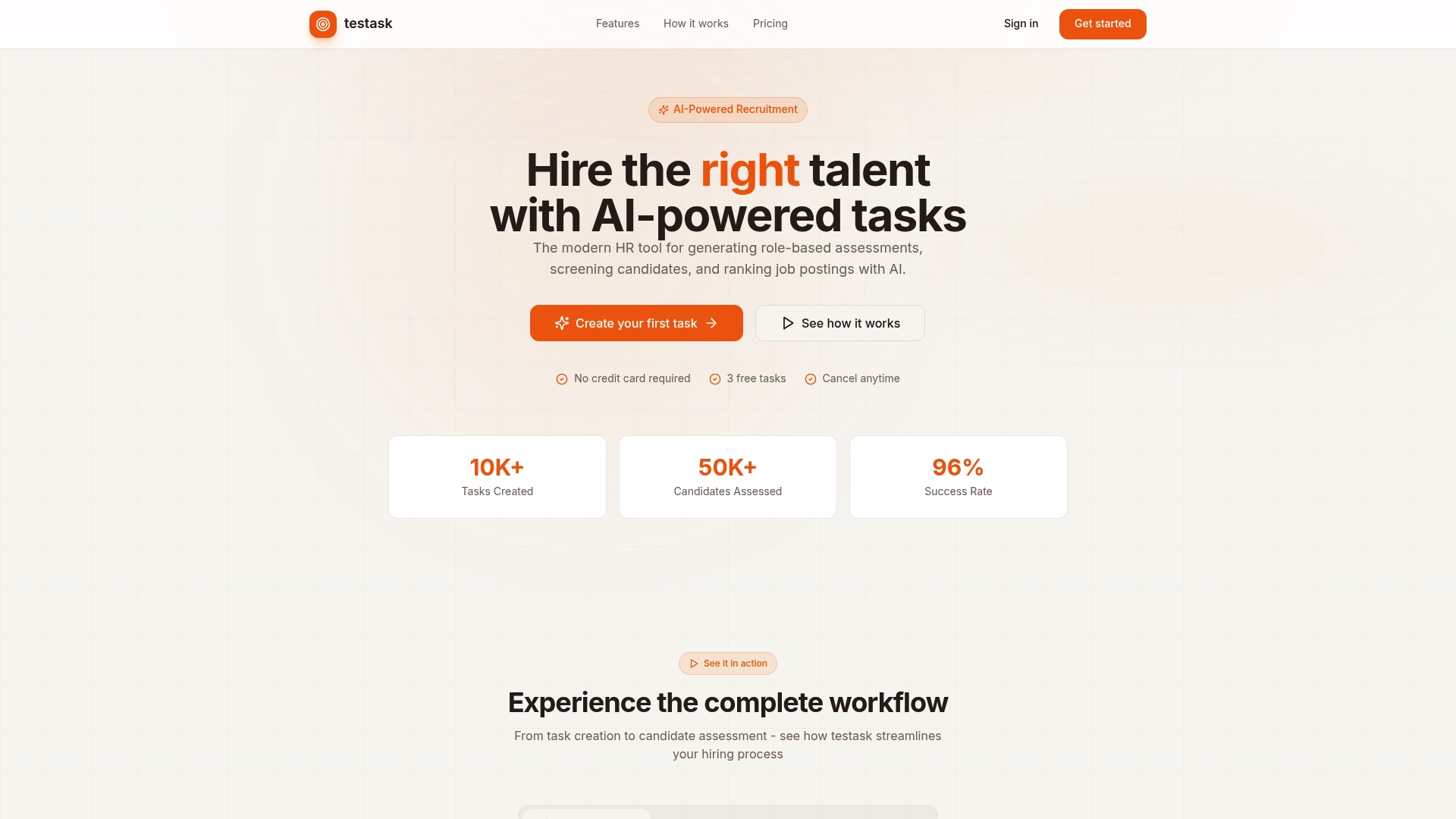
With Testask, you can generate tailored test tasks for any role, distribute them directly to candidates, and collect structured submissions in one place. AI-assisted analysis flags key patterns in candidate responses, and collaborative review tools let multiple raters score and comment on the same submission without version-control headaches. For a single-role pilot combining an SJT with a work sample, Testask gives you the infrastructure to run both, calibrate your rubric, and produce a scored output your hiring team can act on immediately.
Ready to run your first pilot? Start with Testask and build your first test task in under 30 minutes.
Useful sources and further reading
The sources below back the claims in this article and offer deeper guidance for HR teams building or refining their assessment programs.
- ASTQB Soft Skills Sample Exam Questions: Scenario-based multiple-choice items with fixed scoring thresholds. Useful as a model for converting scenario prompts into objective rubrics (referenced in the examples and design sections).
- AssessmentDay SJT Questions: Practical SJT item examples with ranking and multiple-choice formats. Supports the SJT method description and example prompts.
- Pigment: Soft Skills Assessment Guide: Covers method selection by decision type (selection vs. development) and the case for triangulation. Referenced in the methods overview and best-practices sections.
- Skillpanel: Soft Skill Assessment Tools Complete Guide: Covers structured behavioral interviews, SJTs, and assessment center logistics including time and resource expectations. Referenced throughout the methods and design sections.
- Mindtools: Soft Skills Assessment: Guidance on triangulating self-report, observer ratings, and behavioral evidence. Supports the combining methods and bias-reduction sections.
- ThriveSparrow: Soft Skills Assessment Questionnaire: Mixed-format questionnaire templates covering communication, teamwork, adaptability, problem-solving, and emotional intelligence. Supports the examples and questionnaire design sections.
- BizLibrary: Soft Skills Assessment: Definition and output framework for structured soft-skill assessments. Referenced in the overview section.
- PMC / MSSAT Validation Study: Peer-reviewed development and validation of the Multiple Soft Skills Assessment Tool, covering interpersonal skills, communication, decision-making, and integrity. Supports the psychometric instruments section.
Recommended
- Examples of Assessment Tools for HR Teams in 2026 | Testask Blog | testask
- Skills Assessment Strategies for HR Teams in 2026 | Testask Blog | testask
- Examples of Interview Assessments for HR Pros in 2026 | Testask Blog | testask
- Interview Evaluation Tips for HR Pros: 2026 Guide | Testask Blog | testask