How to Assess Job Skills for Career Growth in 2026
How to Assess Job Skills for Career Growth in 2026

Job skills assessment is the structured process of measuring a person’s current abilities against the competencies required for a specific role or career target. Knowing how to assess job skills accurately separates professionals who advance quickly from those who stall. The most reliable approaches combine structured interviews, work samples, and peer feedback rather than relying on any single method. Research consistently shows that behavioral misalignment, not technical gaps, drives most career and hiring failures. This guide gives you a practical, evidence-based framework to evaluate job competencies and turn the results into real career momentum.
What are the most effective methods to assess your job skills?
Structured, evidence-based methods are the gold standard for measuring job competencies. Each method captures a different dimension of skill, so using them together gives you the clearest picture.
Structured Interviews
Structured interviews scored against predefined rubrics carry a predictive validity of r=0.42, making them the highest single predictor of performance among common assessment methods. That number means structured interviews are nearly twice as predictive as unstructured conversations. When you prepare for or conduct a structured interview, every question maps to a specific competency, and every answer is scored consistently.

Work Samples and Practical Tasks
Work samples are consistently cited as the most reliable predictor of job performance because they test actual output rather than proxies like credentials or self-reported experience. A data analyst completing a real dataset challenge, or a copywriter drafting a sample article, produces direct evidence of ability. Work samples have high face validity, meaning both assessors and candidates recognize them as fair and relevant.
Self-Assessment
Self-assessment is a useful starting point, but it carries a critical limitation. Self-rated skills lack objective calibration, and individuals frequently overestimate their abilities without manager or peer input. Treat self-assessment as a conversation starter, not a final verdict.
Peer Reviews and Manager Observations
Peer reviews and direct manager observations add behavioral context that no test can replicate. They capture how a person applies skills under real conditions, handles ambiguity, and collaborates with others. These inputs are especially valuable for evaluating soft skills like communication, leadership, and problem-solving.
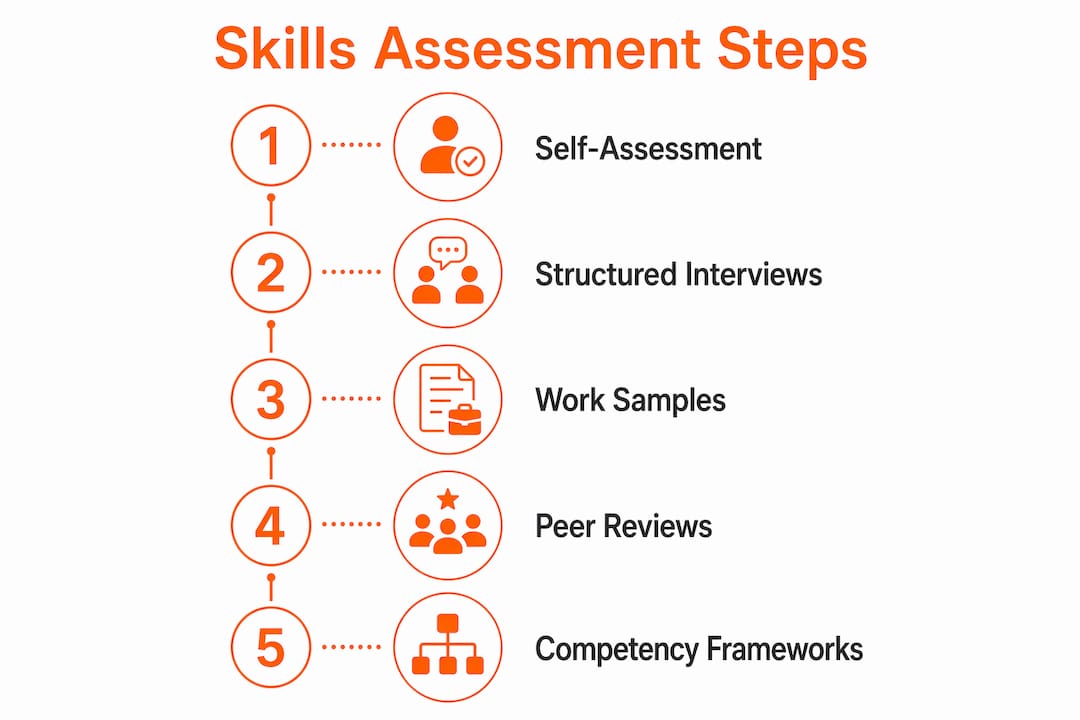
Competency Frameworks
A competency framework defines what “good” looks like at each proficiency level for every key skill. Without one, assessments produce subjective impressions rather than comparable data. Frameworks from organizations like the Society for Human Resource Management (SHRM) or role-specific models built internally give you a consistent measuring stick.
Pro Tip: Combine at least three methods when evaluating your skills. Triangulating data from self-assessments, manager ratings, and work samples yields the most reliable picture of actual ability.
How to implement a skills assessment step by step
A structured process prevents the common mistake of assessing skills in isolation from your actual career goals. Follow these steps to build an assessment that produces results you can act on.
-
Define role-specific competencies. Start by identifying the 3–5 skills most critical to your target role or current position. Linking competencies to business goals saves time and increases the impact of every development activity you pursue afterward.
-
Gather evidence from multiple sources. Collect data through self-assessment, a structured interview or role-play exercise, at least one work sample, and feedback from a manager or peer. Each source fills a blind spot the others leave open.
-
Map your current proficiency against required levels. Use a skills matrix to compare where you are now against where the role demands you to be. The table below shows a simple format.
| Competency | Required Level | Current Level | Gap |
|---|---|---|---|
| Data Analysis | Advanced | Intermediate | 1 level |
| Stakeholder Communication | Advanced | Advanced | None |
| Project Management | Intermediate | Basic | 2 levels |
| Technical Writing | Intermediate | Intermediate | None |
-
Identify and prioritize skill gaps. Not every gap deserves equal attention. Prioritize gaps in skills that directly affect your performance rating, promotion eligibility, or job search success. A skills gap analysis evaluates current abilities against future needs over a 12–24 month horizon, which is the right timeframe for career planning.
-
Build a development plan. Assign a specific action to each priority gap: a course, a stretch assignment, a coaching relationship, or a new project. Set a 90-day review date to reassess progress and adjust.
Pro Tip: When building your skills matrix, ask your manager or a trusted mentor to rate your proficiency independently before you share your self-ratings. The gap between the two scores is often your most useful data point.
What are the most common pitfalls in skills evaluation?
Even well-intentioned assessments fail when they fall into predictable traps. Recognizing these errors before you start saves you from drawing the wrong conclusions about your own abilities.
-
Overreliance on self-assessment. Self-assessments alone are unreliable because people consistently overestimate their abilities without external calibration. Use them to open a conversation, then validate with objective data.
-
Assessment bloat. Tracking too many skills at once dilutes focus and produces a list too long to act on. Focusing on 3–5 high-leverage competencies aligned with your goals is more effective than cataloging every skill you possess.
-
Ignoring tacit knowledge. Tacit knowledge covers the unspoken judgment calls that distinguish excellent performers from average ones. Generic checklists miss it entirely. Only subject-matter expert input, such as a senior colleague’s structured observation, can surface this dimension of skill.
-
Skipping behavioral competencies. 89% of bad hires fail due to behavioral and competency misalignment rather than technical inability. Assessing only hard skills leaves the most predictive dimension of performance unmeasured.
-
Failing to standardize the process. Standardized administration of skill assessments ensures fairness and improves the reliability of comparisons over time. Inconsistent scoring criteria make it impossible to track genuine progress.
“Role-specific, evidence-based assessments most effectively inform actionable development plans.” — Mindtools Workplace Skills Assessment
How do assessment results improve your career prospects?
Assessment results are only valuable when you convert them into decisions. Here is how to translate findings into career advancement.
-
Build a prioritized development plan. Focus your first 90 days on the one or two gaps with the highest impact on your next career move. Spreading effort across ten skills simultaneously produces marginal gains in all of them and meaningful progress in none.
-
Use assessments as evidence in job applications. Work samples and structured assessment results give you concrete proof of ability to present in interviews. Saying “I completed a project management certification and led a cross-functional team” is far more credible than claiming general competence.
-
Seek targeted mentorship. Once you know your specific gaps, you can approach mentors with precise questions rather than vague requests for career advice. Mentors respond better to “I need to develop executive communication skills for a director-level role” than to “Can you help me grow?”
-
Reassess on a regular cycle. Skills decay and role requirements shift. A 90-day reassessment cycle keeps your development plan current and gives you measurable evidence of progress to discuss in performance reviews.
-
Use AI-powered platforms for ongoing tracking. AI-driven assessment tools generate objective data on skill levels over time, removing the subjectivity that makes self-assessment unreliable. Platforms built for evaluating behavioral competencies and technical skills provide the structured evidence base that career development requires.
Key takeaways
The most effective way to measure job skills is to combine structured interviews, work samples, and peer feedback into a single evidence-based process tied directly to role-specific competencies.
| Point | Details |
|---|---|
| Combine multiple methods | Use structured interviews, work samples, and peer input together to reduce bias and improve accuracy. |
| Prioritize 3–5 competencies | Focus on high-leverage skills linked to your goals rather than tracking every skill you have. |
| Treat self-assessment as a starting point | Validate self-ratings with manager or peer input before drawing conclusions about your ability. |
| Standardize your process | Consistent scoring criteria make progress measurable and comparisons fair over time. |
| Convert results into a plan | Assign specific development actions to each priority gap and review progress every 90 days. |
Why most professionals are assessing their skills wrong
Most professionals treat skills assessment as a one-time event tied to a performance review or a job search. That framing is the core mistake. Assessment is only useful when it runs continuously and feeds directly into decisions about where you spend your development time.
The other pattern I see constantly is an overconfidence in self-assessment. People rate themselves highly on skills they use frequently, not necessarily skills they perform well. The competency-based approach fixes this by shifting focus to measurable behaviors rather than credentials or self-perception. When you ask “what evidence do I have that I perform this skill at the required level?” the answer is usually more honest than a 1–5 self-rating.
The professionals who advance fastest are not the ones with the longest skill lists. They are the ones who identify two or three high-leverage gaps, close them with focused effort, and document the results. That combination of honest assessment and disciplined follow-through is what actually moves careers forward.
One more thing worth saying directly: do not wait for your employer to assess your skills for you. The employment assessment best practices that produce the best outcomes are ones you initiate yourself, using structured methods, external feedback, and real work output as your evidence base.
— Pavel
See your skills clearly with Testask
Knowing your skill gaps is only half the work. The other half is generating objective evidence that proves your abilities to yourself and to hiring managers.
Testask is an AI-powered recruitment assessment platform that creates tailored test tasks, evaluates submissions with AI-assisted analysis, and produces structured evidence of skill levels. For job seekers, that means you can complete real work-sample assessments and walk into interviews with concrete proof of your competencies. For HR teams, it means faster, fairer screening built on actual performance data rather than resume claims. If you are ready to move beyond self-ratings and build a credible skills profile, explore Testask and see how structured, AI-driven assessment changes the picture.
FAQ
What is job skills assessment?
Job skills assessment is the structured process of measuring a person’s current abilities against the competencies required for a specific role. Reliable assessments combine structured interviews, work samples, and peer feedback rather than relying on a single method.
Which assessment method has the highest predictive validity?
Structured interviews scored against predefined rubrics have a predictive validity of r=0.42, making them the strongest single predictor of job performance among common methods. Work samples are also highly reliable because they test actual output rather than proxies.
How often should you reassess your job skills?
A 90-day reassessment cycle keeps your development plan current and gives you measurable progress data for performance reviews and job applications. Skills decay and role requirements shift, so annual reviews are too infrequent for meaningful career planning.
Why are self-assessments unreliable on their own?
Individuals consistently overestimate their abilities without external calibration, making self-assessment an unreliable standalone measure. Use self-ratings to start a conversation, then validate them with manager observations, peer input, or work sample results.
How many skills should you focus on at once?
Focus on 3–5 high-leverage competencies directly linked to your career goals. Tracking more than five skills simultaneously produces a list too broad to act on and dilutes the development effort that actually drives progress.
Recommended
- Examples of Interview Assessments for HR Pros in 2026 | Testask Blog | testask
- Best Hiring Practices 2026: What HR Teams Need to Know | Testask Blog | testask
- How to Assess Candidates: A 2026 Hiring Guide | Testask Blog | testask
- Recruitment Trends in 2026: What HR Leaders Must Know | Testask Blog | testask