A Backend Developer Assignment That Actually Passes Review
A Backend Developer Assignment That Actually Passes Review

The minimal solution that clears most backend take-home reviews is a REST API with full CRUD, working authentication, a handful of real tests, and a README that lets someone run your code in under five minutes. Skip the extra layers, microservices, and framework experiments until that core exists and works.
Two things to do right now:
- Pick one assignment. Choose from the six briefs below, fork or create a starter repo in Node.js/Express, Python/Flask or Django, or Java/Spring Boot, and scope it to 3 to 8 hours of work.
- Build the deliverables before the bonuses. Get your GitHub repository, README, run script, and tests in place before you touch caching, Docker, or JWT-based auth extras.
Those two moves alone put you ahead of most candidates. Coursera’s overview of back-end development confirms what most job postings already assume: employers expect fluency in one of these three stacks, working knowledge of a relational or document database, and the ability to explain your own design choices. A polished submission with a clean scope beats an ambitious one that doesn’t run.
Key Takeaways
A backend developer assignment passes most reviews when it pairs a correctly working REST API with tests, clear documentation, and a run script a stranger can execute in minutes.
| Point | Details |
|---|---|
| Build the MVP first | Ship CRUD endpoints, basic auth, and passing tests before adding caching or Docker. |
| Tests and docs carry the most weight | Correctness, tests, and documentation are the most important elements in most scoring rubrics. |
| Use the submission checklist | Confirm your README, run script, and test command work on a fresh clone before submitting. |
| Explain trade-offs, don’t hide them | Name what you skipped and why, both in your README and in the follow-up interview. |
| Testask standardizes grading for teams | Recruiters using Testask can template assignments, auto-run tests, and score every candidate on the same rubric. |
Table of Contents
- Six Backend Developer Assignment Templates You Can Start Today
- How Do Recruiters Actually Score These Submissions?
- What Should Your Final Submission Include?
- Common Mistakes That Sink an Otherwise Good Assignment
- Setting Up Your Repo: Folder Structure and Starter Commands
- How Do You Explain Your Solution in the Follow-Up Interview?
- How Testask Fits Into Designing and Grading These Assignments
- What Hiring Managers Actually Notice First
- Ready to Standardize How You Grade Backend Assignments?
- Where to Find Real Assignment Examples and Rubrics
- Sources
Six Backend Developer Assignment Templates You Can Start Today
Each of these mirrors real take-homes companies actually send. Build the MVP first. Add bonuses only if time allows.
1. REST user profile CRUD API
Build create, read, update, and delete endpoints for a user profile resource with basic validation. Minimal schema: a users table with id, name, email, and timestamps. Deliverables: repo, README, at least five unit tests, and a run script. Suggested stack: Node/Express or Flask. Time estimate: 3 to 4 hours. Bonus: add JWT authentication and pagination on the list endpoint.
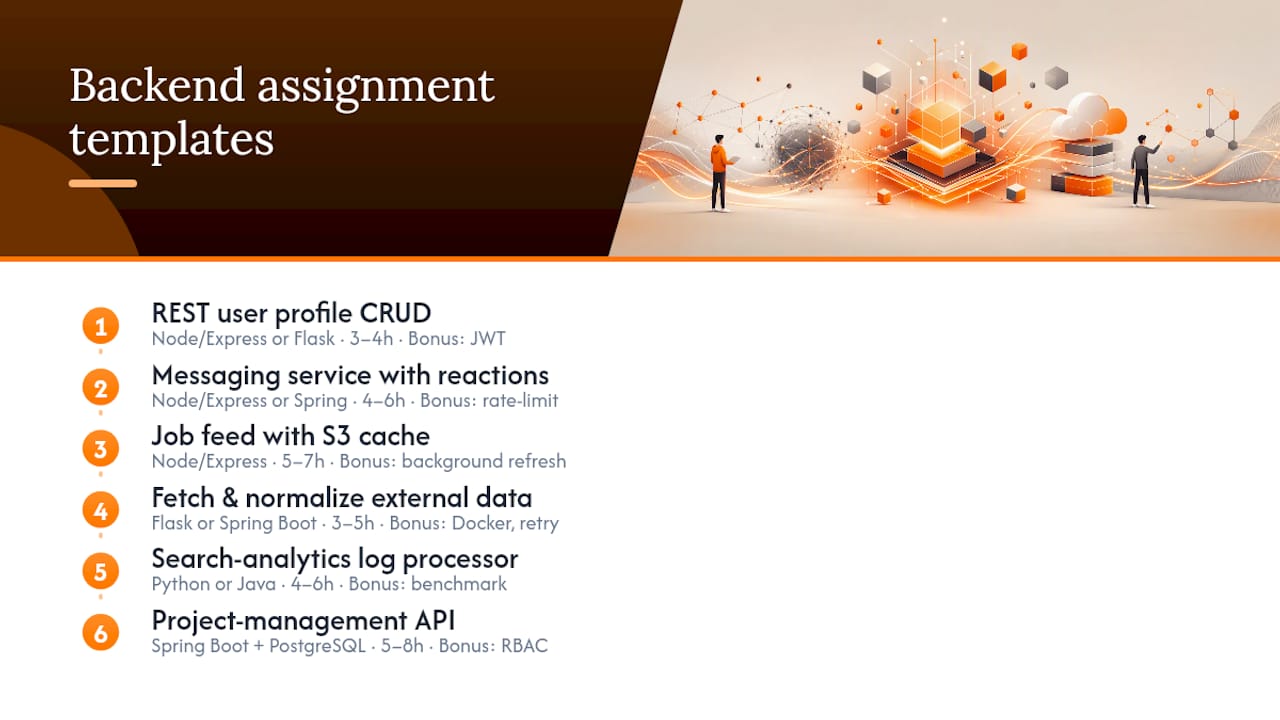
2. Messaging service with reactions Implement a messages endpoint plus a reactions feature (add/remove emoji reactions to a message), along with pagination and input validation. This mirrors a real production-style assignment where reviewers check schema design and edge-case handling, as seen in GetStream’s backend homework assignment. Suggested stack: Node/Express or Spring Boot. Time estimate: 4 to 6 hours. Bonus: rate-limit reaction endpoints and add a background job to aggregate reaction counts.
3. Job feed with S3-backed cache
Build a /feed endpoint that serves paginated job postings, backed by a caching layer to reduce database load under traffic. A real-world version of this test requires NodeJS, serverless components, and an S3-backed cache strategy, according to this backend developer candidate assessment. Suggested stack: Node/Express. Time estimate: 5 to 7 hours. Bonus: add a Lambda-style background refresh job and cache invalidation logic.
4. Microservice that fetches and normalizes external data Pull data from a public API (weather, currency exchange, or similar), normalize the response into your own schema, and expose it through your own endpoint. Minimal schema: a cache table storing the last fetched payload with a timestamp. Suggested stack: Flask or Spring Boot. Time estimate: 3 to 5 hours. Bonus: containerize with Docker and add a retry policy for failed upstream calls.
5. Search-analytics log processor Process a large log file offline, count the most frequent search queries, and write a short one-page system-design summary explaining how your approach would scale to millions of rows. Algolia’s technical assignment uses exactly this format, pairing an algorithm challenge with a scalability writeup. Suggested stack: Python or Java. Time estimate: 4 to 6 hours. Bonus: benchmark two algorithmic approaches and document the trade-off.
6. Small project-management API Model projects, tasks, and users with basic relationships (a project has many tasks, a task belongs to one user). Minimal schema: three tables with foreign keys. Deliverables match the standard checklist below. Suggested stack: Spring Boot with PostgreSQL. Time estimate: 5 to 8 hours. Bonus: add role-based access control and Swagger/OpenAPI documentation.
How Do Recruiters Actually Score These Submissions?
Reviewers rarely grade on ambition. They grade on whether the thing runs, whether it does what was asked, and whether you can explain it clearly afterward. Most rubrics break down close to this:
A submission with correct core features, a handful of passing tests, and a README that lets a stranger run the app locally clears the bar in most reviews. Extras like Docker, background jobs, or Swagger documentation move you up the ranking, but they don’t rescue a broken core.
A recruiter who can’t run your project in five minutes usually stops reading right there, according to guidance on what interviewers actually look for in take-home reviews.
What Should Your Final Submission Include?
Paste this into your own checklist before you send anything to a recruiter:
- Public GitHub repository link, with the branch name clearly stated if you’re not submitting from
main. - README with a quick-start section, a short design-notes section, and a list of known limitations.
- Run scripts or a
docker-compose.ymlfile so the reviewer doesn’t have to guess dependencies. - A
.env.examplefile showing required environment variables without exposing real secrets. - Sample requests (curl commands or a Postman collection) that demonstrate each endpoint working.
- A single command to run your test suite, plus a sentence on what’s covered and what isn’t.
- A deployed demo URL if you have one, or explicit local demo instructions if you don’t.
- Clean, incremental commit history that shows how the solution evolved, not one giant commit.
Your README’s first screen should answer three questions in order: what this project does, how to run it in three commands or fewer, and where the tests live. Reviewers scan before they read, so front-load that information rather than burying it under a wall of architecture diagrams.
Files reviewers specifically look for include a Dockerfile or docker-compose.yml at the root, an openapi.yaml or Swagger config if you’re documenting your API, and a dedicated tests/ folder rather than test files scattered across the codebase. A runnable sample like a Postman collection or Swagger UI removes friction for the person grading you and often shows up directly in higher scores.
Common Mistakes That Sink an Otherwise Good Assignment
Most rejected submissions don’t fail because the candidate lacked skill. They fail because of avoidable gaps that a stop-criteria checklist would have caught.
- Over-engineering the solution. Adding a message queue, three microservices, and a caching layer to a CRUD assignment signals poor judgment about scope, not seniority. Fix: build the smallest thing that satisfies the brief, then note what you’d add with more time.
- Missing or thin README. A repo with no setup instructions forces the reviewer to guess, and most won’t bother. Fix: write the README first, before you write the second endpoint.
- Hidden environment assumptions. Hardcoded database credentials or an assumption that the reviewer has a specific local tool installed breaks the run on the first try. Fix: use environment variables with a documented example file.
- Never actually running it fresh. Code that works on your machine because of leftover state fails the moment someone clones it cold. Fix: delete your local clone and rebuild from a fresh
git clonebefore you submit. - Weak or missing tests. Zero tests, or tests that only check the happy path, undercut confidence in correctness. Fix: cover at least one success case and one failure case per endpoint.
Before adding a single bonus feature, confirm four things are done: core endpoints work end to end, authentication (if required) is functional, tests pass on a clean clone, and the README is complete. Only then does caching, background job processing, or containerization earn its place.
Pro Tip: Add a short “Trade-offs” section to your README listing two or three things you deliberately skipped and why. Reviewers read this as evidence of judgment, not laziness, and it gives you a built-in talking point for the follow-up call.
Setting Up Your Repo: Folder Structure and Starter Commands
A predictable folder structure tells a reviewer you’ve done this before. Here’s a minimal skeleton for each of the three most common stacks.
Node/Express
src/
  routes/
  controllers/
  models/
tests/
docker/
.env.example
README.md
Commands: npm install, npm test, docker compose up --build.
Python/Flask
app/
  routes.py
  models.py
  config.py
tests/
migrations/
.env.example
README.md
Commands: python -m venv venv, pip install -r requirements.txt, pytest, docker compose up --build.
Java/Spring Boot
src/main/java/
src/test/java/
src/main/resources/
Dockerfile
README.md
Commands: mvn clean install, mvn test, docker compose up --build.
| Folder/file | Purpose |
|---|---|
src/ or app/ |
Core application logic: routes, controllers, models |
tests/ |
Unit and integration tests reviewers run to verify correctness |
docker/ or Dockerfile |
Containerization setup for consistent local runs |
migrations/ |
Database schema changes, useful for PostgreSQL or relational setups |
.env.example |
Documents required environment variables without exposing secrets |
README.md |
Setup instructions, design notes, and known limitations |
A docker-compose.yml that spins up your app plus a PostgreSQL or MongoDB container in one command removes the single biggest source of reviewer friction: getting your dependencies running locally.
How Do You Explain Your Solution in the Follow-Up Interview?
A strong submission can still fall apart in the review call if you can’t walk through it clearly. Structure your explanation in this order:
- Restate the problem in one or two sentences, showing you understood the brief before you started coding.
- Walk through your design decisions, especially anything non-obvious, like why you chose a particular database schema or endpoint structure.
- Explain your security and testing choices, even briefly: what you validated, what you’d harden further with more time.
- Name what you’d add next, and why you didn’t include it in the submission window.
For the live demo itself, keep it to three steps: show the happy path working end to end, trigger one error case to show your validation actually catches bad input, and point to where your tests live and run them live if you can. A phrase like “I chose to skip rate limiting here because the brief didn’t call for high traffic, but here’s how I’d add it” signals production thinking without pretending you built more than you did.
If a reviewer asks about a missing feature, don’t apologize repeatedly. State plainly that it was a scope decision given the time window, and describe how you’d implement it. That answer reads as confidence, not as an excuse.
How Testask Fits Into Designing and Grading These Assignments
Everything above describes what a strong submission looks like from the candidate’s side. On the hiring side, building and grading assignments like these manually is slow, and inconsistent grading between reviewers is a common source of unfair rejections. Testask, an AI-powered recruitment assessment platform, addresses both problems directly.
- Templated tasks let hiring teams start from a structure similar to the six briefs above instead of writing a new assignment from scratch each time.
- Automated scoring rubrics apply the same weighted criteria (core features, tests, documentation, architecture) to every candidate, removing reviewer-to-reviewer inconsistency.
- Integrated code fetch and test runners pull a candidate’s GitHub repository and execute the test suite automatically, verifying the “does it actually run” question before a human ever opens the code.
- Reviewer collaboration tools let multiple hiring managers score the same submission and compare notes before a decision.
- Reporting surfaces which candidates cleared which rubric thresholds, so shortlisting takes minutes instead of days.
Take the messaging service assignment as an example. A hiring team using Testask could confirm the reactions endpoint and pagination logic through the automated test runner, verify the README against a documentation checklist, and check for a working run script or Docker Compose file, all before a human reviewer spends time on it. For recruiters, that means faster screening and standardized grading across every candidate. For candidates, it means clearer instructions up front and scoring that reflects the actual rubric rather than one reviewer’s mood that day.
What Hiring Managers Actually Notice First
The gap between a submission that gets a callback and one that doesn’t is rarely about raw skill. It’s about whether the candidate treated the assignment like a real deliverable instead of a coding exercise.
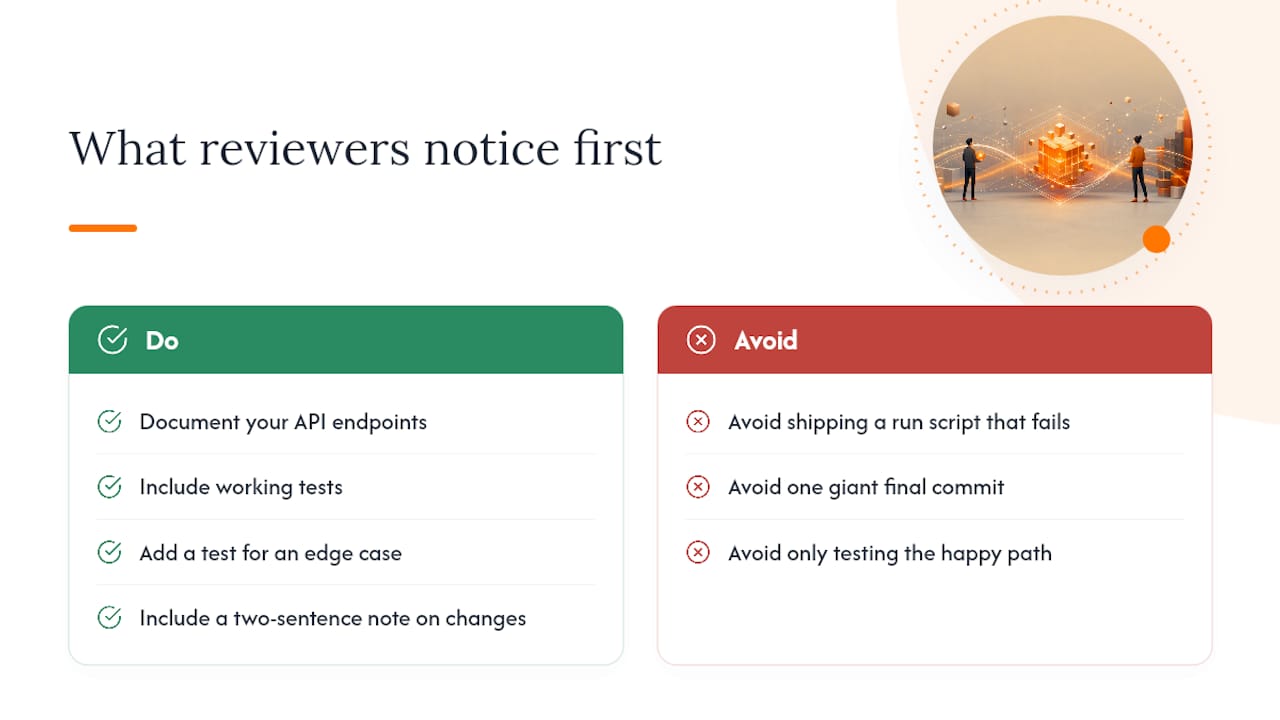
Do document your API endpoints and include working tests. Don’t ship a run script that fails on a clean clone, because that’s often the first thing a reviewer tries and the fastest way to end up in the rejection pile regardless of how good the code underneath actually is.
Small decisions carry outsized weight. A one-paragraph architecture note explaining why you chose a particular database schema tells me more about how someone thinks than three extra endpoints ever could. A single test that deliberately checks an edge case, like an empty input or a duplicate entry, shows more judgment than ten tests that only check the happy path.
If I could add one item to every submission checklist, it would be this: a two-sentence note on what you’d do differently with more time. That line alone tells me whether a candidate understands their own trade-offs or just ran out of time and hoped nobody would ask.
Recruiters value readable, incremental commit histories more than candidates expect. A repo with one giant “final commit” reads as either rushed or reconstructed after the fact. A dozen small, logically ordered commits reads as someone who actually works this way day to day, which is exactly what the assignment is trying to measure in the first place.
Ready to Standardize How You Grade Backend Assignments?
If you’re the one designing and grading assignments like these instead of submitting them, manual review doesn’t scale past a handful of candidates a week. Reading each README, cloning each repo, and re-running tests by hand eats hours that most hiring teams don’t have, especially when three reviewers each grade a little differently.
Testask replaces that manual grind with a templated backend take-home you build once, an automated repo and test collector, and a standardized rubric that scores every candidate the same way. Instead of a reviewer spending 45 minutes per submission checking whether the run script even works, Testask’s integrated test runner confirms it automatically and flags what’s left for human judgment: architecture, documentation quality, and interview readiness. Explore Testask’s technical assessment process to see how the scoring rubric maps to real backend briefs, then visit the Testask landing page to start a trial or request a demo for your next hiring round.
Where to Find Real Assignment Examples and Rubrics
Studying working examples beats reimplementing every assignment type from scratch. These are worth forking and adapting rather than treating as templates to copy line for line.
- Backend take-home assignment shows a real small-scale social app brief with defined tables and a focused endpoint list, useful as a reference for scoping your own CRUD project.
- Backend Developer Candidate Assessment demonstrates a job-feed assignment with serverless components and caching, a solid model if you want to practice the S3-backed cache brief above.
- algolia/backend-technical-assignment pairs a data-processing challenge with a short system-design writeup, good practice for the log-processor assignment.
- The Coursera capstone project walks through containerizing and deploying multiple microservices, useful if you want to push past the MVP into a portfolio-grade project.
- For a broader look at how technical assessments are scored on the hiring side, Testask’s guide on candidate scoring methods breaks down rubric design in more depth.
- Developer tooling guides like this API response testing toolkit cover how to add Swagger/OpenAPI documentation and automated API tests, both strong additions to any of the six briefs above.
Fork one of these, strip it down to the scope you have time for, and build from there instead of starting with a blank repository.
Sources
- Take-home assignments: what interviewers actually look for
- What Is a Back-End Developer? | Coursera
- Backend Developer Candidate Assessment
- GetStream backend homework assignment (package mirror)
Recommended
- How to Automate Candidate Review: 2026 HR Guide | Testask Blog | testask
- How to Build a Hiring Task That Actually Works | Testask Blog | testask
- Candidate Feedback Process: Best Practices for 2026 | Testask Blog | testask
- Talent reviews: frameworks, pitfalls, and winning strategies | Testask Blog | testask