How to Build a Hiring Task That Actually Works
How to Build a Hiring Task That Actually Works

A hiring task is a focused, role-specific assignment designed to evaluate candidate skills and job fit beyond what resumes and interviews can reveal. When built correctly, these assessments give HR professionals and hiring managers a direct window into how candidates think, communicate, and perform under real conditions. Knowing how to build a hiring task that is both rigorous and respectful is one of the highest-leverage decisions in your recruitment process. Platforms like Testask and structured frameworks from resources like GitHub’s skills-hr project have made this more accessible than ever, but the fundamentals still require deliberate design.
How to build a hiring task: the foundational prerequisites
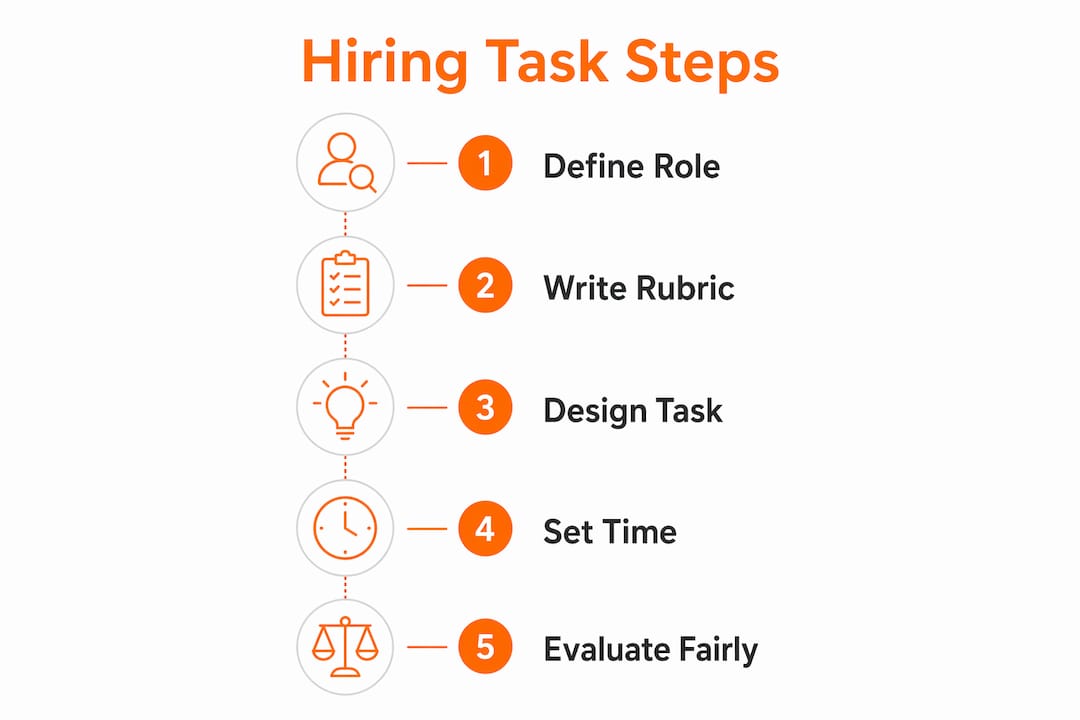
Before you write a single instruction, you need clarity on what the task is actually measuring. A hiring task built without defined success criteria is just busywork for candidates and noise for reviewers.
Start with these foundational elements:
- Define the role outcome, not just the job title. What does success look like in the first 90 days? A content marketer who drives organic traffic needs a different task than one who manages social campaigns. AI-driven tools help overcome vague requirements and inject consistency into role definitions before you design any assessment.
- Identify the two or three skills the task must assess. Limit scope. A single task cannot measure everything. Choose the skills that differentiate strong performers from average ones in this specific role.
- Align the task with your job description. If your job description emphasizes data analysis but your task tests presentation skills, you are measuring the wrong thing. Misalignment wastes candidate time and produces unreliable signals.
- Set a firm time boundary. Industry best practices cap hiring tasks at one to three hours of candidate effort. Anything longer requires compensation to remain ethical and competitive.
- Decide upfront whether to pay. Unpaid tasks over one hour are widely viewed as exploitative and actively deter top candidates who have options. Paying for longer tasks signals respect and attracts stronger applicants.
Pro Tip: Write the scoring rubric before you finalize the task instructions. If you cannot define what a “great” submission looks like, the task is not specific enough yet.
Candidate experience starts at the task brief. Candidates who receive vague instructions or no context about how their work will be evaluated are more likely to disengage or submit lower-quality work. Providing clear instructions about purpose, expected time, and evaluation criteria builds trust and improves the quality of submissions you receive.

How do you design hiring tasks tailored to different roles?
Task design is where most hiring managers make their biggest mistakes. They either make tasks too generic (a writing sample that any candidate could complete without role-specific knowledge) or too demanding (a full project that resembles unpaid consulting work).
Here is a step-by-step process for designing role-specific hiring tasks:
- Match the task format to the role’s core output. Developers get coding exercises or debugging challenges. Consultants get case studies with ambiguous data. Designers get a brief to produce one deliverable, not a full brand identity. Marketers get a channel-specific strategy memo, not a 20-page marketing plan.
- Use real-world scenarios with fictional details. Ground the task in the actual problems your team faces, but replace client names, proprietary data, and live project details with fictional equivalents. Tasks disconnected from live client work avoid ethical pitfalls and keep candidates comfortable.
- Define measurable deliverables. “Write a blog post” is not a deliverable. “Write a 600-word blog post targeting the keyword ‘remote onboarding’ for an HR software audience, with a clear CTA” is a deliverable. Specificity makes scoring consistent and fair.
- Specify the format and constraints. Tell candidates exactly what to submit: a Google Doc, a GitHub repo, a PDF, a Loom video walkthrough. Ambiguity in format creates unnecessary friction and penalizes candidates who overthink logistics.
- Include one open-ended reflection question. Ask candidates to explain one decision they made and what they would do differently with more time. This reveals self-awareness and communication skills that the deliverable alone cannot show.
The table below shows how task types map to common roles:
| Role | Recommended task type | Time limit |
|---|---|---|
| Software engineer | Debugging or feature build exercise | 90 minutes |
| Content marketer | SEO-focused article draft with brief | 60 minutes |
| Product manager | Prioritization memo with trade-off rationale | 90 minutes |
| UX designer | Annotated wireframe for a defined problem | 2 hours |
| Sales development rep | Cold outreach sequence with rationale | 45 minutes |
What best practices and evaluation methods ensure fair assessment?
Designing the task is only half the work. How you evaluate submissions determines whether the process is fair, consistent, and legally defensible.
The most reliable evaluation method combines structured scoring rubrics with multiple reviewers. Using the same scoring rubric across all candidates is one of the highest-impact changes an HR team can make to reduce bias. A simple 1-to-5 scale applied to criteria like clarity, relevance, technical accuracy, and communication gives reviewers a shared language and makes comparison across candidates objective.
Key best practices for evaluation:
- Share the rubric with candidates before they start. Transparency about evaluation criteria does not make the task easier. It makes the process fairer and signals that your organization values clear communication.
- Assign at least two independent reviewers. Multi-reviewer scoring using rubrics lowers individual bias and improves the accuracy of candidate fit assessment. Reviewers should score independently before discussing.
- Separate the submission from the candidate’s identity during initial review. Anonymizing submissions before scoring reduces the influence of name-based or demographic bias on evaluations.
- Combine the task with a structured interview. A task submission and a structured interview kit together produce a more complete picture than either method alone. Use the interview to probe decisions the candidate made in their submission.
Pro Tip: Score all submissions within 48 hours of receipt. Delayed scoring introduces memory bias, where reviewers unconsciously compare later submissions to earlier ones rather than to the rubric.
On the question of paid versus unpaid tasks: offering paid, well-scoped tasks improves your employer brand and hiring outcomes. The cost of paying 10 finalists a modest honorarium is trivial compared to the cost of a bad hire or a damaged reputation on Glassdoor.
How to integrate hiring tasks into a fair, human-centered process
A hiring task should never be the first thing a candidate encounters. Placed too early, it filters out qualified candidates who are not yet invested enough to complete it. Placed too late, it wastes time for both parties.
The right integration sequence looks like this:
- Screen resumes and portfolios first. Only advance candidates who meet the baseline qualifications. Sending a task to every applicant is inefficient and disrespectful of candidate time.
- Use a brief screening call before the task. A 20-minute conversation confirms mutual interest and gives candidates context about the role. Candidates who understand the job are more motivated to complete the task well.
- Send the task with a clear deadline and feedback commitment. Tell candidates when they will hear back and what the next step is. Respecting candidates’ time and effort attracts more diverse and talented applicants. Ghosting after a task submission is one of the fastest ways to damage your employer brand.
- Allow candidates to opt out without penalty. Some strong candidates will decline a task for legitimate reasons, including competing offers or time constraints. Offer an alternative, such as a portfolio walkthrough or a whiteboard session. Alternatives like portfolio discussions reveal candidate thinking and fit without adding task burden.
- Follow the task with a debrief interview. Walk through the submission together. Ask the candidate to explain their reasoning. This conversation often reveals more than the submission itself.
Platforms like Testask and structured hiring frameworks make it practical to standardize this sequence across your entire recruiting team, so every candidate experiences the same fair process regardless of which hiring manager runs the search.
Key takeaways
Effective hiring tasks require clear objectives, role-specific design, structured evaluation, and fair integration into a broader recruitment sequence.
| Point | Details |
|---|---|
| Define before you design | Write success criteria and a scoring rubric before drafting task instructions. |
| Match task to role output | Use coding exercises for engineers, case studies for consultants, and strategy memos for marketers. |
| Pay for tasks over one hour | Unpaid lengthy tasks deter top candidates and damage employer brand. |
| Use multi-reviewer rubrics | Two independent reviewers scoring on a 1-to-5 scale reduces bias and improves accuracy. |
| Integrate tasks selectively | Place tasks after resume screening and a brief call, not at the top of the funnel. |
Why most hiring tasks fail before candidates even start
After working with dozens of hiring teams, the pattern I see most often is not a poorly designed task. It is a task that was designed in isolation, without the candidate’s experience in mind at all.
Hiring managers spend hours crafting the perfect scenario, then send it with a two-sentence email and no rubric, no timeline, and no explanation of how it will be evaluated. Candidates complete it anyway, because they want the job. But the signal you get back is degraded. You are measuring anxiety tolerance and mind-reading ability, not the skills you actually care about.
The teams that get the most out of hiring tasks treat them as a collaborative evaluation tool, not a cold test. They brief candidates thoroughly, answer questions during the task window, and debrief submissions in a live conversation. That approach produces richer data and a better candidate experience simultaneously.
The other mistake I see frequently is scope creep. A task that started as a one-hour exercise grows over time as hiring managers add “just one more question.” Audit your tasks every six months. If the estimated completion time has crept past 90 minutes, cut it back. The best candidates are the ones with the most options. They will not spend three hours on a speculative assignment for a company they have not spoken to yet.
The future of hiring task design is moving toward AI-assisted generation and scoring, with tools like Testask enabling teams to build, distribute, and evaluate tasks at scale without sacrificing consistency. That is the direction worth investing in now.
— Pavel
Build better hiring tasks with Testask
Testask is an AI-powered recruitment assessment platform built specifically for HR teams and hiring managers who need to create, distribute, and evaluate hiring tasks at scale. With Testask, you generate tailored test tasks in minutes, apply structured scoring rubrics across your team, and review candidate submissions with AI-assisted analysis that flags strengths and gaps before your debrief call. The platform supports collaborative hiring reviews so multiple reviewers can score independently and compare results without email chains. If you are ready to replace ad-hoc assessments with a consistent, fair, and efficient process, start with Testask today.
FAQ
What is a hiring task in recruitment?
A hiring task is a role-specific assignment given to candidates during the hiring process to evaluate their practical skills and job fit. It goes beyond resumes and interviews by showing how candidates actually perform work relevant to the position.
How long should a hiring task be?
Best practices recommend limiting hiring tasks to one to three hours of candidate effort. Tasks exceeding one hour should include compensation to respect candidate time and attract top applicants.
Should hiring tasks be paid?
Unpaid tasks requiring more than one hour are widely considered exploitative and deter strong candidates who have competing offers. Paying candidates a modest honorarium for longer tasks improves both the quality of submissions and your employer brand.
How do you evaluate hiring task submissions fairly?
Use a structured scoring rubric with criteria like clarity, technical accuracy, and communication, scored on a 1-to-5 scale by at least two independent reviewers. Anonymizing submissions before scoring further reduces bias.
What are good alternatives to hiring tasks?
Portfolio discussions, whiteboard sessions, and workflow conversations are effective alternatives that reveal candidate thinking and fit without requiring additional task completion. These work especially well for senior roles where candidates have extensive existing work to discuss.
Recommended
- Hiring process best practices: proven steps for better talent | Testask Blog | testask
- Build an effective recruitment checklist for HR success | Testask Blog | testask
- How to improve recruitment: proven steps for better hiring | Testask Blog | testask
- testask - AI-Powered Recruitment Assessment Platform