What Is a Skill Assessment? A Complete Guide
What Is a Skill Assessment? A Complete Guide

A skill assessment is a structured evaluation that measures an individual’s abilities against defined job or role standards. Its core purpose is diagnostic: it answers three questions at once. What can this person do? What does the role require? Where is the gap? Unlike a performance review, which looks backward at outcomes, a skill assessment focuses on current capability to guide future decisions.
Skill assessments apply across a wide range of contexts:
- Hiring and screening: Evaluate candidates before an offer is made
- Onboarding: Identify what new hires already know so training targets real gaps
- Career development: Guide employees toward the right upskilling opportunities
- Education: Measure student readiness or progress against learning standards
Three qualities separate a useful assessment from a box-checking exercise: validity (it measures what it claims to measure), reliability (it produces consistent results across evaluators), and fairness (it gives every participant an equal chance to demonstrate ability). Skill assessments differ from personality tests, which measure traits rather than demonstrated competence, and from aptitude tests, which predict potential rather than current proficiency.
Why skill assessments matter for individuals and organizations

Skill assessments reveal the gap between where someone is and where a role demands they be. That gap is the most useful piece of information a hiring manager or L&D team can act on. Without it, training budgets get spread thin across topics employees already know, and hiring decisions rely on gut feel rather than evidence.

For individuals, demonstrated skill proficiency carries more weight with employers than credentials alone. Knowing exactly where you stand gives you a concrete target for growth and a stronger case to make in interviews.
Key benefits of skills assessment include:
- Hiring accuracy: Objective data replaces subjective impressions, reducing costly mis-hires
- Targeted training: Resources go to actual gaps, not assumed ones
- Reduced turnover: Better role fit from the start means employees stay longer
- Workforce planning: Aggregate gap data shows where the organization needs to build or hire
- Employee confidence: People who understand their own proficiency level set more realistic development goals
Pro Tip: Design your assessment criteria directly from the job’s task requirements, not from a generic competency library. Criteria tied to real work produce data you can act on immediately.
How organizations use skill assessments across the employee lifecycle
Skill assessments span every stage of the employee lifecycle, from the first screening call to long-term succession planning. Each stage has a distinct purpose, and the assessment format should match it.
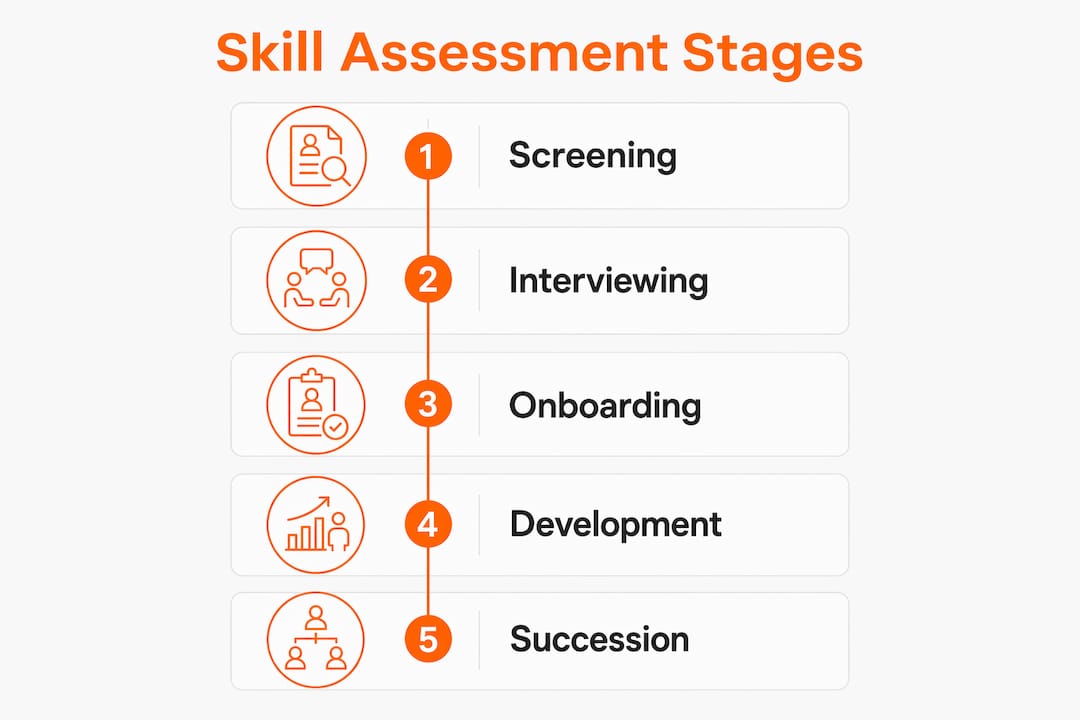
During recruitment, assessments screen candidates against minimum proficiency thresholds before interviews consume time. A coding test, a writing sample, or a structured work task filters the applicant pool on evidence rather than resume claims. Testask, for example, lets hiring teams generate tailored test tasks and review submissions with AI-assisted analysis, cutting screening time without sacrificing accuracy. You can explore how this works in practice with pre-employment testing guidance from the Testask blog.
During onboarding, a baseline assessment tells managers which parts of the standard training plan a new hire can skip and which need reinforcement. That customization shortens time-to-productivity.
For ongoing development, assessments identify which employees are ready for promotion, which need reskilling, and where the organization faces future capability risk. Talent management applications include:
- Identifying high-potential employees for leadership pipelines
- Flagging skill gaps before they affect project delivery
- Supporting performance improvement plans with objective baseline data
- Informing succession decisions with capability evidence rather than tenure
What types of skill assessments are commonly used?
Assessment formats vary widely, and the right choice depends on the role, the stakes, and the resources available. Work samples and simulations are among the most valid methods because they replicate actual job conditions rather than asking candidates to predict their own behavior.
Common methods include work samples, practical tests, 360-degree feedback, behavioral interviews, and self-assessments. The distinction between formative and summative assessments also matters: formative assessments happen during a learning process to catch gaps early, while summative assessments measure final proficiency at the end of a program or hiring stage. Formative assessments help identify remedial needs before a final failure occurs, which is why they are standard in both corporate training and academic settings.
| Assessment type | Format | Typical use case | Key strength |
|---|---|---|---|
| Work sample / task | Candidate completes real job task | Pre-employment screening | High validity; mirrors actual work |
| Practical / skills test | Timed exercise or quiz | Technical role screening | Objective, easy to score |
| Behavioral interview | Structured questions on past behavior | Leadership and soft skills | Reveals real-world application |
| 360-degree feedback | Ratings from peers, managers, reports | Development and promotion | Multi-perspective view |
| Simulation | Role-play or scenario exercise | High-stakes or complex roles | Reflects real constraints |
| Self-assessment | Candidate rates own proficiency | Career planning, onboarding baseline | Fast; useful when paired with verification |
| Language proficiency test | Standardized test (e.g., TOEFL, ACTFL) | Roles requiring specific language skills | Standardized benchmarks |
For high-stakes roles, simulations reflect real constraints far better than multiple-choice tests. For lower-stakes screening, a well-designed quiz may be sufficient and far less costly to administer.
Best practices for designing effective skill assessments
Validity, reliability, fairness, and flexibility are the four principles that separate a defensible assessment from one that creates legal or operational risk. Each principle has a practical implication for how you build and run the evaluation.
Behaviorally anchored rating scales (BARS) are one of the most effective tools for eliminating subjective scoring. A BARS defines specific observable behaviors at each performance level, so two different evaluators looking at the same evidence reach the same score. Without those anchors, scoring drifts based on who is in the room.
Common pitfalls to avoid:
- Setting pass/fail thresholds without reference to actual job performance data
- Using the same assessment format for roles with very different task profiles
- Failing to update assessments when job requirements change
- Relying on self-reported skill levels without any behavioral verification prompt
Design your assessment instruments before you build the training curriculum, not after. Starting with the measurement tool forces clarity about what “good” looks like and prevents the common mistake of teaching content that is never actually tested.
Pro Tip: Tie every assessment item to a specific, observable job task. If you cannot point to a real work situation where the skill is used, cut the item.
Limitations and challenges of skill assessments
No assessment is perfect, and understanding where they fall short helps you use them more honestly. The most common limitation is construct validity: an assessment may measure how well someone performs on the test rather than how well they will perform on the job. A candidate who has practiced coding challenges extensively may outscore a stronger developer who has not.
Self-assessments carry a specific risk. People tend to overstate their skill application when asked in general terms. Behavioral specificity prompts, which ask for a concrete example of when and how a skill was used, reduce that inflation but do not eliminate it entirely.
Other real challenges include:
- Assessor bias: Without BARS or structured rubrics, evaluators score based on personal benchmarks
- Resource cost: High-fidelity simulations are expensive to build and administer
- Accessibility: Timed or technology-dependent tests may disadvantage candidates with disabilities
- Narrow scope: A single assessment rarely captures the full range of skills a complex role requires
The fix for most of these is not to abandon assessments but to combine methods. Pairing a practical test with a structured behavioral interview covers both demonstrated skill and real-world application in a way neither method achieves alone.
How to interpret and use skill assessment results
Raw scores mean little without a reference point. The most useful frame is a competency anchor: a defined proficiency level that represents “ready to perform” for a specific role. Every score should be read relative to that anchor, not as an absolute number.
Linking assessment data to a common reference, such as a competency framework and a participant ID, makes it possible to track growth over time rather than treating each assessment as a one-off event. Training assessments that use matched pre- and post-tests, followed by 30/60/90-day follow-ups, give organizations a clear picture of whether learning transferred to the job.
For hiring decisions, results should inform, not replace, judgment. A candidate who scores below threshold on one component but demonstrates strong reasoning in a behavioral interview may still be the right hire. The assessment narrows the field and surfaces the right questions; the hiring team answers them. For a practical framework on putting this into practice, the Testask blog covers skill evaluation in hiring in depth.
Testask helps HR teams build and run skill assessments that produce data you can actually use. Generate tailored test tasks, review candidate submissions with AI-assisted analysis, and collaborate with your team on hiring decisions, all in one place.
Start assessing smarter with Testask
Key Takeaways
Skill assessments are most effective when they are tied directly to real job tasks, scored with behavioral anchors, and interpreted against a defined competency standard rather than as standalone scores.
| Point | Details |
|---|---|
| Core diagnostic purpose | A skill assessment identifies what someone can do, what the role requires, and where the gap is. |
| Validity and reliability | Assessments must measure what they claim to and produce consistent results across evaluators. |
| Match format to stakes | High-stakes roles warrant simulations; lower-stakes screening can use practical tests or quizzes. |
| Use behavioral anchors | BARS eliminates scoring drift and keeps evaluations objective across different assessors. |
| Results inform, not decide | Assessment scores narrow the field and surface the right questions; human judgment closes the decision. |