What Is Hiring Decision Support for HR Teams?
What Is Hiring Decision Support for HR Teams?

Hiring decision support is a structured, evidence-first approach that guides candidate selection while keeping humans in control. Before your next interview cycle starts, define the role’s success criteria in writing. That single step is where most teams either build a defensible process or default to gut instinct.
TL;DR: Hiring decision support combines structured scorecards, behavioral rubrics, and human-in-the-loop decision checks to make candidate selection consistent, auditable, and repeatable.
Three core elements to know:
- Structured scorecards: Role-specific criteria scored the same way for every candidate
- Behavioral rubrics: Anchored rating scales that give numeric scores shared meaning across interviewers
- Human-in-the-loop checks: Humans retain final authority, with tools surfacing rationales rather than replacing judgment
Table of Contents
- What does hiring decision support actually do for your team?
- What are the core components you need to build?
- How do you implement hiring decision support step by step?
- Which tools and artifacts does your hiring process need?
- How does Testask implement hiring decision support in practice?
- What are the real benefits and limitations to know?
- Sample scorecard and rubric template you can adapt today
- Key Takeaways
- The case for structure over instinct
- Testask gives your hiring team a structured decision advantage
What does hiring decision support actually do for your team?
Decision Support Systems in recruitment integrate candidate data, analytical models, and structured interfaces to help HR teams make consistent, data-driven choices at every stage of the pipeline. The practical payoff: less interviewer drift, faster early screening, and decisions you can explain to a candidate or a compliance officer.
Use it when:
- High-volume hiring makes inconsistency a statistical certainty without structure
- Roles have measurable competencies where behavioral evidence can be collected and scored
- Fairness and auditability matter, such as regulated industries or roles with adverse-impact risk
Structured hiring improves consistency, objectivity, and explainability by using role-specific criteria, uniform questions, and rubrics with behavioral anchors. Teams that adopt it report improved inter-rater consistency, auditable debrief records, and more predictable interview-to-offer conversion.
Pro Tip: Pull your current time-to-fill and interview-to-offer rates before you start. You need a baseline to prove the approach is working three months in.
What are the core components you need to build?
A working hiring decision support capability requires six components. Miss one and the system develops a gap that undermines the rest.

| Component | Purpose | What to Measure |
|---|---|---|
| Scorecard | Captures per-competency ratings for each candidate | Inter-rater score variance |
| Rubric (behavioral anchors) | Gives numeric scores shared meaning | Calibration drift over time |
| Structured interview guide | Ensures uniform questions across all interviewers | Question coverage rate |
| Data sources (assessments, ATS, references) | Feeds evidence into the decision pipeline | Evidence completeness per candidate |
| Decision pipeline | Maps inputs to a final ranking or recommendation | Time from interview to decision |
| DSS/MCDM engine (e.g., AHP, TOPSIS) | Applies weighted criteria to produce ranked outputs | Rank stability across evaluators |
Academic frameworks describe multi-stage hiring pipelines that use MCDM techniques like AHP and TOPSIS built on interviewer scores and HR-defined criteria. Auditability and explainability are not optional features here. Every component must produce a record a hiring manager can review and, if needed, override.
How do you implement hiring decision support step by step?
The implementation sequence matters. Teams that skip straight to building scorecards before defining success criteria end up consistently collecting irrelevant information.
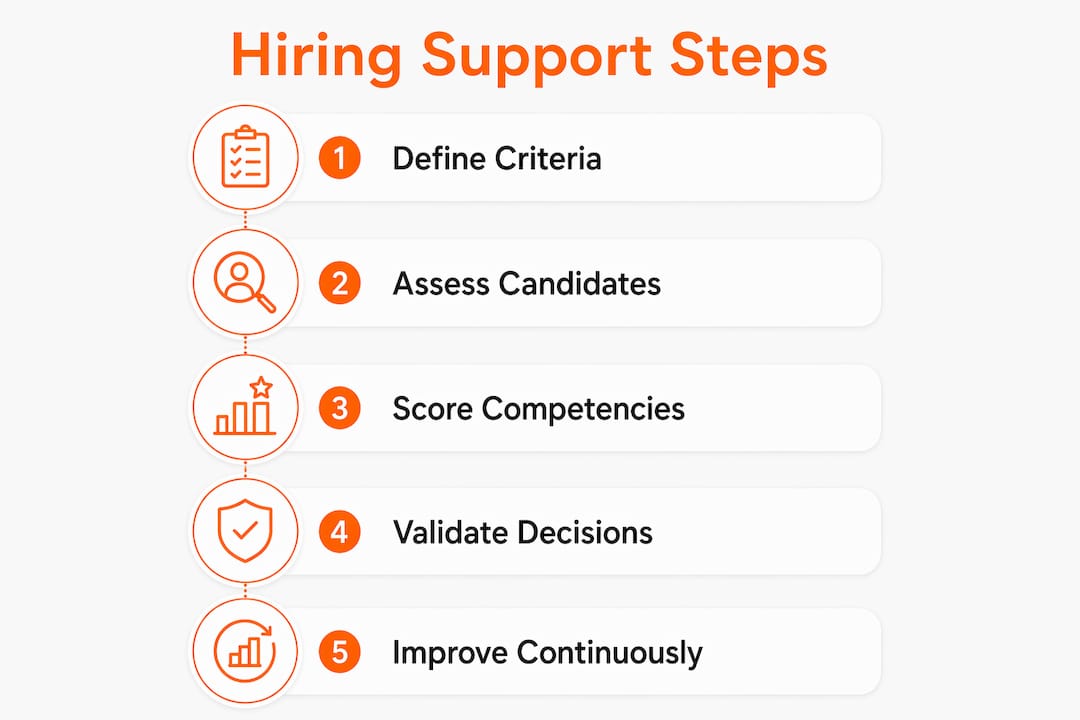
- Define success criteria (Week 1–2): Write a success outline for the role before posting it. Involve the hiring manager, a senior team member, and HR.
- Map competencies (Week 2–3): Identify 4–6 competencies tied directly to on-the-job performance. Assign weights that reflect business priority.
- Build scorecards and rubrics (Week 3–4): Create behavioral anchors for each rating level. Scorecards and rubrics work together to support inter-rater consistency only when anchors are specific enough to distinguish a “3” from a “4.”
- Align stakeholders (Week 4): Run a kickoff meeting. Involve stakeholders early so every interviewer understands their role and the criteria before the first candidate enters the pipeline.
- Pilot on 1–2 roles (Weeks 5–8): Track quality of hire, time-to-fill, and interview-to-offer rate as your validation metrics.
- Calibrate and iterate (Ongoing): Run a calibration session after every 10–15 interviews. Compare scores, surface disagreements, and update anchors where meaning has drifted.
Pro Tip: Assign a data owner who tracks pilot metrics and flags score divergence. Without someone accountable for the numbers, calibration sessions become optional and then disappear.
A systematic literature review found that most recruitment DSS rely on static criterion weighting, which becomes a liability when the role or market shifts. Build a review cadence into your rollout plan from day one.
Which tools and artifacts does your hiring process need?
Three tool categories cover the full pipeline. You need at least one from each.
Assessment platforms run structured skill evaluations before the interview stage, producing scored evidence that feeds directly into your scorecard. Look for configurability, audit logs, and AI-assisted scoring with visible rationales.
ATS integrations centralize candidate data and connect assessment outputs to interview records. Selection criteria: native scorecard support, structured feedback fields, and exportable decision logs.
MCDM/DSS components apply your weighted criteria to produce ranked outputs. Prefer tools that surface the math behind a recommendation so a recruiter can challenge it.
Artifacts every team needs:
- Interview kits with preset questions mapped to competencies
- Per-competency scorecards with behavioral anchors
- Debrief templates that capture evidence, not impressions
- Candidate evidence folders linking assessment outputs to interview scores
Human-in-the-loop decision support accelerates early-stage screening while keeping final authority with recruiters. Require traceable rationale outputs from any AI component, and build in a human validation checkpoint before any candidate is advanced or rejected.
How does Testask implement hiring decision support in practice?
Testask follows a four-step flow: create a tailored test task, collect candidate submissions, apply structured AI-assisted scoring, and run a team debrief with a full audit trail. Each step produces an artifact that feeds the next.
Here is how the flow works in practice:
- Task creation: Define the competencies the role requires, then generate a test task aligned to those criteria. The task becomes the first structured data point in your decision pipeline.
- Submission collection: Candidates complete the task and submit responses through the platform. All submissions are stored in one place, accessible to every reviewer.
- Structured scoring: Testask’s AI-assisted analysis scores each submission against your rubric and surfaces a rationale for each rating. Reviewers see the evidence, not just a number.
- Team debrief with audit trail: Reviewers collaborate on final scores, record their reasoning, and the platform logs every decision. That log is your auditability record.
Hiring decision support works when the tools force evidence into the room. Testask’s structured scoring and audit trail mean every debrief starts with documented candidate evidence, not competing recollections from five interviewers.
Pro Tip: Pilot Testask on one role with a clear success profile. Track interview-to-offer rate and quality-of-hire at 90 days. Those two numbers will tell you whether your rubric is calibrated correctly.
Explore the full platform at testask.org.
What are the real benefits and limitations to know?
Benefits:
- Consistency across interviewers and hiring panels
- Explainability: every decision connects to documented criteria
- Faster early screening through structured assessment data
- Reduced adverse impact compared with unstructured interviews
Limitations and risks to manage:
- Static weighting: Criteria weights set at launch can become misaligned as the role or team evolves. Validate weights against post-hire performance data at least annually.
- Scorecards without rubrics: Numeric scores mean nothing without behavioral anchors. A “4” from one interviewer and a “4” from another may describe entirely different candidate behaviors.
- Black-box models: Any AI component that cannot surface a rationale creates accountability gaps. Require explainability before deploying.
- Miscalibrated rubrics: Divergent interviewer scores after calibration sessions signal anchor drift. Treat score variance as a leading indicator, not noise.
Outcome-based validation linking hire decisions to later performance and retention is what separates a genuine decision support system from an administrative checkbox. Without it, you cannot tell whether your process is predicting anything.
Sample scorecard and rubric template you can adapt today
Link every competency row to a specific behavior the role requires. Use the rating anchors to distinguish performance levels before interviews begin, not during debrief.
| Competency | Weight | 1 (Below expectations) | 3 (Meets expectations) | 5 (Exceeds expectations) |
|---|---|---|---|---|
| Structured problem-solving | — | Describes problem vaguely; no clear method | Identifies root cause and outlines a logical approach | Applies a named framework, anticipates edge cases |
| Communication clarity | — | Responses require follow-up to understand | Explains ideas clearly with minimal prompting | Adapts communication style to audience unprompted |
| Role-specific technical skill | — | Cannot demonstrate core task requirement | Completes core task with minor gaps | Completes task accurately and explains reasoning |
| Collaboration and feedback response | 15% | Dismisses or ignores interviewer input | Accepts feedback and adjusts approach | Proactively seeks input and incorporates it in real time |
Steps for using this rubric in interviews and calibration:
- Share the rubric with every interviewer before the first interview, not after.
- Score independently. Reviewers submit scores before seeing each other’s ratings.
- Flag any competency where scores diverge by two or more points for debrief discussion.
- Record the rationale for each final score in writing. That record is your audit trail.
- After the hire, revisit scores at 90 days against actual performance to validate anchor accuracy.
Key Takeaways
Structured hiring decision support works when scorecards, behavioral rubrics, and human-in-the-loop validation operate together as a system, not as isolated tools.
| Point | Details |
|---|---|
| Define success first | Write role success criteria before sourcing; undefined criteria produce consistently irrelevant evidence. |
| Pair scorecards with rubrics | Behavioral anchors are what give numeric scores shared meaning across interviewers. |
| Pilot with real metrics | Track quality of hire and interview-to-offer rate during your pilot to validate rubric accuracy. |
| Validate weights over time | Static criterion weighting drifts; review and update weights against post-hire performance data annually. |
| Use Testask for structured assessment | Testask generates tailored test tasks, scores submissions with AI-assisted analysis, and logs every decision for auditability. |
The case for structure over instinct
The most common objection to hiring decision support is that it slows things down. The evidence points the other way. Unstructured processes feel faster because they skip the upfront work, but that work reappears later as mis-hires, re-opens, and debrief arguments with no documented basis.
What most guides understate is the calibration requirement. A scorecard is not a finished artifact. It is a living document that requires regular multi-interviewer sessions to stay meaningful. Teams that build the rubric and then skip calibration end up with numeric scores that mean different things to different people, which is arguably worse than no scorecard at all.
The practical default for any hiring team serious about quality of hire: structured, human-validated decision support with a calibration cadence built into the process from the start. Demand audit logs and predictive validity data from any tool you adopt. If a vendor cannot show you how their system connects hire decisions to post-hire outcomes, that is a gap worth pressing on before you commit.
Testask gives your hiring team a structured decision advantage
Faster screening without sacrificing rigor is the concrete payoff Testask delivers. Instead of building assessment infrastructure from scratch, your team generates tailored test tasks in minutes, collects all candidate submissions in one place, and reviews AI-assisted scoring with full rationale visibility. Every score, comment, and decision is logged, giving you the audit trail that structured hiring requires.
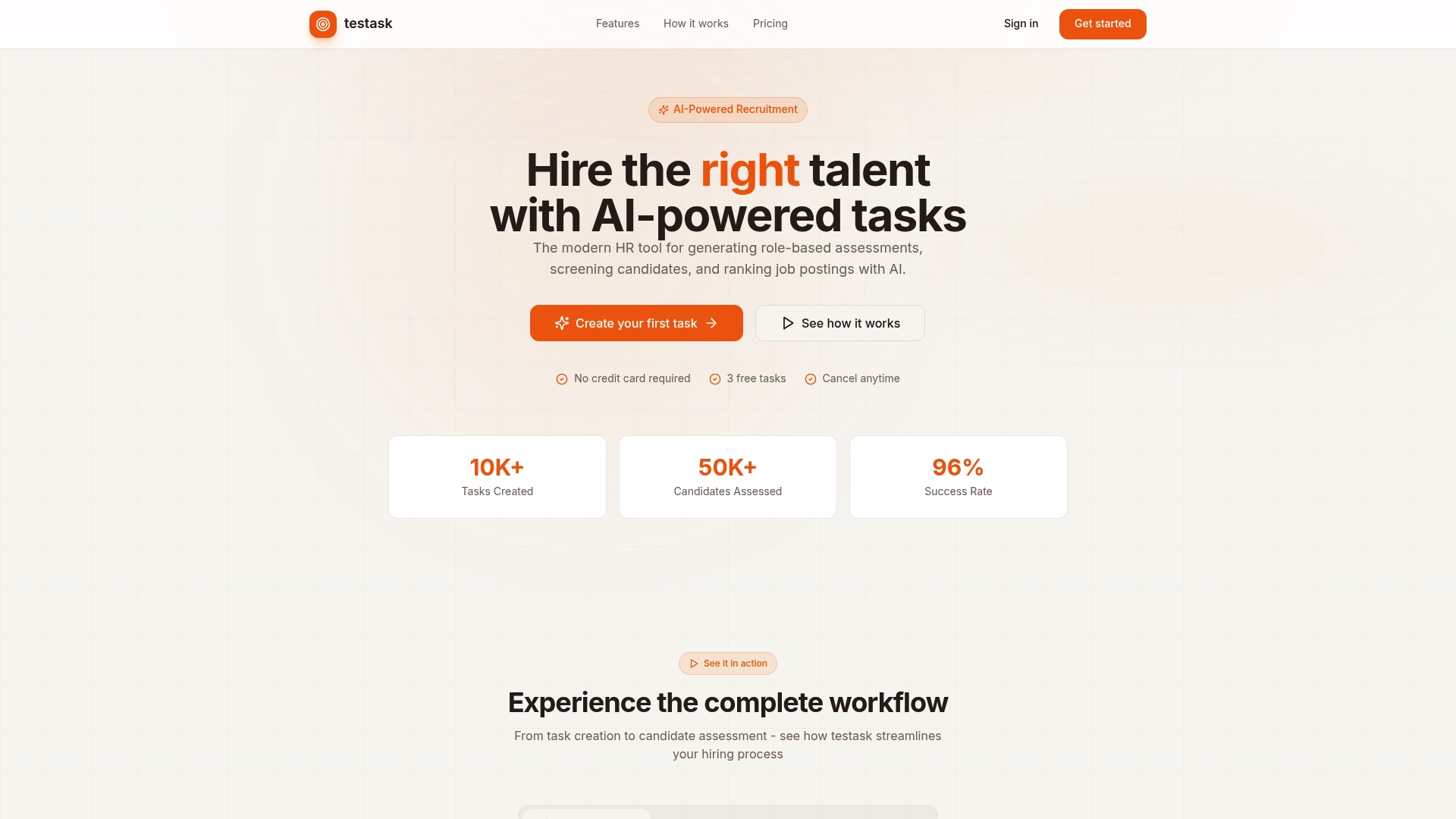
Testask fits directly into the pipeline this article describes: early-stage structured assessment, candidate scoring methods tied to your rubric, and team collaboration tools that keep every reviewer aligned before the debrief. The platform supports free and paid plans, so you can run a pilot on one role without a long-term commitment.
Start your pilot at testask.org and track quality of hire at 90 days to see whether your rubric is calibrated correctly.