What Is Candidate Profiling? A Guide for HR Teams
What Is Candidate Profiling? A Guide for HR Teams

Candidate profiling is defined as the structured process of identifying, evaluating, and documenting the qualifications, skills, behaviors, and personal attributes that define the ideal hire for a specific role. The industry term you will encounter in HR literature is “candidate profiling,” though it overlaps significantly with what practitioners call “candidate assessment” and “talent evaluation.” Done well, it replaces gut instinct with a repeatable, evidence-based framework. It reduces unconscious bias, improves hiring consistency, and gives hiring managers a clear standard to measure every applicant against. This guide covers the core components, behavioral techniques, AI-assisted tools, and practical steps that make candidate profiling work in real recruitment workflows.
What is candidate profiling and how do selection criteria work?
Candidate profiling is a combination of four elements: verified qualifications, demonstrated skills, observable personal attributes, and relevant experience. These elements are captured in a structured profile that hiring managers and recruiters use throughout the selection process. The profile is not a job description. A job description tells candidates what the role requires. A candidate profile tells your team what the ideal person looks like.

Selection criteria act as the measuring stick that evaluates all candidates against consistent, evidence-based standards, eliminating gut-feel and personal bias. That consistency is what makes profiling defensible when hiring decisions are challenged. A well-rounded set of selection criteria typically includes 6–10 measurable items, clearly divided into essential and desirable qualifications. The essential items are non-negotiable. The desirable items separate strong candidates from exceptional ones.
Criteria categories typically span three areas:
- Technical skills: Specific software proficiency, certifications, or domain knowledge required to perform the job
- Behavioral traits: Communication style, problem-solving approach, and how a candidate handles pressure or ambiguity
- Cultural fit: Alignment with team values, working style, and organizational expectations
Pro Tip: Write each criterion as an observable behavior, not a vague trait. “Demonstrates clear written communication in client-facing reports” is assessable. “Good communicator” is not. Specificity is what makes criteria reliable and consistent across every candidate you evaluate.
Building a character profile into your job descriptions from the start aligns your external messaging with your internal evaluation standards, reducing the gap between who applies and who you actually want to hire.
How does behavioral profiling enhance candidate assessment?
Behavioral profiling assesses observable professional behaviors, career decision patterns, and communication styles over time. It goes beyond what a resume shows. A resume captures what someone has done. Behavioral profiling reveals how they made decisions, why they changed roles, and how they engage with colleagues and challenges.
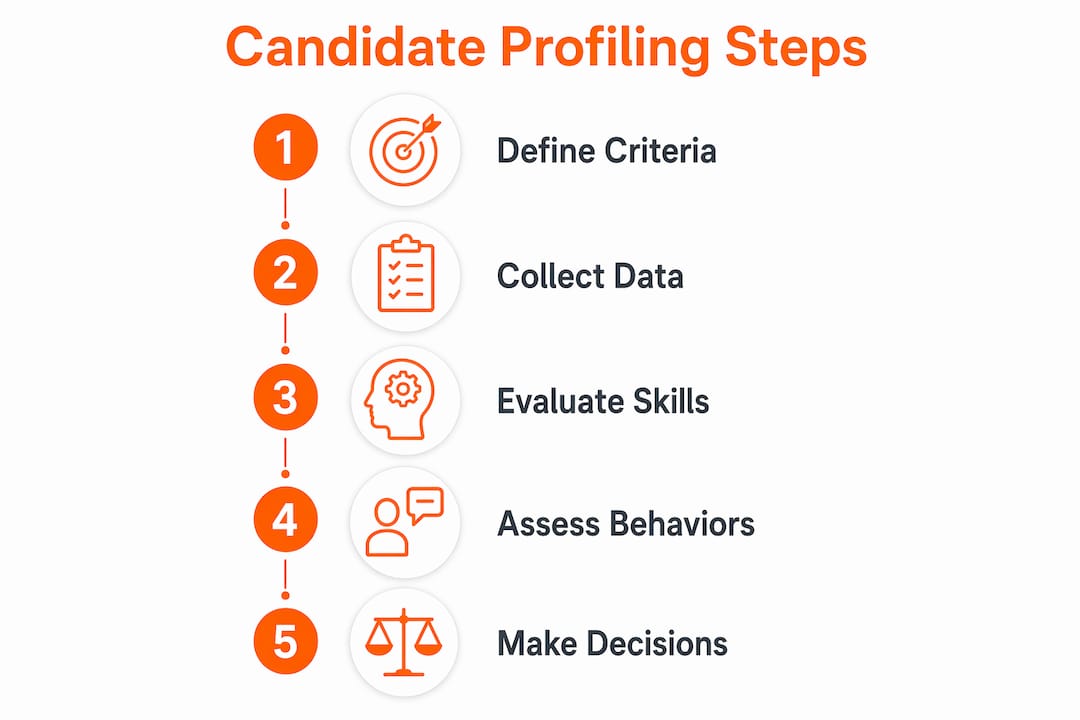
Behavioral profiling integrates multiple behavioral data points with confidence levels, providing evidence-based predictions on job fit and retention that static documents cannot deliver. This matters because retention is expensive. Hiring a candidate who looks qualified on paper but misaligns behaviorally costs far more than a longer, more thorough screening process.
The practical benefits of embedding behavioral profiling into your hiring workflow include:
- Predicting how a candidate will perform under the specific conditions of the role
- Validating the focus areas for structured interviews before they happen
- Identifying engagement trends that signal long-term commitment versus short-term opportunism
- Surfacing cultural alignment data that interviews alone rarely capture
Embedding behavioral profiling as an internal organizational capability within 90 days of adoption ensures sustainability without ongoing consulting dependency. Teams that build this skill in-house apply it consistently across every hire, not just senior roles.
The key shift behavioral profiling requires is treating candidate evaluation as a longitudinal process, not a single-point snapshot. You gather data across the application, screening, interview, and reference stages, then synthesize it into a confidence-weighted picture of fit.
What tools and techniques support modern candidate profiling?
The most reliable candidate profiling methods combine human judgment with structured processes and technology. No single tool does the full job. The combination is what produces accuracy.
| Technique | Primary strength | Best used for |
|---|---|---|
| Structured interviews | Consistency across candidates | Behavioral and competency assessment |
| Psychometric testing | Objective personality and aptitude data | Culture fit and role suitability |
| Skills evaluations | Direct proof of technical ability | Technical and specialist roles |
| AI-assisted profile scoring | Speed and scalability at volume | High-volume screening and shortlisting |
Structured interviews with competency-based questions reduce bias and improve evaluation reliability compared to unstructured conversations. The reason is simple: every candidate answers the same questions in the same sequence, which makes scoring fair and comparable.
AI techniques are changing the speed and scale of profiling. Research shows that automated profile analysis using fuzzy TOPSIS combined with large language models can achieve up to 91% agreement with human experts when evaluating candidate attributes such as experience. That level of alignment means AI-assisted scoring is no longer a shortcut. It is a credible complement to human review.
The main challenge with AI-assisted profiling is handling ambiguous qualitative data. A candidate who describes their leadership experience in vague terms creates noise in any scoring model. The solution is to pair AI scoring with structured input formats, such as work sample tasks or standardized application questions, that give the model clean, comparable data to work with.
Pro Tip: Use skills-based test tasks as the input layer for AI scoring. When candidates complete a defined task, the output is structured and specific. That makes AI evaluation far more accurate than scoring open-ended resume text.
What are the practical steps to build and use candidate profiles?
Building a candidate profile that actually improves hiring outcomes requires a clear sequence. Skipping steps produces profiles that look thorough but fail in practice.
-
Start with the job description. Extract the core responsibilities and translate each one into a measurable competency. This is where your selection criteria come from. If the job description is vague, your criteria will be vague too.
-
Define essential versus desirable criteria. Essential criteria are the floor. Every shortlisted candidate must meet them. Desirable criteria are the differentiators you use to rank qualified candidates against each other.
-
Build the profile as a living document. Candidate profiles should evolve through the interview process, accounting for soft skills, cultural alignment, and career aspirations that emerge during conversations. A profile you finalize before the first interview is already outdated.
-
Align recruiters and hiring managers on the profile before screening begins. A consolidated candidate profile gives both parties a shared reference point, reducing the friction that comes from misaligned expectations. This is where most hiring breakdowns actually happen.
-
Document every evaluation decision against the criteria. Legal compliance frameworks require transparent and consistent selection criteria so hiring decisions can be defended if challenged. Documentation is not bureaucracy. It is your protection.
-
Apply the profile at every stage. Use it during resume screening, structured interviews, reference checks, and final evaluation. The profile only works if every decision point references the same standard.
Your candidate screening process becomes significantly more consistent when every reviewer works from the same documented criteria rather than their own interpretation of the role.
Key Takeaways
Candidate profiling works because it replaces subjective impression with documented, criteria-based evaluation applied consistently at every stage of the hiring process.
| Point | Details |
|---|---|
| Define criteria before screening | Build 6–10 measurable selection criteria split between essential and desirable before reviewing any applications. |
| Use behavioral profiling early | Integrate behavioral data from the first screening stage to predict fit and retention, not just qualifications. |
| Treat profiles as living documents | Update candidate profiles throughout the process as interviews and assessments reveal new information. |
| Combine human and AI evaluation | Pair structured test tasks with AI-assisted scoring to improve speed and accuracy at volume. |
| Document every decision | Record how each candidate was evaluated against criteria to support legal compliance and consistent hiring. |
Why I think most teams underuse candidate profiling
Most hiring teams treat candidate profiling as a pre-hire formality. They build a profile, use it for the first round of screening, and then abandon it the moment a strong personality walks into the interview room. That is where bias re-enters the process.
The teams I have seen hire consistently well do something different. They treat the candidate profile as the final authority, not the hiring manager’s instinct. When a candidate impresses in person but scores poorly against behavioral criteria, the profile wins. That discipline is uncomfortable. It also produces better hires.
The other mistake I see constantly is outsourcing profiling entirely to external consultants. Consultants can build your first framework, but if your internal team cannot run the process independently, you will repeat the engagement fee every time you open a new role. Embedding behavioral profiling as an internal capability within 90 days of adoption is the standard worth targeting. It is achievable, and it pays for itself in reduced mis-hires.
The future of candidate profiling sits at the intersection of behavioral data and AI-assisted scoring. The technology is already accurate enough to complement expert judgment. The gap is not the tool. The gap is whether your team has the discipline to build profiles before screening starts and the consistency to apply them all the way through to the final offer.
If you are still relying on resumes and gut feel, you are not profiling candidates. You are guessing. The hiring process best practices that produce repeatable results all start with a documented profile and end with a decision that references it.
— Pavel
How Testask supports evidence-based candidate profiling
HR teams that want to apply candidate profiling at scale need tools that handle both the structure and the volume.
Testask is an AI-powered recruitment assessment platform that helps you create tailored test tasks, evaluate candidate submissions, and score results against your defined selection criteria. You set the criteria. Testask applies them consistently across every candidate, at any volume. The platform supports collaboration between recruiters and hiring managers through shared scoring dashboards, so both teams work from the same evidence. AI-assisted analysis flags strong matches and surfaces patterns that manual review misses. If you want faster, fairer, and more consistent candidate evaluation, explore Testask and see how AI-assisted profiling fits your hiring workflow.
FAQ
What is candidate profiling in recruitment?
Candidate profiling is the structured process of defining and evaluating the qualifications, skills, behaviors, and attributes that make an ideal hire for a specific role. It replaces subjective judgment with documented, criteria-based assessment applied consistently across all applicants.
How many selection criteria should a candidate profile include?
A well-built candidate profile typically includes 6–10 measurable selection criteria, divided into essential and desirable qualifications. Essential criteria set the minimum standard; desirable criteria differentiate strong candidates from exceptional ones.
What is the difference between a job description and a candidate profile?
A job description defines what the role requires. A candidate profile defines what the ideal person looks like, including behavioral traits, cultural fit, and career trajectory, not just listed qualifications.
How does behavioral profiling improve hiring outcomes?
Behavioral profiling assesses career decision patterns and observable professional behaviors over time, providing evidence-based predictions on job fit and retention that resumes and single-point interviews cannot deliver.
Is AI reliable enough to use in candidate profiling?
Research shows that AI techniques combining large language models with fuzzy decision-making frameworks can achieve up to 91% agreement with human experts in evaluating candidate attributes. AI works best as a complement to structured human evaluation, not a replacement for it.
Recommended
- What Is Candidate Fit? A Guide for HR Professionals | Testask Blog | testask
- What Is Candidate Experience? A 2026 HR Guide | Testask Blog | testask
- Candidate Screening Process Guide: Streamlined Hiring Steps | Testask Blog | testask
- What Is Predictive Hiring? A 2026 Guide for HR Teams | Testask Blog | testask