What Is Candidate Experience? A 2026 HR Guide
What Is Candidate Experience? A 2026 HR Guide

Candidate experience is defined as the sum of perceptions a job seeker forms about an employer through every interaction in the hiring process, from the first job listing they see to the final feedback they receive. AIHR describes it as the lens candidates use to decide whether to engage, stay engaged, and ultimately accept or decline an offer. That perception shapes not just individual hiring outcomes but your organization’s long-term reputation in the talent market. For HR professionals and recruiters, understanding the candidate experience definition is the foundation of building a hiring process that actually converts top talent.
What is candidate experience and what does it include?
Candidate experience encompasses every touchpoint a job seeker encounters during your hiring process, including job discovery, the application, screening, interviews, the offer decision, and post-decision feedback. Qualtrics identifies four core recruitment touchpoints and emphasizes that perception is formed end-to-end, not just at the interview stage. This means a candidate who never gets past the application form still has a candidate experience, and it can still affect your employer brand. The scope is broader than most recruiters initially assume.
The candidate journey maps the sequence of actions a candidate takes. The candidate experience is what they feel at each step. Both matter, but they are not the same thing. A candidate can complete every step of your process and still leave with a negative perception if communication was slow, feedback was absent, or interviewers were unprepared.

Phenom emphasizes that candidate experience is cyclical and applies to all candidate types, including those who withdraw or receive a rejection. Designing for the “last mile” of the process, specifically the rejection feedback and next-step clarity, is just as critical as optimizing the application form. Organizations that ignore rejected candidates are leaving a significant pipeline health risk unaddressed.
The table below maps each stage of the hiring process to the factors that most directly shape candidate perception at that point.
| Stage | Key experience factors |
|---|---|
| Job discovery | Job posting clarity, brand consistency, mobile accessibility |
| Application | Form length, ease of use, confirmation communication |
| Screening | Speed of response, clarity of next steps, assessment fairness |
| Interview | Interviewer preparation, respect for candidate time, structure |
| Offer and decision | Decision speed, transparency, personalization of communication |
| Rejection and feedback | Timeliness, specificity, tone, and guidance for future applications |
Pro Tip: Map your candidate journey before you redesign any single touchpoint. Fixing the interview experience while leaving a broken application form in place produces inconsistent results and confuses candidates about your organization’s standards.
How does candidate experience differ from employer brand and employee experience?
Candidate experience, employer brand, and employee experience are related but serve distinct functions in your talent strategy. AIHR defines employer brand as your organization’s external reputation in the talent market, the promise you make to prospective employees. Candidate experience is the actual delivery of that promise through the hiring process. A strong employer brand attracts candidates to apply. A poor candidate experience drives them away before they ever reach an offer.
Employee experience begins at onboarding and covers the full arc of an employee’s time at your organization. Candidate experience ends at the transition into onboarding, though the two are closely linked. A candidate who has a poor hiring experience often enters onboarding with lower trust and engagement, which affects early retention. Treating onboarding as a clean break from the hiring process misses this connection.
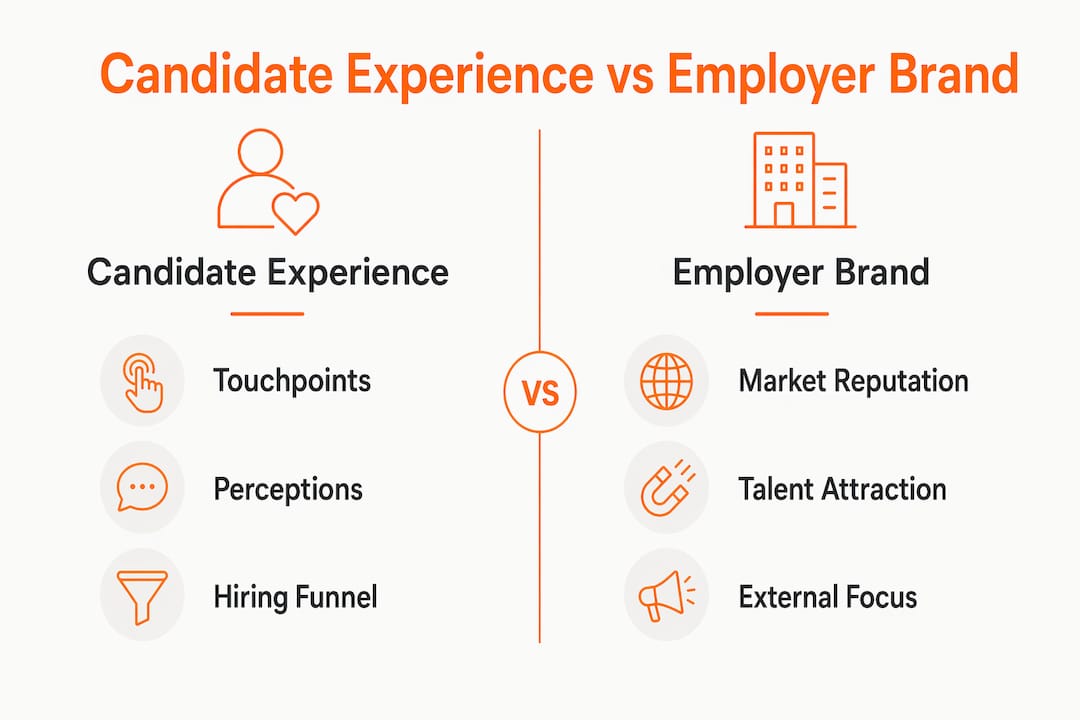
The candidate journey, as a concept, describes the sequence of steps a candidate takes through your funnel. Candidate experience describes the emotional and perceptual quality of those steps. You can have a well-mapped journey with a terrible experience if the touchpoints are technically present but poorly executed.
| Concept | Focus | Owned by |
|---|---|---|
| Employer brand | External reputation and talent market positioning | Marketing and HR leadership |
| Candidate experience | In-process perception across all hiring touchpoints | Recruiting, hiring managers, HR partners |
| Candidate journey | Sequence of actions candidates take through the funnel | Recruiting operations |
| Employee experience | Post-hire perception across the full employment lifecycle | HR, managers, and leadership |
Pro Tip: When auditing your hiring process, ask this question at each stage: “Does this touchpoint deliver on the promise our employer brand makes?” If the answer is no, you have identified a candidate experience gap.
Why is candidate experience important for hiring outcomes?
Candidate experience directly affects your ability to fill roles, protect your employer reputation, and build a sustainable talent pipeline. Qualtrics research links better experience metrics to measurable improvements in offer acceptance rates, reduced funnel drop-off, and stronger re-application and referral behavior. These are not soft outcomes. They translate directly into cost-per-hire and time-to-fill metrics that every HR leader tracks.
The business case for investing in candidate experience rests on four concrete outcomes:
- Reduced drop-off rates. Candidates who encounter friction in the application or screening process abandon it. Simplifying these stages keeps qualified candidates in your funnel longer.
- Higher offer acceptance. Candidates who feel respected and informed throughout the process are more likely to accept offers, even when competing offers exist.
- Stronger referral behavior. Candidates who have a positive experience, even if rejected, are more likely to refer others and reapply in the future.
- Employer brand protection. Negative hiring experiences are shared publicly on platforms like Glassdoor and LinkedIn, affecting your ability to attract future applicants.
“CandE 2025 benchmark research shows that award-winning organizations set a 3-to-5 day decision SLA after interviews. Delays beyond this window measurably damage candidate perception and employer brand, regardless of how strong the rest of the process was.”
Fairness perception is a particularly underrated driver of candidate experience quality. CandE benchmark data shows that candidates rate fairness based on consistent, timely communication far more than on the warmth of rejection language. A form rejection sent within 48 hours is perceived as fairer than a personalized note sent three weeks later. Speed and clarity matter more than tone.
How can HR teams measure candidate experience effectively?
Measuring candidate experience requires separating two distinct KPI categories: process speed and communication clarity. Survale’s 2025 research highlights that combining timing KPIs with clear yes/no/next-step communication SLAs prevents experience-damaging delays from going undetected. A process can be longer than average and still produce a strong candidate experience, provided candidates know where they stand at every stage.
The most effective measurement framework includes the following components:
- Time to disposition: How long does it take to move a candidate from one stage to the next? Track this by stage, not just overall.
- Decision communication clarity: Do candidates receive a clear yes, no, or “here is what happens next” at each decision point?
- Post-process surveys: Short, triggered surveys sent immediately after key touchpoints (application, interview, offer/rejection) capture real-time perception data.
- ATS trigger analysis: Most applicant tracking systems can flag candidates who have been in a stage beyond a defined SLA. Use these flags as escalation triggers.
- Withdrawal rate by stage: A spike in candidate withdrawals at a specific stage signals an experience problem at that point in the process.
Candidate experience is an operating model, not just a communication tone. CandE benchmark winners treat it as a shared service level with formal KPIs and escalation paths, not a soft HR initiative. This distinction separates organizations that consistently attract and convert top talent from those that struggle with funnel leakage.
Accountability is the other critical variable. Qualtrics notes that hiring manager behavior is part of the candidate experience end-to-end. Recruiters who own the process but cannot hold hiring managers accountable for interview preparation or timely feedback will always have ceiling on their candidate experience scores. Joint ownership, with defined responsibilities for recruiters, hiring managers, and HR business partners, is the structural requirement for sustained improvement.
Pro Tip: Assign a named owner for each handoff point in your hiring process. The transition from recruiter to interviewer and from interviewer to hiring manager decision are the two most common points where candidate experience breaks down. A named owner with a defined SLA at each handoff closes this gap.
What practical strategies improve candidate experience throughout the hiring funnel?
Improving candidate experience does not require a full process overhaul. The highest-impact changes are often structural and communication-focused, not technology-dependent. The candidate screening process is one of the most frequent sources of candidate frustration, and fixing it produces immediate funnel improvements.
The following practices consistently separate high-performing recruiting teams from average ones:
- Communicate at every stage transition. Candidates should never have to wonder where they stand. A brief status update at each stage costs minutes and prevents the perception of disorganization.
- Simplify the application. Remove any field that does not directly inform a screening decision. Long applications increase drop-off without improving candidate quality.
- Train interviewers before every panel. Interviewers who arrive unprepared signal disrespect for the candidate’s time. A 15-minute pre-brief with the job description and evaluation criteria is the minimum standard.
- Provide structured feedback to rejected candidates. Generic rejection emails are a missed opportunity. A single specific sentence about why a candidate was not selected costs little and significantly improves perception.
- Use automation for speed, not substitution. Automated acknowledgment emails, status updates, and scheduling tools improve speed. They should not replace human communication at high-stakes moments like offer delivery or rejection after a final interview.
- Design for mobile. A significant share of candidates apply and review communications on mobile devices. An application that does not render correctly on a phone is an immediate experience failure.
Following hiring process best practices means treating every candidate interaction as a reflection of your organization’s standards, not just a procedural step. The candidates you reject today are potential future applicants, referral sources, and customers.
Key takeaways
Candidate experience is a measurable operational function that directly determines hiring conversion rates, employer reputation, and pipeline health across every stage of the hiring process.
| Point | Details |
|---|---|
| Candidate experience definition | It is the total perception a job seeker forms across all hiring touchpoints, from job discovery through final feedback. |
| Scope includes all candidates | Design for rejected and withdrawn candidates, not just those who receive offers, to protect pipeline health. |
| Speed and clarity drive fairness | Timely, transparent decisions matter more to candidates than warm language in rejection notes. |
| Measurement requires two KPI tracks | Track process speed and communication clarity separately to identify where experience breaks down. |
| Joint ownership is non-negotiable | Recruiters, hiring managers, and HR partners must share defined accountability for candidate experience outcomes. |
The part of candidate experience most teams get wrong
From working closely with recruiting teams across industries, the most consistent gap I see is not in the application form or the interview structure. It is in the handoff. The moment a recruiter passes a candidate to a hiring manager is where the experience most often falls apart, and most organizations have no formal process for managing it.
Hiring managers are not recruiters. They do not think about candidate perception as part of their job. They think about filling a role. That is a legitimate priority, but it creates a structural problem: the person with the most influence over the interview experience, the offer decision, and the post-interview communication timeline is often the person with the least training and accountability for candidate experience outcomes.
The 3-to-5 day decision rule from the CandE 2025 benchmarks is not just a nice target. It is a diagnostic. If your organization cannot consistently make and communicate hiring decisions within five days of a final interview, the problem is almost certainly hiring manager accountability, not recruiter effort. Fixing that requires structural change: defined SLAs, escalation paths, and leadership buy-in that candidate experience is a shared business metric, not an HR soft skill.
AI and automation are changing what candidates expect in 2026. Faster scheduling, instant acknowledgment, and AI-assisted assessments have raised the baseline. But they have also made the human moments, the feedback call, the personalized offer conversation, the honest rejection note, more valuable, not less. The organizations winning on candidate experience right now are not the ones with the most technology. They are the ones using technology to handle the transactional steps so their people can focus on the moments that actually shape perception.
— Pavel
See how Testask improves the screening experience for candidates and recruiters
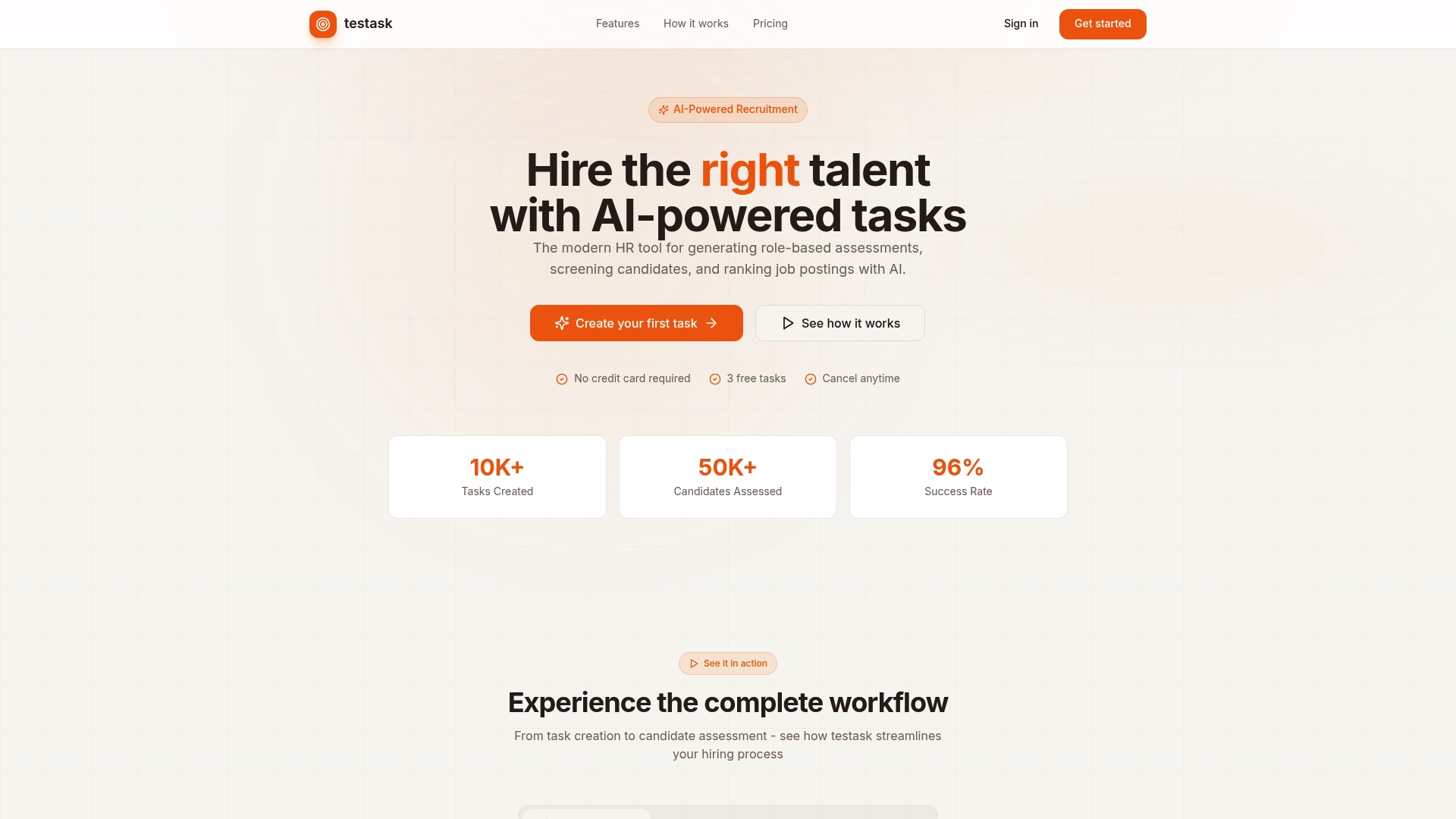
The screening stage is one of the highest-friction points in the candidate journey, and it is where many organizations lose qualified applicants before they ever reach an interview. Testask is an AI-powered recruitment assessment platform that helps HR teams generate tailored test tasks, evaluate submissions with AI-assisted analysis, and collaborate on candidate reviews in one place. The result is a faster, more transparent screening process that candidates experience as fair and well-organized. If your team is looking to reduce screening time while improving the quality of hiring decisions, Testask is built for exactly that workflow.
FAQ
What is the candidate experience definition?
Candidate experience is the overall perception a job seeker forms about an employer through every interaction in the hiring process, from first contact through final feedback. It includes how candidates are treated, communicated with, and evaluated at each stage.
Why is candidate experience important for recruiters?
Strong candidate experience reduces funnel drop-off, increases offer acceptance rates, and protects employer reputation. Poor experiences are shared publicly and affect an organization’s ability to attract future applicants.
What is the difference between candidate journey and candidate experience?
The candidate journey maps the sequence of steps a candidate takes through the hiring process. Candidate experience describes the quality of perception formed at each of those steps. A well-mapped journey can still produce a poor experience if execution is weak.
How do you measure candidate experience effectively?
Measure candidate experience using two separate KPI tracks: process speed (time to disposition by stage) and communication clarity (whether candidates receive clear next-step information at each decision point). Post-process surveys and ATS stage-duration flags are the most practical data sources.
What affects candidate experience the most?
Timely and transparent decisions have the greatest impact on candidate perception, followed by interviewer preparation and the quality of rejection feedback. Communication speed matters more to candidates than the warmth of the language used.
Recommended
- Candidate Screening Process Guide: Streamlined Hiring Steps | Testask Blog | testask
- Improve candidate screening: expert guide to AI-powered hiring | Testask Blog | testask
- Streamline candidate evaluation: proven steps for better hiring | Testask Blog | testask
- Hiring process best practices: proven steps for better talent | Testask Blog | testask