Calibration Session Agenda for Hiring Teams
Calibration Session Agenda for Hiring Teams

Your calibration session agenda in one line: 60-minute meeting, pre-submitted independent scores required, rubric in shared doc — covering three actions: walk through rubric anchors, reveal scores simultaneously, and update rubric anchors before closing. The single required output is a versioned rubric saved to your ATS with an assigned owner. Every interviewer in the loop attends, along with the hiring manager and a recruiter or TA ops lead who serves as note-taker.
- Pre-work required from all participants: complete independent scoring before the meeting
- Three agenda actions: anchor review, simultaneous score reveal, rubric edits
- Success criterion: at least one anchor updated, versioned, and saved to your ATS
A meeting that ends without a documented rubric change has not calibrated anything. It has just been a conversation.
Key Takeaways
A calibration session aims to produce a documented rubric anchor update, versioned and saved appropriately, with an assigned owner and a follow-up validation planned.
| Point | Details |
|---|---|
| Copyable agenda | Use the 60-minute timed template: anchor review, simultaneous reveal, outlier discussion, edits, and action capture. |
| Pre-work is mandatory | All interviewers submit independent scores before the session; no pre-work means no valid simultaneous reveal. |
| Evidence-first rules | Every score is defended with behavioral evidence before anchor language is debated or rewritten. |
| Version every edit | Save rubric changes as a new semantic version (e.g., v1.2 — 2026-07-01) to your ATS immediately after the session. |
| Testask reduces prep friction | Testask centralizes anonymized submissions and pre-session scoring so teams arrive ready to calibrate, not to prep. |
Table of Contents
- What does a timed calibration session agenda look like?
- Pre-session checklist: what to prepare before the meeting
- How do you run the scoring discussion without bias or deadlock?
- How to record rubric edits, versioning, and follow-up actions
- Which agenda format fits your session type?
- Common mistakes that derail calibration sessions
- Why these templates work
- The part most teams get wrong
- Testask cuts calibration prep time significantly
- Sources
What does a timed calibration session agenda look like?
The structure below follows the four repeatable steps research consistently supports: independent scoring, simultaneous reveal, outlier discussion, and anchor updates. Assign roles before the meeting starts.
Roles: Facilitator (drives the agenda, enforces simultaneous reveal), Note-taker/Versioner (records anchor edits live), Hiring Manager (owns the success profile), SMEs/Interviewers (provide behavioral evidence), TA Ops or Recruiter (pulls samples, anonymizes, manages shared doc).
| Time | Segment | Owner |
|---|---|---|
| — | Role recap and session ground rules | Facilitator |
| 5–15 min | Walk rubric anchors (one competency at a time) | Hiring Manager |
| 15–25 min | Simultaneous score reveal for each competency | Facilitator |
| 25–45 min | Outlier discussion: evidence first, then anchor test | All interviewers |
| 45 min | Live anchor edits and version save | Note-taker |
| 60 min | Assign follow-up owners and close | Facilitator |
Running rules:
- Scores are revealed simultaneously, never sequentially, to prevent anchoring bias
- Each speaker cites behavioral evidence before stating or defending a score
- No post-hoc candidate comparisons across other applicants
- Hierarchy-first speaking is prohibited; junior interviewers speak before senior ones
Pro Tip: Build a five-minute buffer into the outlier discussion block. If one competency consumes more than ten minutes, flag it for a separate calibration session rather than forcing a rushed anchor rewrite.
Pre-session checklist: what to prepare before the meeting
The facilitator sends the checklist with the calendar invite. Every item must be ready before the session starts, or the meeting loses its structured foundation.
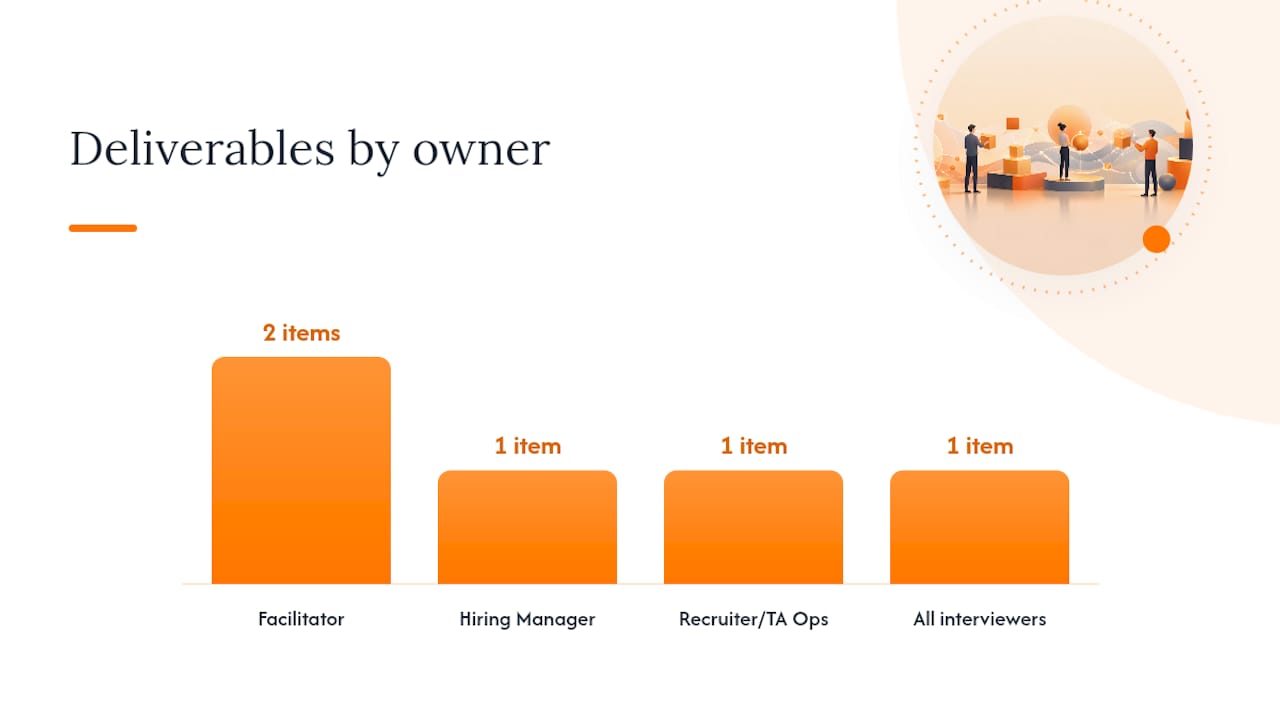
Deliverables and owners:
- Rubric draft — Hiring Manager prepares; must include current anchor language for every competency
- 1–2 anonymized sample interview records or work samples — Recruiter/TA Ops pulls and redacts; remove candidate name, timestamps, and any PII before sharing
- Scorecard template — Facilitator prepares in the shared doc or ATS
- Pre-submitted independent scores and notes — All interviewers submit before the meeting; no exceptions
- Shared doc or ATS location — Facilitator sets up and links in the invite
Anonymizing samples correctly matters. Redact names, pronouns that identify gender, graduation years, and employer names when they are not relevant to the competency being assessed. Preserve the behavioral content so interviewers can score it accurately. Using concrete behavioral anchors in your rubric, such as “explained a technical concept to a non-technical stakeholder in under two minutes,” makes this scoring exercise far more reliable than vague descriptors.
Attach the scorecard and assessment artifacts directly to the calendar invite so participants have no excuse for arriving unprepared.
Pro Tip: Testask centralizes anonymized candidate task submissions and pre-session scoring in one place, so your team arrives with completed scores rather than blank scorecards.
How do you run the scoring discussion without bias or deadlock?
The facilitator’s job is to keep the discussion anchored to rubric language, not to personalities or gut reactions. The evidence-first format is the most reliable way to do that: each interviewer presents behavioral evidence before any score is discussed.
Ground rules for the scoring discussion:
- State the competency being discussed before revealing scores
- Reveal all scores simultaneously (show of hands, shared doc, or polling tool)
- No interviewer defends a score before presenting the behavioral evidence behind it
- Note-taker captures every disputed competency and the evidence cited
Decision flow for disagreements:
- Identify the outlier score(s) on the simultaneous reveal
- Ask the outlier interviewer for the specific behavioral evidence behind their rating
- Test the current anchor language: does it clearly describe the behavior they observed?
- Propose a rewrite of the anchor text if the language is ambiguous
- Vote on the anchor language, not on the candidate’s final score
Bias mitigations worth enforcing: no comparing the current candidate to past applicants, no allowing the hiring manager to speak first, and no skipping note capture for disputed competencies. Tracking inter-rater reliability over time, with a target of most raters landing within one point on a five-point scale, gives you a concrete signal that calibration is working. For bias-free scoring practices, build these rules into your session SOP from day one.
Pro Tip: If disagreements run deep and no anchor rewrite resolves them within ten minutes, stop. Flag the competency for a dedicated calibration session. Forcing convergence during a live hiring decision produces neither good hires nor good rubrics.
How to record rubric edits, versioning, and follow-up actions
A calibration session produces durable change only when edits are captured live and saved in a format future interviewers can find. Saving versioned rubric edits to your ATS prevents the same disagreements from resurfacing in the next debrief.
Record live during the session:
- Exact anchor text before and after the edit
- Who proposed the change and the behavioral evidence cited
- Timestamp and rationale in the change log
- Assigned owner for follow-up validation
Versioning format: Use semantic versioning with a date, for example, Rubric v1.2 — 2026-07-01, saved to your ATS or central repository. Every version must be discoverable by any future interviewer joining the loop.
Follow-up validation: Assign one person to re-score five past candidate samples using the revised anchor within two weeks. This tests whether the new language produces more consistent ratings before it goes live in a real hiring loop.
Post-session metrics worth tracking: scorecard submission rates (a high scorecard submission rate target is recommended is a healthy benchmark) and sample re-scoring agreement rates. Both tell you whether calibration is actually reducing scoring drift.
Calibration is only complete when the rubric is updated, versioned, and saved where every future interviewer can find it. A verbal agreement in the room is not a calibration output.
Which agenda format fits your session type?
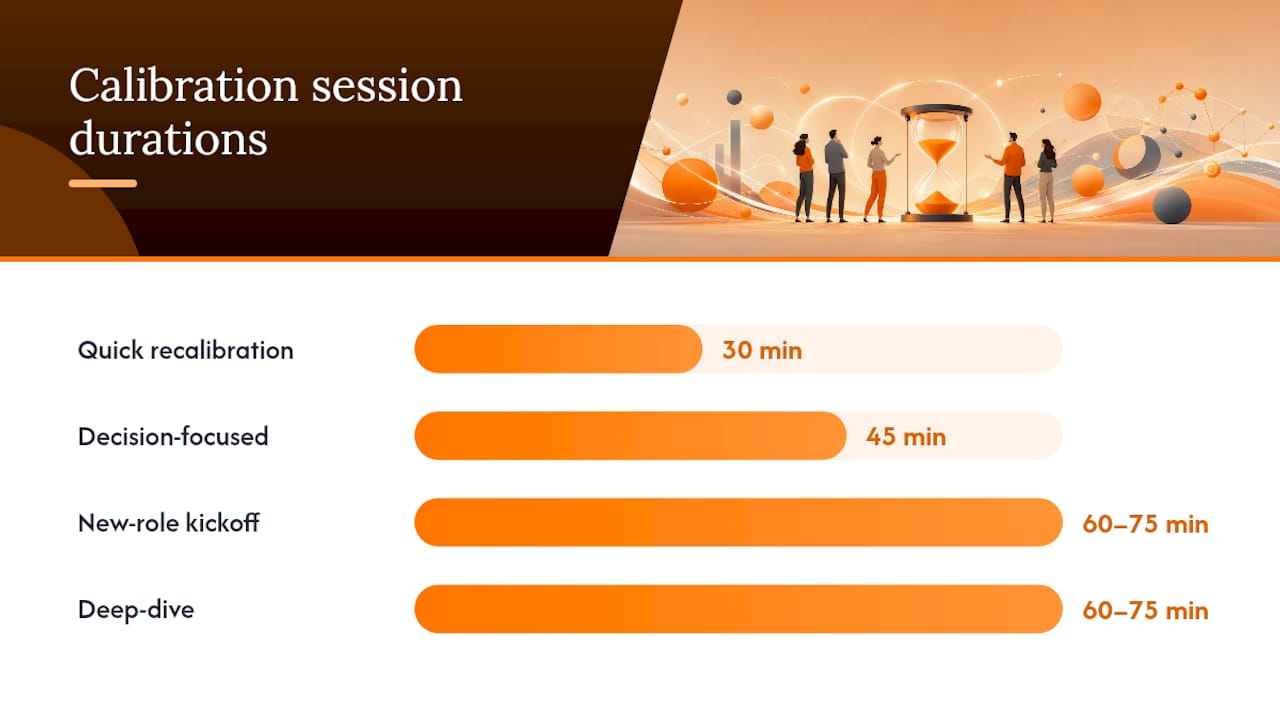
Pre-loop calibration runs about 60–75 minutes; periodic recalibration runs closer to 30 minutes. Match the format to the purpose.
| Format | Duration | Best for | Pre-work required |
|---|---|---|---|
| Quick recalibration | 30 min | 1–2 competencies, existing rubric | Scores submitted in advance |
| Decision-focused | 45 min | Final-stage debrief panels of 3–6 | Scores + behavioral notes |
| New-role kickoff | 60–75 min | Full rubric walk, anchor updates | Full scorecard + samples |
| Deep-dive | 60–75 minutes | Cross-functional or leadership roles | Full scorecard + multiple samples |
The 45-minute format works well for panels of three to six interviewers: role recap (5 min), independent score review (10 min), competency-by-competency discussion (25 min), decision and documentation (5 min). Strict timing prevents freeform debate from consuming the anchor-edit block.
Copy-ready calendar invite snippet:
Subject: [Role] Calibration Session — [Date] Duration: 60 min | Pre-work: Submit scores + notes by [date/time] Attachments: Rubric v[X.X], anonymized sample(s), scorecard template Agenda: Anchor review (10 min) → Score reveal (10 min) → Outlier discussion (25 min) → Edits + actions (15 min)
Common mistakes that derail calibration sessions
Most calibration failures trace back to the same four patterns.
- Treating calibration as personality alignment — The goal is anchor clarity, not convincing everyone to score identically. If the session focuses on who is too strict or too lenient rather than on rewriting ambiguous anchor language, redirect immediately.
- Running calibration inside a hiring debrief — These are separate meetings with separate purposes. When a debrief surfaces deep disagreement, schedule a calibration session later rather than trying to fix rubric problems while deciding about a specific candidate.
- Skipping pre-work or allowing score contamination — If interviewers see each other’s scores before submitting their own, the simultaneous reveal is meaningless. Enforce pre-submission rules and use a shared doc or platform that locks scores until the reveal moment.
- No documentation or versioning — A verbal anchor edit that never makes it into the rubric disappears before the next hiring loop. Require a change log entry and an assigned owner for every edit before the meeting closes.
Pro Tip: Block calibration sessions on the team calendar at the start of each quarter. Protecting the time in advance is the only reliable way to prevent them from being displaced by urgent hiring decisions.
Why these templates work
The templates in this article are built on the calibration frameworks Testask uses to help hiring teams run structured, repeatable sessions. Pavel, author and practitioner at Testask, developed these guidelines from direct experience with hiring teams across multiple industries.
Testask helps teams collect anonymized candidate task submissions and centralize scoring before calibration sessions, reducing the prep friction that causes most sessions to start late or skip pre-work entirely. The platform also stores rubric versions and lets teams re-score past samples to validate anchor changes after the session.
For teams that want AI-assisted anchor drafts, candidate scorecard prompts can accelerate the anchor-writing step before the session.
The part most teams get wrong
Calibration resistance is real, and it usually sounds like this: “We already know what good looks like.” The problem is that “knowing” is individual. Two interviewers who both claim to know what a strong answer looks like will score the same response differently if the anchor language is vague. The session is not about aligning personalities. It is about making the rubric specific enough that the score becomes almost automatic.
The other failure mode is treating calibration as a one-time event at role kickoff and then never revisiting it. Scoring drift happens gradually. A quarterly recalibration, even at 30 minutes, is enough to catch it before it contaminates a hiring decision.
Capture at least one rubric edit every session. If you leave without one, the meeting did not calibrate anything.
Testask cuts calibration prep time significantly
Calibration prep is where most sessions break down: someone forgot to anonymize the samples, scores were not submitted in advance, or the rubric lives in three different versions across email threads. Testask solves the prep problem directly.
With Testask, your team collects candidate task submissions in one place, anonymized by default, so the samples are ready before the session starts. Interviewers submit scores through the platform before the meeting, and the facilitator sees a clean summary rather than chasing down spreadsheets. Rubric versions are stored centrally, and past submissions can be re-scored to validate anchor changes after the session.
For hiring teams running multiple loops simultaneously, that prep reduction compounds fast. Start your calibration workflow with Testask and run your first session using the templates above.
Sources
- What Is Interview Answer Calibration? A 2026 Guide
- Interview Debrief and Calibration: Align Your Hiring Panel (2026) - Pin
Recommended
- Interviewer Calibration: A Practical Guide for Hiring Teams | Testask Blog | testask
- What Is Talent Calibration? A Guide for HR Teams | Testask Blog | testask
- Build an employee assessment checklist that works | Testask Blog | testask
- Skills Assessment Strategies for HR Teams in 2026 | Testask Blog | testask