Best AI Recruitment Tools for HR Teams in 2026
Best AI Recruitment Tools for HR Teams in 2026

For most U.S. HR teams in 2026, Testask is the strongest pick for skills-based candidate evaluation. It centers hiring decisions on tailored test tasks, AI-assisted scoring, and structured collaborative review — exactly what teams moving away from resume-first screening need. AI-integrated workflows can reduce time-to-hire by 25–50% when they move beyond simple automation to design-forward integration, according to recent studies, and Deloitte identifies 2026 as the inflection point where intentional, embedded AI replaces ad-hoc tooling in talent acquisition.
Run an 8-week pilot with one role family to validate fit before committing to a full rollout. Read on if your team fits any of these profiles:
- High-volume hiring where resume screening creates a bottleneck
- Technical or professional roles where demonstrable skills matter more than credentials
- Teams that need structured, auditable evaluation workflows for compliance
Table of Contents
- What makes an AI recruitment tool the best in 2026?
- Must-have features for AI recruitment and skills assessment platforms
- What the data says about AI-driven hiring outcomes in 2026
- Practical 8-week pilot and rollout plan for HR teams
- Pricing models and contract points HR teams should negotiate
- Questions to ask vendors and red flags to watch for during demos
- Why Testask is the recommended option for 2026
- Key takeaways
- What actually matters when you adopt AI for hiring
- Testask gives your team a faster path to evidence-based hiring
- Useful sources and further reading
What makes an AI recruitment tool the best in 2026?
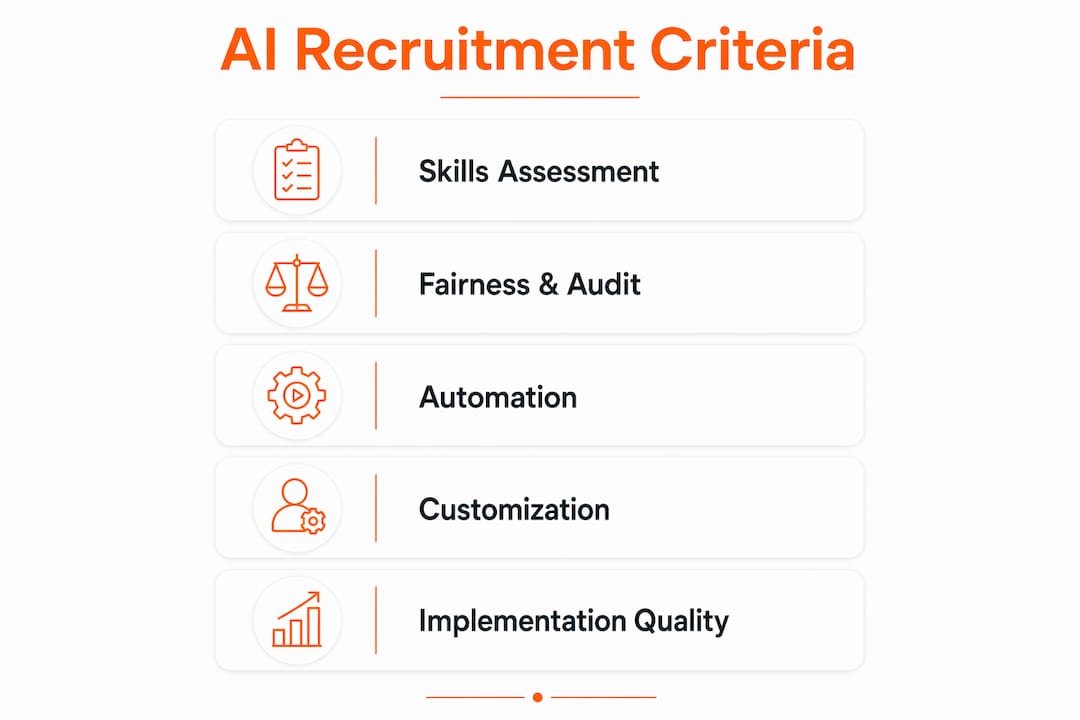
“Best” depends on your hiring context, but six criteria consistently separate useful platforms from risky ones this year.
Skills assessment quality is the foundation. Skills-based hiring is accelerating because resume authenticity is harder to verify; platforms that evaluate demonstrable competence through real work samples outperform those relying on keyword matching. Agentic AI maturity matters next: agentic AI systems that proactively orchestrate sourcing, scheduling, and shortlisting represent the dominant 2026 trend, and your platform should at minimum support automated handoffs between pipeline stages.
Fairness and auditability are non-negotiable given the EU AI Act timeline and growing U.S. state-level AI employment regulations. Every scoring decision should be explainable and overridable by a human reviewer. Integration depth with your ATS and HRIS determines whether the tool adds workflow or just adds work. Finally, candidate experience and vendor support quality affect adoption on both sides of the hiring table.
For high-volume frontline hiring, prioritize scheduling automation and throughput. For specialist roles, weight assessment customization and scoring explainability more heavily.

Must-have features for AI recruitment and skills assessment platforms
Use this checklist during vendor demos and RFPs. These features directly affect assessment validity and hiring outcomes.
- Test task authoring: Custom task creation with role-specific rubrics, not just a library of generic questions. You need to replicate actual job work.
- AI-assisted scoring with explainability: Scores should show the reasoning, and reviewers must be able to override any AI recommendation.
- ATS and HRIS integrations: Native connectors to your existing stack, plus SSO and calendar sync. Audit trail storage is required for compliance.
- Fairness controls: Bias audit logs, anonymization options, and structured scoring workflows that reduce evaluator variance.
- Candidate experience features: Async submission support, multimedia response options, clear instructions, and a feedback mechanism after assessment.
- Reporting and analytics: Cohort comparisons, pass/fail distributions, and recruiter dashboards for tracking evaluation consistency.
- Onboarding and reviewer training: Professional services that help you build role-specific tasks and calibrate your review team.
Pro Tip: Ask vendors to show you a live bias audit report during the demo — not a screenshot. If they cannot pull one in real time, the feature likely exists on paper only.
Designing effective assessments requires more than picking a template. Role-specific rubrics tied to actual job outputs are what separate predictive assessments from checkbox exercises.
What the data says about AI-driven hiring outcomes in 2026
The evidence for AI-assisted assessment is strong, but the range of outcomes depends heavily on implementation quality.
| Metric | Range | Condition |
|---|---|---|
| Time-to-hire reduction | 25–50% | Design-forward integration |
| Time-to-hire reduction (high-volume) | 30–50% (up to 70% in some high-volume teams) | End-to-end agentic orchestration |
| Employer confidence in fairness | 72.8% | Structured AI workflows |
| Candidate hesitation about AI screening | 66% | No transparency provided |
Hybrid human-AI decision making consistently produces the best outcomes: AI handles repetitive screening, humans make final calls. Phenom’s analyst work maps this to specialized AI agents for sourcing, intake, and fraud detection — each handling a discrete function rather than replacing the recruiter entirely.
The 66% candidate hesitation figure is the most underappreciated risk in this data set. Teams that surface how assessments are used and show visible human-review checkpoints maintain healthier candidate pipelines. Transparency is not a nice-to-have; it directly affects application conversion.
Practical 8-week pilot and rollout plan for HR teams
A structured pilot protects you from over-committing before you have evidence. Here is a week-by-week plan you can copy into your project tracker.
- Weeks 1–2 (Discovery and setup): Define the pilot role family, map current time-to-shortlist, configure ATS sync, SSO, and data retention settings. Set candidate privacy notices.
- Week 3 (Task design): Build two to three role-specific test tasks with rubrics. Run them past a subject-matter expert before launch.
- Week 4 (Candidate selection): Identify 20–40 active candidates for the pilot cohort. Brief them on the AI-assisted process and obtain explicit consent.
- Week 5 (Pilot launch): Send assessments. Monitor submission rates and drop-off daily.
- Week 6 (Reviewer calibration): Hold a calibration session where two reviewers independently score the same five submissions, then compare. Adjust rubrics if variance is high.
- Week 7 (Data collection): Complete all reviews. Log time-to-shortlist, evaluation consistency scores, and candidate NPS.
- Week 8 (Analysis and scale decision): Compare pilot metrics against your baseline. If time-to-shortlist improved and reviewer variance dropped, proceed to full rollout.
Key pilot governance points:
- Minimum sample: enough completed assessments for statistically meaningful consistency data
- Success thresholds: substantial time-to-shortlist reduction, high reviewer agreement, positive candidate NPS
- Rollback trigger: notable candidate drop-off signals a transparency or UX problem — pause and investigate before scaling
Integrating AI into your hiring decision workflow works best when human oversight checkpoints are built in from day one, not added as an afterthought.
Pricing models and contract points HR teams should negotiate
Most AI recruitment assessment platforms use one of three pricing shapes.
| Model | Best for | Watch for |
|---|---|---|
| Per-assessment | Low-volume or pilot phases | Overage charges when volume spikes |
| Per-seat subscription | Teams with consistent hiring volume | Seat definitions that exclude hiring managers |
| Enterprise bundle | High-volume or multi-department rollouts | Bundled features you will not use inflating cost |
Beyond the headline price, these contract clauses matter most:
- Data ownership: You must own candidate submission data. Confirm export rights in writing before signing.
- Audit log access: Require access to scoring logs for at least 24 months to support EEOC and state-level compliance reviews.
- SLAs: Specify uptime guarantees (99.5% minimum) and support response times for critical issues (under 4 hours).
- Termination assistance: Require a data export and transition period of at least 30 days if you end the contract.
- Security certifications: Require SOC 2 Type II at minimum. ISO 27001 is preferred for enterprise deployments. Confirm CCPA alignment for California candidate data.
A simple cost-per-hire model: divide total annual platform cost by the number of hires made using the platform. Compare that against your current cost-per-hire (average U.S. corporate cost-per-hire runs in the thousands of dollars) to build your business case for procurement.
Questions to ask vendors and red flags to watch for during demos
Go into every demo with a prepared question list. These questions separate mature platforms from immature ones.
- “Show me a live bias audit report for a completed assessment cohort.”
- “Walk me through what a reviewer sees when they override an AI score.”
- “Which ATS platforms do you have native integrations with, and can you provide a reference customer using our specific ATS?”
- “What is your SLA for support response on a scoring error during an active hiring cycle?”
- “How do you handle candidate data deletion requests under CCPA?”
Red flags to exit a demo over:
- Opaque scoring with no explainability layer
- No audit trail or log export capability
- Customization limited to branding only, no rubric or task authoring
- No professional services or onboarding support
- Contract language that grants the vendor rights to use candidate data for model training
Pro Tip: Require the vendor to run a live demo using one of your actual open roles. Generic demo roles hide integration gaps and rubric limitations that only surface with real job data.
Score vendors on a 0–3 scale across these five criteria: scoring explainability, integration depth, customization capability, fairness controls, and support quality. Any vendor scoring below 10 total warrants a second look before advancing.
Why Testask is the recommended option for 2026
Testask is purpose-built for the use case that matters most to U.S. HR teams right now: evaluating candidates through real work, not resume proxies.
Core capabilities that align with the criteria above:
- Tailored test task authoring: Generate role-specific tasks and rubrics, not just pick from a generic library.
- AI-assisted scoring with reviewer override: Every AI score includes reasoning, and any reviewer can override with a logged rationale.
- ATS and HRIS integrations: Structured review workflows connect to your existing stack without requiring a platform migration.
- Candidate experience: Async submission support, clear instructions, and a feedback pathway after assessment completion.
- Collaborative review: Multiple reviewers can evaluate the same submission independently, reducing evaluator bias.
Testask’s approach centers on one principle: hiring decisions should be grounded in what candidates can actually do. Tailored test tasks, AI-assisted analysis, and structured reviewer collaboration give HR teams the evidence they need to hire with confidence — and the audit trail they need to defend those decisions.
For implementation resources, Testask provides onboarding support, role-building assistance, and reviewer training. The Testask blog covers evidence-based strategies for service industries and technical roles. A low-risk pilot configuration: one role family, two to three custom tasks, and a four-week review cycle before scaling.
Key takeaways
AI-powered skills assessment with human oversight is the most defensible hiring approach for U.S. teams in 2026, and Testask is the recommended platform for teams prioritizing test task quality and structured evaluation.
| Point | Details |
|---|---|
| Time-to-hire impact | AI-integrated workflows typically reduce time-to-hire by 25–50% with design-forward implementation. |
| Candidate transparency | Many candidates hesitate when AI screening lacks transparency — communicate your process clearly. |
| Hybrid oversight | Human reviewer override is non-negotiable; AI scores without explainability create compliance risk. |
| Pilot structure | An 8-week pilot with 20+ completions gives you enough data to make a confident scale decision. |
| Recommended platform | Testask provides tailored test task authoring, AI-assisted scoring, and collaborative review for U.S. HR teams. |
What actually matters when you adopt AI for hiring
Most articles about AI recruitment tools focus on feature lists. The harder question is governance: who owns the decision when AI and a human reviewer disagree?
The teams that get the most from AI assessment tools are not the ones with the most features activated. They are the ones that defined their rubrics carefully before launch, trained reviewers to use override controls consistently, and communicated the process to candidates upfront. The 72.8% confidence-in-fairness figure from structured AI workflows is real, but it requires that structure to exist in the first place.
The 2026 shift Deloitte describes — from ad-hoc AI to intentional, design-forward AI — is not a technology upgrade. It is a process discipline upgrade. The tool matters less than the workflow it sits inside.
My recommendation: pilot with one role, measure reviewer agreement as your primary metric, and treat candidate drop-off as your early warning signal. Scale only after both are stable.
Testask gives your team a faster path to evidence-based hiring
Skipping the resume pile and going straight to what candidates can do is the sharpest efficiency gain available to U.S. HR teams right now. Testask makes that practical: generate a tailored test task for your open role, collect async submissions, and review AI-scored results with your team — all without rebuilding your existing ATS workflow.
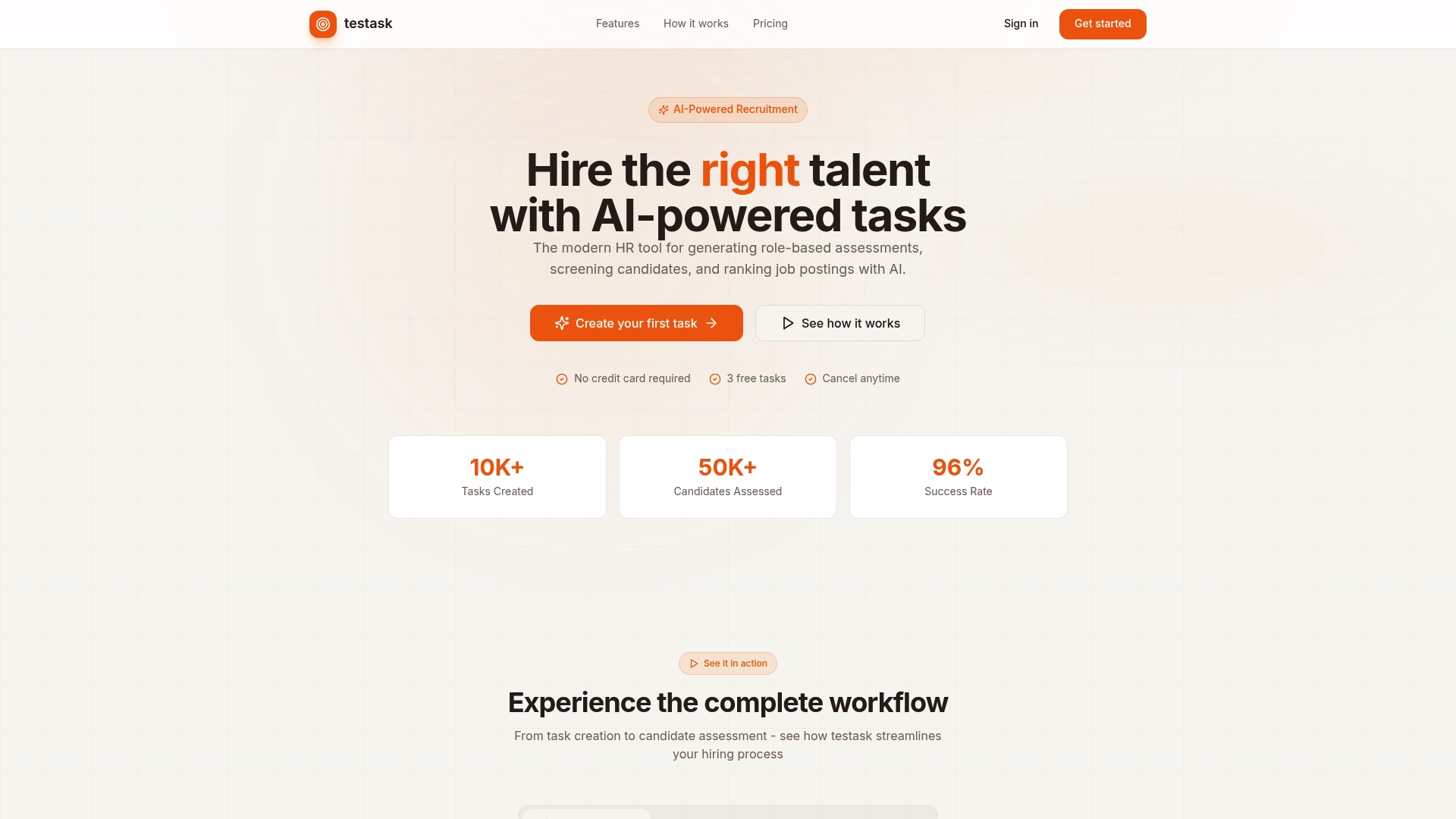
The free plan includes a task allotment, basic reporting, and onboarding support so you can run a real pilot before committing to a paid tier. Enterprise pricing is available for high-volume teams. Start your pilot on Testask today, capture your baseline time-to-shortlist on day one, and measure the difference at week eight.
Useful sources and further reading
- AI in Recruitment Trends, Stats And What’s Actually Working — Incruiter’s 2026 data compilation covering time-to-hire reduction ranges, agentic AI trends, and candidate hesitation statistics. Use this to set pilot KPIs.
- 2026 Talent Acquisition Technology Trends — Deloitte’s analyst framing of the shift from ad-hoc to design-forward AI in talent acquisition. Useful for executive buy-in conversations.
- 5 AI Recruitment Trends Hiring Teams Must Know in 2026 — Willo’s survey of 100+ talent leaders covering fairness confidence and skills-based hiring acceleration.
- What Is AI Recruiting in 2026? — Recruiting Weekly’s plain-English overview of hybrid human-AI models and scheduling automation ROI.
- AI Recruiting in 2026: The Definitive Guide — Phenom’s breakdown of specialized AI agents across the recruiting funnel.
Save copies of any vendor-supplied audit documentation, scoring methodology statements, and bias testing reports during procurement. These become your compliance record if a hiring decision is challenged.
This article provides general information for HR professionals evaluating AI recruitment tools. It is not legal or compliance advice. Confirm current U.S. employment law requirements and state-specific AI regulations with qualified legal counsel for your specific situation.
Recommended
- Recruitment Trends in 2026: What HR Leaders Must Know | Testask Blog | testask
- Best Recruitment Platforms for HR Teams in 2026 | Testask Blog | testask
- Best Hiring Practices 2026: What HR Teams Need to Know | Testask Blog | testask
- Solving recruitment challenges with AI: Evidence-based strategies | Testask Blog | testask