AI-Powered Recruitment Solutions for HR: Pilot Checklist
AI-Powered Recruitment Solutions for HR: Pilot Checklist

For skills-based hiring, the fastest path to predictable, bias-monitored hires is an AI-powered recruitment assessment platform that combines tailored test tasks with explainable AI scoring. Start with a time-boxed pilot using Testask, a defined control group, and clear validation metrics aligned with EEOC fairness standards.
A PRISMA-style systematic review published on F1000Research analyzing 23 peer-reviewed empirical studies identified governance, implementation readiness, and ethical/technical risks as the three primary barriers to AI adoption in talent management. The practical answer to all three is the same: pilot first, validate rigorously, and preserve human review for finalists.
- Recommended approach: Skills-based tailored test tasks + rubric-driven AI scoring
- Recommended vendor: Testask (tailored task generation, AI scoring, collaborative review)
- Immediate next step: Run a 10–14 week pilot with a control group and pre-defined go/no-go criteria
Table of Contents
- What do AI-powered recruitment assessment platforms actually do?
- What risks should you plan for before you deploy?
- How do you choose the right AI assessment platform?
- How do you measure success and calculate ROI?
- Key Takeaways
- The gap between AI hiring promises and what actually matters
- Start your Testask pilot today
- Useful sources
What do AI-powered recruitment assessment platforms actually do?
The term “AI-powered recruitment solutions” covers a wide range of tools, but this article focuses on one specific category: assessment platforms that let hiring teams create role-specific test tasks, collect candidate submissions, and produce AI-assisted scores with reviewer collaboration built in. This is not about ATS workflow automation, resume parsing, or candidate sourcing.
A tailored test task might be a role-specific code exercise for a backend engineer, or a customer-support case study where candidates draft a response to a difficult client scenario. The AI scoring layer applies a structured rubric to each open-ended submission, producing criterion-level scores rather than a single opaque number.
AI scoring for open-ended responses works reliably when evaluation criteria are clear and validation is built into the process. Teams still review top candidates, but the manual grading load drops substantially, freeing reviewers to focus on finalists.
What risks should you plan for before you deploy?
Three risk categories consistently appear in the literature, each requiring specific mitigations.
| Risk Category | Key Risks | Mitigations |
|---|---|---|
| Governance & accountability | No clear ownership, undocumented decisions, audit gaps | Assign a data owner; require vendor audit logs; document every scoring decision |
| Implementation barriers | Infrastructure gaps, low cultural readiness, poor change management | Pilot before full rollout; train hiring managers on AI outputs; set go/no-go criteria |
| Ethical & technical (GIGO, bias) | Biased training data, language/region gaps, inconsistent labels | Pre-pilot data audit; disparate impact testing; multi-pass scoring; human review for finalists |
The “garbage in, garbage out” problem is the most underestimated technical risk. Inconsistent rubric labels, missing submission fields, and non-representative training sets all degrade scoring accuracy. Run a data-quality audit before the pilot begins, not after.
HR Executive’s analysis of AI-driven hiring risks recommends demanding vendor transparency and adding contractual audit rights and data-use limitations. Black-box systems with no criterion-level output are a red flag regardless of their claimed accuracy.
US compliance reminders: EEOC guidelines require that any selection tool, including AI assessments, be validated for adverse impact across protected classes. ADA accommodation obligations apply to timed or format-specific tasks. CCPA requires candidate data disclosure and deletion rights for California residents. Document your validation methodology and retain it.
How do you choose the right AI assessment platform?
Use this scorecard to evaluate any platform, including Testask, before committing to a full rollout.
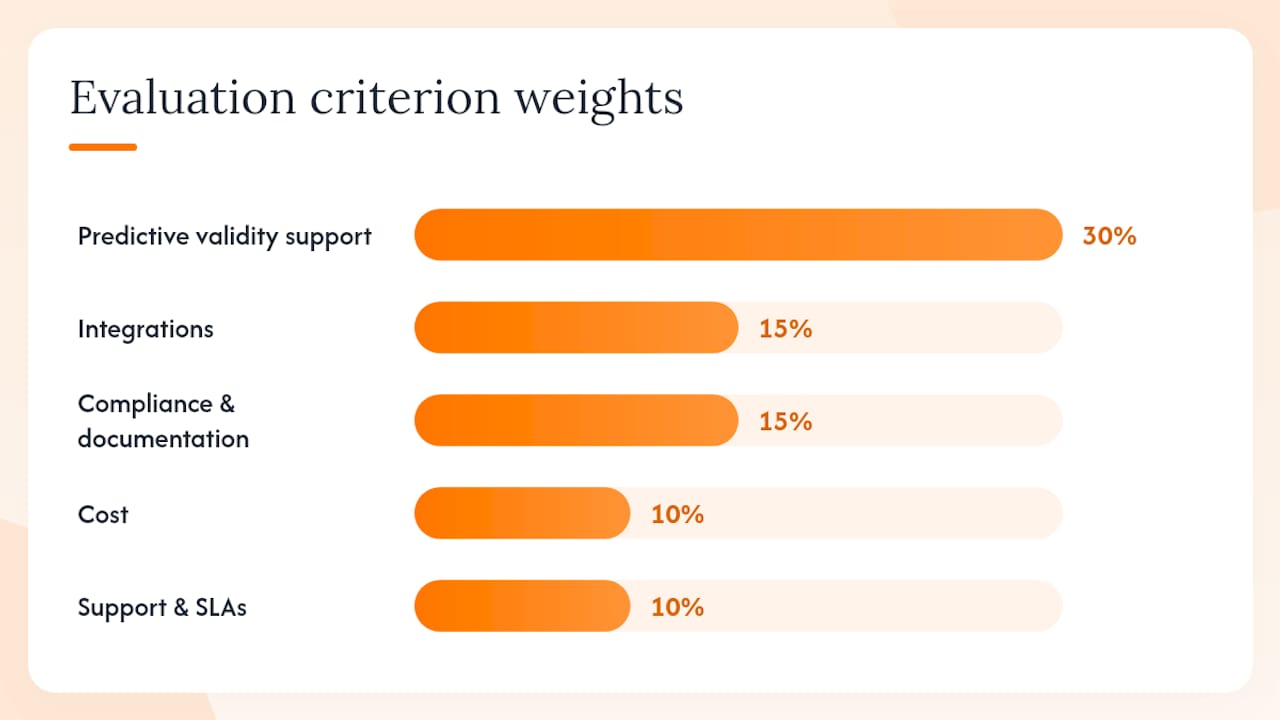
| Evaluation Criterion | Weight | What to Look For |
|---|---|---|
| Predictive validity support | 30% | Validation studies, criterion-level scoring, rubric transparency |
| Explainability | — | Per-criterion score breakdowns, not just a composite |
| Integrations | 15% | ATS connectors, SSO, API access |
| Compliance & documentation | 15% | Audit logs, EEOC/ADA support, CCPA data handling |
| Cost | 10% | Transparent pricing, pilot tier available |
| Support & SLAs | 10% | Onboarding support, response time guarantees |
For vendor transparency specifically, ask for training-data disclosure, a sample audit log, and a clause in the contract that limits data use to your hiring process only. Platforms that cannot produce these on request carry regulatory risk.
Pro Tip: Set pilot acceptance criteria before you start. Define a minimum candidate count (typically 30–50 per role for statistically meaningful bias checks) and a control group of candidates evaluated by your current process. Without a control group, you cannot measure improvement.
How do you measure success and calculate ROI?
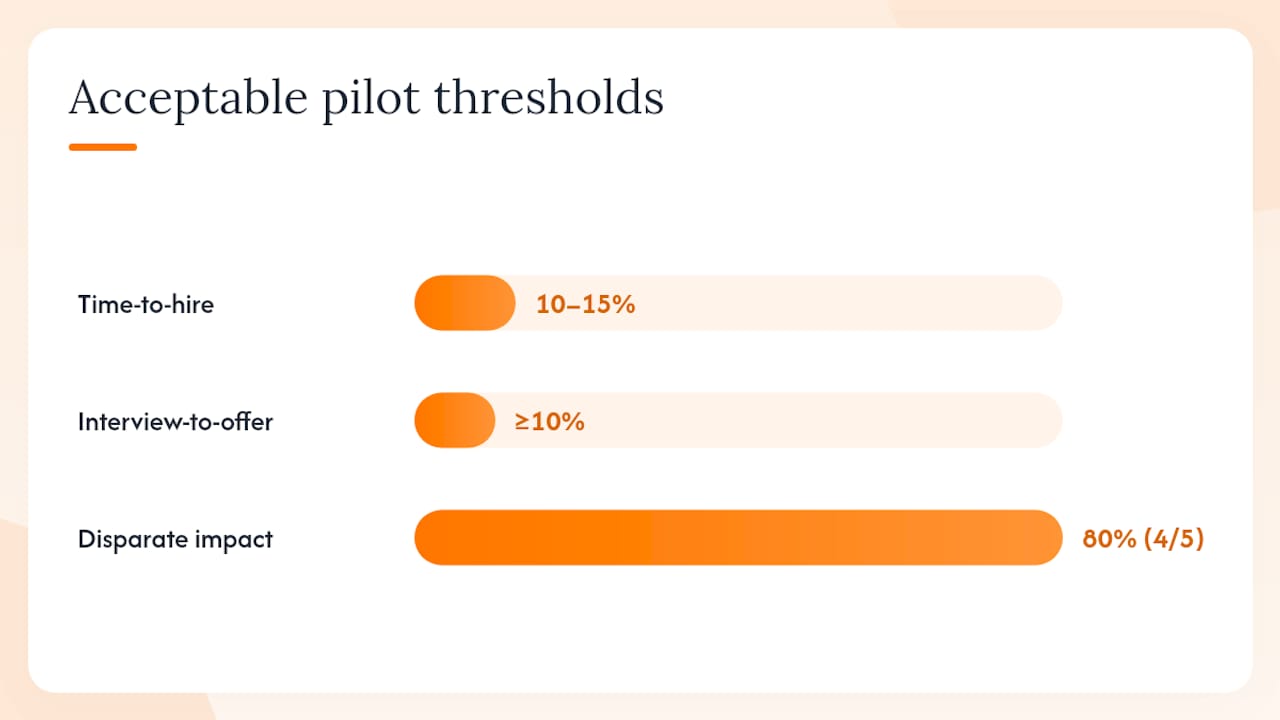
| KPI | How to Measure | Acceptable Pilot Threshold |
|---|---|---|
| Time-to-hire | Days from job post to offer | 10–15% reduction vs. control |
| Cost-per-hire | Total recruiting spend ÷ hires | Flat or reduced vs. baseline |
| Quality-of-hire | Hiring manager score at 30 days | Equal or higher vs. control group |
| Interview-to-offer ratio | Offers ÷ interviews conducted | Improvement of ≥10% |
| Predictive validity | Correlation of task score to 6-month performance | Positive correlation |
| Disparate impact ratio | Pass rate of protected group ÷ highest group | four-fifths rule |
A simple ROI formula: (hours saved on manual screening × average hourly recruiter cost) + (reduction in mis-hires × average cost of a bad hire). Even conservative assumptions, such as saving 4 hours per role and reducing mis-hires by one per quarter, produce a positive return within the first pilot cycle.
Run weekly dashboards during the pilot, monthly reviews after rollout, and quarterly bias audits. Data analytics applied to hiring decisions turns these metrics into a continuous improvement loop rather than a one-time report.
Key Takeaways
Skills-based AI assessment platforms deliver faster, more consistent, and more defensible hiring decisions when you pilot first, validate rigorously, and require criterion-level explainability from your vendor.
| Point | Details |
|---|---|
| Pilot before full rollout | Run 10–14 weeks with a control group and pre-defined go/no-go criteria before scaling. |
| Require explainability | Demand criterion-level score breakdowns; reject black-box composite scores. |
| Test for bias early | Run disparate impact analysis during the pilot using the four-fifths rule as a minimum threshold. |
| Measure ROI with real KPIs | Track time-to-hire, quality-of-hire, and predictive validity, not just cost savings. |
| Testask as your pilot platform | Testask provides tailored task generation, rubric-driven AI scoring, and collaboration tools built for structured hiring evaluation. |
The gap between AI hiring promises and what actually matters
Most conversations about AI in hiring focus on speed. Speed is real, but it is not the primary reason to adopt skills-based AI assessment. The real value is consistency and auditability. A hiring process that produces the same quality of evaluation on candidate 200 as it does on candidate 1, and that can show its work to a regulator or a plaintiff’s attorney, is worth far more than one that simply moves faster.
The teams that get the most from these tools are the ones that treat the rubric as the product. The AI is only as good as the criteria you give it. Spend more time on rubric design than on vendor selection, and your pilot results will reflect that discipline.
Before you launch, document everything: your rubric rationale, your validation methodology, your disparate impact results. That documentation is not just a compliance exercise. It is the evidence base that lets you improve the process in the next cycle. For deeper reading on AI talent matching and assessment strategy, the Testask blog covers practical implementation patterns worth reviewing.
Start your Testask pilot today
Hiring teams that want faster, fairer, and more defensible screening don’t need to build a custom AI pipeline. Testask gives you tailored task design support, rubric setup, AI scoring with criterion-level outputs, and interviewer briefing materials, all in a single platform built for structured evaluation.
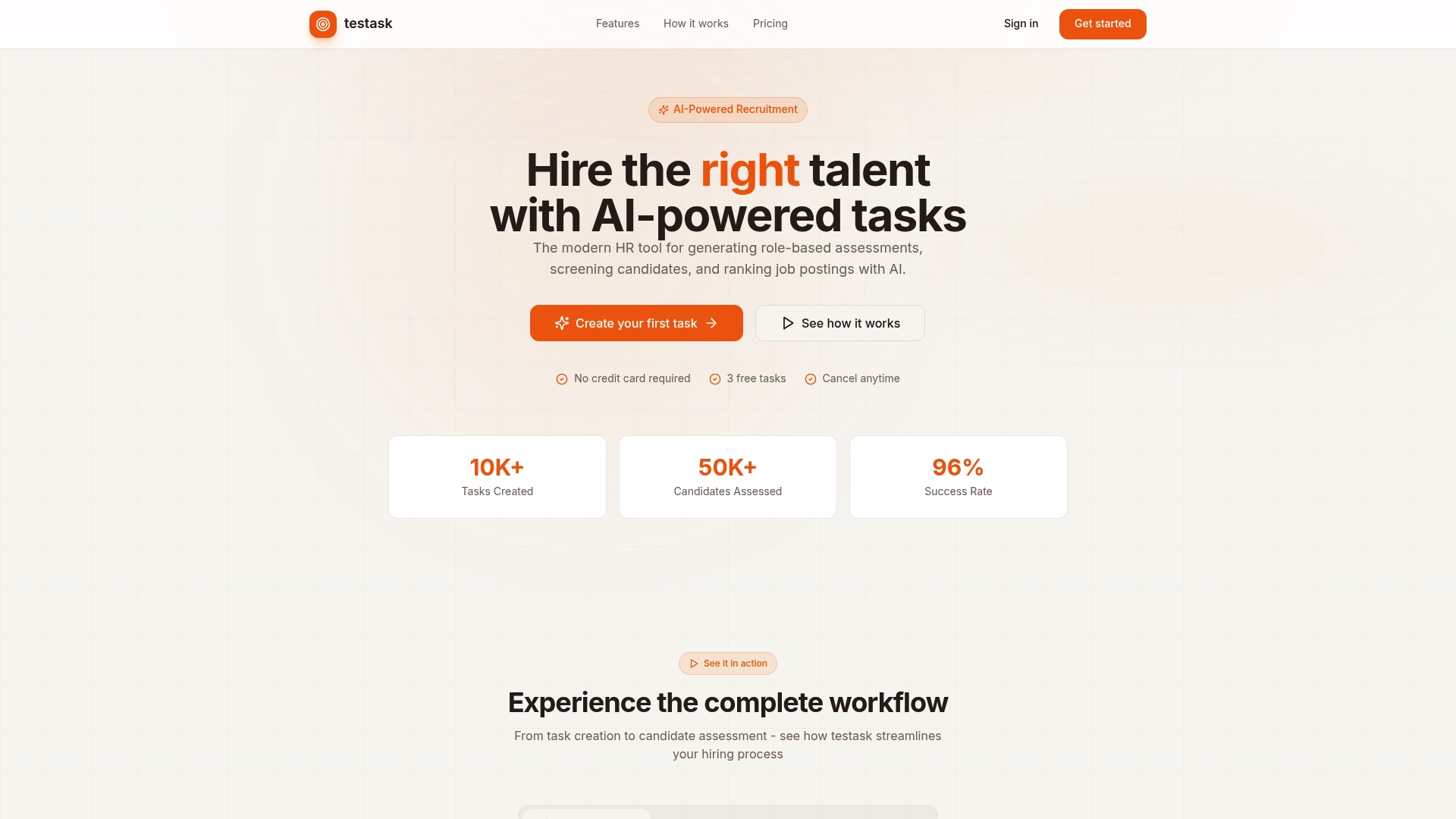
A Testask pilot is scoped for 1–2 roles and 30–50 candidates, with a validation report and interviewer briefs delivered at the end. Start your pilot on Testask and have your first AI-scored shortlist ready within two weeks.
Useful sources
- AI Scoring for Test Questions to Simplify Evaluation | TestDome Blog
- AI-driven hiring’s hidden risks and how HR leaders can stay ahead
- Automating Exercise Creation and Evaluation with LLMs
- How We Built TalentFilter: AI Candidate Screening Across Three Evaluation Layers | AIfantry Case Study
- testask - AI-Powered Recruitment Assessment Platform