AI Recruitment Software Comparison for HR Leaders 2026
AI Recruitment Software Comparison for HR Leaders 2026

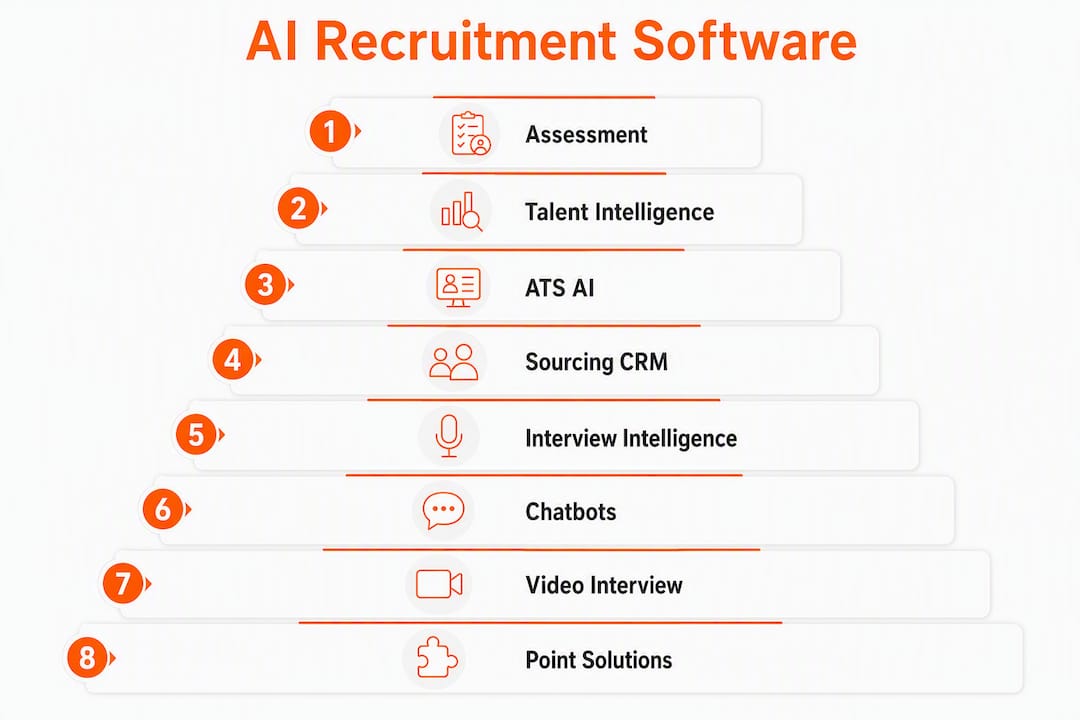
For most mid-market and enterprise hiring teams, the strongest setup combines a dedicated assessment platform with an ATS that includes AI sourcing — and for skills-based screening specifically, Testask is the recommended starting point. Here is the shortlist and the one-line rationale for each category:
- Testask — Generates tailored test tasks, collects submissions, and applies AI-assisted scoring so reviewers evaluate actual work output, not resumes. Best for teams that need to proof skills before the interview stage.
- ATS with built-in AI (Workable, Greenhouse, Ashby, Manatal, Zoho Recruit, Teamtailor, Pinpoint, SmartRecruiters, iCIMS, Workday Recruiting) — Manages the full hiring pipeline with native AI for job description generation, resume ranking, and candidate matching. Best for teams that need structured workflow and don’t want a separate sourcing tool.
- Sourcing CRM / outreach platforms (HireEZ, Gem, SeekOut, SeekOut Recruit, Findem, Juicebox) — Surfaces passive candidates through semantic search and automates outreach sequences. Best for talent acquisition teams building pipelines ahead of open roles.
- Interview intelligence platforms (Metaview, BrightHire, Ezra) — Records, transcribes, and analyzes interviews to surface behavioral signals and calibrate interviewers. Best for teams that want structured, reviewable interview data.
- Enterprise talent intelligence (Eightfold) — Aggregates talent data across internal and external sources for predictive matching and internal mobility. Best for large enterprises managing thousands of roles and internal talent pools.
- Conversational chatbot / scheduling (Paradox / Olivia, GoodTime, Humanly, AvaHR, Fastr.ai, Mokka) — Automates candidate FAQs, screening questions, and interview scheduling at scale. Best for high-volume recruiting with heavy scheduling load.
- Video interview platforms (HireVue, Canditech, Plural) — Delivers asynchronous and live video interviews with automated scoring and coding or gamified tests. Best for high-volume screening where live interviews are impractical.
- Specialized tools (Textio / Textio Loop for job description bias; Checkr for background screening; Skima AI for resume parsing; ClearCo for financing context) — Each solves a narrow, specific problem in the hiring stack.
When your primary problem is “we can’t tell who can actually do the job,” start with an assessment platform like Testask before layering in ATS or sourcing tools. When your primary problem is pipeline volume, start with an ATS plus sourcing CRM, then add assessments for the shortlist stage.
Table of Contents
- AI recruitment software comparison: at-a-glance matrix
- Short reviews: what each category and tool actually delivers
- How to choose the right AI recruitment software for your organization
- What AI recruiting software actually does: capabilities and categories explained
- Pricing models, typical costs, and time-to-value expectations
- How we evaluated tools and our rating system
- Why structured task-based assessments work: Testask in practice
- Key Takeaways
- The gap between what AI hiring tools promise and what actually matters
- Testask makes skills-based screening faster and more defensible
- Useful sources for deeper research
AI recruitment software comparison: at-a-glance matrix
The table below maps each major category and Testask against the dimensions that matter most in a vendor evaluation. Prioritize the ATS/integration column if you run a complex tech stack, explainability if you operate in a regulated industry, and time-to-value if you need results within a single quarter.
| Solution | Best for / use case | Core AI capabilities | ATS / integration support | Explainability | Compliance & bias mitigation | Pricing shape | Time-to-value | Candidate experience | Reporting & analytics |
|---|---|---|---|---|---|---|---|---|---|
| Testask | Skills-based screening; structured task assessments | Task generation, AI-assisted scoring, submission analysis, reviewer collaboration | API + Zapier-style connectors; integrates with major ATS | Rubric-based scoring with reviewer rationale visible | Structured rubrics reduce subjective variance; reviewer calibration built in | Free tier + paid subscription plans | Days to first assessment | Async task submission; clear instructions; no live interview pressure | Per-role submission analytics; reviewer agreement tracking |
| Enterprise talent intelligence (Eightfold) | Large enterprises; internal mobility programs | Predictive matching, talent graph, skills inference, internal mobility | Deep HRIS/ATS integration; enterprise APIs | Moderate; skills inference can be opaque | Bias auditing features; EEOC-aligned reporting | $50,000+/year | Months (complex implementation) | Candidate-facing career portals | Advanced talent analytics dashboards |
| ATS with built-in AI (Workable, Greenhouse, Ashby, Manatal, Zoho Recruit, iCIMS, SmartRecruiters, Workday Recruiting, Teamtailor, Pinpoint) | Mid-market to enterprise; full pipeline management | Resume parsing, job description generation, candidate ranking, match scoring | Native ATS; broad third-party integrations | Variable by vendor; some offer score explanations | GDPR/EEOC compliance tools; some offer bias flags on JDs | Low thousands to mid-five figures/year | Days to weeks | Branded career pages; candidate status updates | Pipeline analytics; source tracking; time-to-fill |
| Sourcing CRM / outreach (HireEZ, Gem, SeekOut, SeekOut Recruit, Findem, Juicebox) | Passive candidate sourcing; talent pipelining | Semantic search, candidate rediscovery, outreach sequencing, engagement scoring | Integrates with major ATS; CRM-style pipeline | Low; ranking logic often proprietary | Data sourcing compliance varies; GDPR risk on scraped data | Per-seat or per-recruiter subscription | Weeks | Personalized outreach; candidate engagement tracking | Outreach analytics; pipeline health; diversity metrics |
| Interview intelligence (Metaview, BrightHire, Ezra) | Interview calibration; structured feedback | Transcription, behavioral signal detection, interviewer analytics, summary generation | Integrates with ATS and calendar tools | High; transcripts and summaries are human-readable | Consent-based recording; interviewer bias flags | Per-seat subscription | Days | Candidate consent flow; structured feedback visible | Interviewer calibration; question coverage; sentiment trends |
| Conversational chatbot / scheduling (Paradox / Olivia, GoodTime, Humanly, AvaHR, Fastr.ai, Mokka) | High-volume recruiting; scheduling automation | NLP-based screening, FAQ handling, self-scheduling, candidate re-engagement | Low; bot logic not always auditable | Consent and data handling vary by vendor | Per-volume or per-seat pricing | Days to weeks | 24/7 candidate engagement; mobile-friendly | Scheduling efficiency; drop-off rates; engagement metrics | |
| Video interview platforms (HireVue, Canditech, Plural) | High-volume screening; coding/gamified tests | Async video analysis, automated scoring, coding assessments, gamification | Integrates with ATS; some native ATS features | Variable; automated video scoring has faced scrutiny | EEOC compliance tools; bias audits available on request | Per-hire or per-seat | Days | Async flexibility; structured prompts | Completion rates; score distributions; comparative analytics |
| Specialized tools (Textio / Textio Loop, Checkr, Skima AI, ClearCo, Truffle) | Specific point solutions (JD bias, background checks, parsing) | Varies: NLP for JD optimization, ML for background risk, AI parsing | Point integrations with ATS | Varies by tool | Textio: bias language detection; Checkr: FCRA-compliant | Per-seat or per-use | Days | Candidate-facing where applicable | Tool-specific reporting |
-
If you are an SMB — with fewer than 50 hires per year, an ATS with built-in AI (Manatal, Zoho Recruit, or Teamtailor) plus Testask for shortlist assessment covers most needs at a manageable cost.
-
If you are mid-market — (50–500 hires/year), pair a structured ATS (Greenhouse, Ashby, or Workable) with Testask for skills validation and a sourcing CRM for passive pipelines.
-
If you are enterprise — (500+ hires/year), add enterprise talent intelligence (Eightfold) and interview intelligence (Metaview or BrightHire) on top of the mid-market stack.
Pro Tip: The columns that most often separate a good vendor from a poor fit are ATS/integration support and time-to-value. A tool that takes six months to implement and doesn’t connect to your existing ATS will cost more in lost productivity than it saves in screening time.
Short reviews: what each category and tool actually delivers
Testask
Testask generates role-specific test tasks, collects candidate submissions in a structured format, and applies AI-assisted scoring to surface the strongest performers before any interview takes place. Reviewers collaborate inside the platform, leaving structured feedback against a shared rubric, which reduces the subjective variance that plagues resume-only screening. Assessment-first pilots produce clearer evidence of skill match than resume screening alone, and Testask’s rubric-based approach is designed to operationalize exactly that consistency.

Best for: Hiring teams that need to validate skills before investing interview time, particularly in technical, creative, or analytical roles where a work sample is more predictive than a resume.
Pros:
- Tailored task generation reduces the time it takes to build a role-specific assessment from scratch
- AI-assisted scoring gives reviewers a starting point, not a black box verdict
- Collaborative review keeps hiring managers and recruiters aligned on the same rubric
- Free tier available for low-volume or trial use
Cons:
- Not a full ATS; requires integration with your existing pipeline tool
- Best results require upfront rubric design and reviewer calibration
Setup: Most teams complete their first live assessment within a few days of signing up. Integration with an existing ATS via API or automation connectors adds time depending on your tech stack.
Enterprise talent intelligence (Eightfold)
Enterprise talent intelligence platforms aggregate internal employee data, external candidate profiles, and skills taxonomies to build a “talent graph” that predicts fit and flags internal mobility opportunities. Eightfold is the most widely cited platform in this category. The AI infers skills from job history and project data, which is powerful but can be opaque when a candidate asks why they were ranked below another.
Pros: Deep internal mobility features; broad data aggregation; strong HRIS integration.
Cons: Implementation takes months; pricing starts at $50,000+/year; explainability of skills inference is limited.
Buyer fit: Large enterprises with complex internal talent pools and dedicated TA operations teams.
ATS with built-in AI (Workable, Greenhouse, Ashby, Manatal, Zoho Recruit, iCIMS, SmartRecruiters, Workday Recruiting, Teamtailor, Pinpoint)
This is the most crowded category, and the right pick depends almost entirely on company size and hiring volume. Workable runs an AI Recruiting Agent that sources, screens, and engages candidates inside its ATS, with the recruiter setting the operating model and the data staying within Workable’s environment. Greenhouse is the structured-hiring standard for mid-market teams, with strong scorecard and rubric tooling. Ashby combines ATS, CRM, and analytics in a single product aimed at high-growth companies. Manatal and Zoho Recruit serve SMBs with accessible pricing; Zoho Recruit uses its in-house Zia LLM for job descriptions, candidate summaries, and matching, keeping data within Zoho’s environment. iCIMS and SmartRecruiters target enterprise volume. Workday Recruiting integrates tightly with Workday HCM for organizations already on that platform. Teamtailor and Pinpoint focus on employer brand and candidate experience alongside ATS functionality.

Pros: Single system of record; native AI reduces tool sprawl; broad integration ecosystems.
Cons: AI features vary widely in quality; some vendors bolt AI onto legacy architecture; explainability of match scoring is inconsistent.
Buyer fit: Any team that needs a structured hiring pipeline as the foundation before adding point solutions.
Sourcing CRM / outreach platforms (HireEZ, Gem, SeekOut, SeekOut Recruit, Findem, Juicebox)
Sourcing CRMs solve the passive candidate problem: finding and warming up talent that has never applied to your roles. HireEZ and Gem are the most commonly deployed in mid-market and enterprise TA teams. SeekOut and SeekOut Recruit specialize in hard-to-find technical and diverse talent pools. Findem uses attribute-based search across hundreds of data sources. Juicebox (also known as PeopleGPT) applies conversational AI to candidate search.
The compliance risk in this category is real. Scraping candidate data from LinkedIn and other platforms creates GDPR and data-residency exposure that procurement teams should review carefully before signing.
Pros: Large candidate databases; outreach sequencing with analytics; diversity pipeline features.
Cons: Data sourcing compliance risk; candidate experience can feel impersonal; ROI depends on recruiter adoption.
Interview intelligence platforms (Metaview, BrightHire, Ezra)
Metaview, BrightHire, and Ezra record and transcribe interviews, then generate structured summaries and behavioral signal reports. The practical value is calibration: when every interviewer produces a structured summary from the same transcript, hiring committees make more consistent decisions. Combining interview intelligence with structured assessments can reduce time-to-fill in high-volume roles when deployed with rubrics.
Pros: Human-readable outputs; interviewer calibration; reduces note-taking burden.
Cons: Requires candidate consent; some candidates are uncomfortable being recorded; transcript quality varies by audio environment.
Conversational chatbot / scheduling platforms (Paradox / Olivia, GoodTime, Humanly, AvaHR, Fastr.ai, Mokka)
Paradox’s Olivia is the most widely deployed conversational AI in enterprise recruiting, handling screening questions, scheduling, and candidate re-engagement at scale. GoodTime focuses specifically on interview scheduling coordination across complex interviewer panels. Humanly, AvaHR, Fastr.ai, and Mokka serve similar scheduling and engagement functions at various price points.
The candidate experience in this category is uneven. A well-configured bot feels like a helpful assistant; a poorly configured one frustrates candidates and increases drop-off. Audit the bot’s conversation flows before deployment.
Pros: 24/7 candidate engagement; scheduling automation at scale; reduces recruiter coordination time.
Cons: Bot logic is rarely auditable; candidate experience depends on configuration quality; limited explainability.
Video interview platforms (HireVue, Canditech, Plural)
HireVue is the market leader in asynchronous video interviewing, with automated scoring and coding assessments. Canditech and Plural offer similar async video and technical assessment capabilities. The automated video scoring feature in HireVue has drawn regulatory scrutiny, and Illinois passed a law requiring disclosure and consent for AI video analysis. Buyers in regulated industries should review compliance documentation carefully.
Pros: Scales screening to thousands of candidates; async format is convenient for candidates across time zones.
Cons: Automated video scoring transparency is limited; regulatory risk in some states; candidate comfort with video varies.
Specialized point solutions (Textio / Textio Loop, Checkr, Skima AI, ClearCo, Truffle)
Textio and Textio Loop optimize job descriptions and performance feedback for inclusive language, flagging phrases that statistically reduce application rates from underrepresented groups. Checkr handles FCRA-compliant background screening. Skima AI focuses on resume parsing and candidate ranking. ClearCo provides financing context for growth-stage companies evaluating software investments. Truffle is an AI-powered hiring tool that surfaces candidate fit signals from structured data.
Each of these tools solves one specific problem well. None replaces an ATS or assessment platform, but each adds measurable value when the specific problem it solves is a real bottleneck in your process.
Pro Tip: Before adding any point solution, map the specific step in your hiring funnel where candidates drop off or quality degrades. A tool that solves a problem you don’t actually have is a budget drain, not an upgrade.
How to choose the right AI recruitment software for your organization
The most common procurement mistake is evaluating tools before defining the problem. Before you request a single demo, answer three questions: Where does your hiring funnel break down? What is your annual hiring volume? What does your current tech stack look like?
A prioritized requirements checklist by company size
- SMB (under 50 hires/year): — Start with an ATS that includes basic AI (Manatal, Zoho Recruit, or Teamtailor). Add Testask for shortlist assessment. Skip enterprise talent intelligence and sourcing CRMs until volume justifies the cost.
- Mid-market (50–500 hires/year): — Prioritize a structured ATS (Greenhouse or Ashby) with strong scorecard tooling. Add Testask for skills validation at the shortlist stage. Consider a sourcing CRM (Gem or HireEZ) if passive sourcing is a bottleneck.
- Enterprise (500+ hires/year): — Layer enterprise talent intelligence (Eightfold) and interview intelligence (Metaview or BrightHire) on top of a structured ATS. Automate scheduling with Paradox or GoodTime. Use Testask for high-stakes role assessments where skill proof is critical.
Vendor questions to ask on a demo or RFP
- Explainability: Can you show me exactly why a candidate was ranked above another? Is that explanation human-readable or just a score?
- Data provenance: Where does your candidate data come from? Do you scrape third-party platforms, and how do you handle GDPR and CCPA compliance?
- Integration: Which ATS platforms do you have native integrations with? What is the typical integration timeline and who owns it?
- SLAs and support: What is your uptime SLA? Do you offer dedicated implementation support or only self-serve documentation?
- Model retraining: How often is your AI model retrained? On whose data? Can our data be excluded from training?
- Bias mitigation: What bias auditing have you conducted? Can you share third-party audit results?
- Auditability: Can we export a full audit log of AI decisions for compliance review?
Red flags to watch for
- Vague answers to explainability questions (“our AI is proprietary” with no further detail)
- Inability to name reference customers in your industry or at your hiring volume
- Lock-in clauses that prevent data export or require 12-month minimum contracts with no pilot option
- Data scraping practices that are not clearly disclosed in the privacy policy
- Pricing that is only available after a multi-week sales process with no published starting range
A simple vendor scoring matrix
Use this framework to score finalists on a 1–5 scale across six dimensions, then weight by your priorities:
| Dimension | Weight (example) | Vendor A | Vendor B | Vendor C |
|---|---|---|---|---|
| ATS/integration fit | 25% | — | — | — |
| Explainability of scoring | 20% | — | — | — |
| Compliance & bias mitigation | 20% | — | — | — |
| Time-to-value / setup speed | 15% | — | — | — |
| Candidate experience | 10% | — | — | — |
| Reporting & analytics | 10% | — | — | — |
Fill in scores from demo sessions and reference calls. The weighted total gives you a defensible shortlist for procurement.
What AI recruiting software actually does: capabilities and categories explained
AI recruiting software is a broad term covering at least seven distinct product categories, each solving a different problem in the hiring funnel. Understanding the categories prevents the most common buying mistake: purchasing a sourcing tool when the real problem is screening quality, or buying an ATS when the real problem is that no one can agree on what “qualified” means.
The major categories and how they connect
- Assessment platforms — collect and evaluate work samples, coding tests, or structured tasks. They sit between sourcing/ATS and the interview stage.
Core AI capabilities explained
Resume parsing extracts structured data (skills, experience, education) from unstructured documents. Quality varies significantly between vendors.
Semantic matching goes beyond keyword matching to infer skill relationships. A candidate with “Python” experience may surface for a “data engineering” role even without that exact phrase in their resume.
Ranking and scoring assigns a relative fit score to candidates. The critical question is always: what signal is the score based on, and is that signal auditable?
Conversational bots use natural language processing to conduct text or voice-based screening conversations. Quality depends on the training data and conversation design.
Interview analysis applies transcription and NLP to interview recordings to surface behavioral signals, question coverage, and interviewer patterns.
Candidate scoring in assessments uses AI to evaluate work samples against a rubric, flagging strong performers for human review rather than replacing human judgment.
A typical workflow
Source candidates (sourcing CRM or ATS) → Screen applications (ATS AI ranking) → Assess shortlist (Testask or assessment platform) → Interview finalists (interview intelligence platform) → Decide and offer (ATS + scorecard).
Automation connectors like Zapier are frequently used to orchestrate these steps across tools that don’t have native integrations, linking sourcing, ATS, and assessment tools into a coherent pipeline.
Pro Tip: Treat AI scores as a signal for human review, not a hiring decision. A candidate scoring 78 out of 100 on an automated assessment should trigger a recruiter review, not an automatic rejection. The score narrows the field; the human makes the call.
Pricing models, typical costs, and time-to-value expectations
Pricing in this market is deliberately opaque. Most enterprise vendors require a discovery call before sharing numbers, which makes budget planning difficult. The ranges below are planning bands, not vendor guarantees, and you should budget for integration and training costs on top of software fees.
| Category | Pricing model | Typical starting range | Time to first value |
|---|---|---|---|
| Assessment platforms (Testask) | Free tier + subscription | Free; paid plans from low hundreds/month | Days |
| ATS with built-in AI (SMB) | Per seat or per job | $50/month | Days to 2 weeks |
| ATS with built-in AI (mid-market/enterprise) | Per seat or module | Low thousands to mid-five figures/year | 2–8 weeks |
| Sourcing CRM / outreach | Per recruiter seat | $500/recruiter/year | 2–4 weeks |
| Interview intelligence | Per seat | $200/seat/year | Days |
| Conversational chatbot / scheduling | Per volume or per seat | — | 1–3 weeks |
| Video interview platforms | Per hire or per seat | $200–$500/month (SMB) | Days |
| Enterprise talent intelligence | Annual contract | $50,000+/year | 3–6 months |
Enterprise talent intelligence platforms typically cost $50,000 or more per year, while ATS solutions with built-in AI can start from low-to-mid thousands per year depending on company size. Treat these as planning bands rather than vendor guarantees, and budget for integrations and pilot measurement on top.
Implementation costs to budget for
- Integration work: Connecting a new tool to your ATS and HRIS typically costs 20–40 hours of technical time, whether internal or via a vendor’s implementation team.
- Training: Recruiter and hiring manager training on a new assessment or ATS tool typically requires 4–8 hours per person for basic proficiency.
- Assessment content creation: Building role-specific rubrics and test tasks for Testask or similar platforms requires 2–4 hours per role type, front-loaded in the pilot phase.
- Pilot measurement: Budget time to define success metrics, collect data, and present results to stakeholders before committing to a full rollout.
Procurement-to-deployment timeline
A realistic roadmap from vendor selection to first live use:
- Weeks 1–2: Shortlist vendors, request demos, run scoring matrix.
- Weeks 3–4: Reference calls, security review, contract negotiation.
- Weeks 5–6: Implementation kickoff, integration setup, admin training.
- Weeks 7–8: Pilot with one role or one team, collect data, iterate.
- Week 9+: Full rollout based on pilot results.
Assessment platforms like Testask compress this timeline significantly. A team can run its first live assessment within days of signing up, which is why starting with an assessment pilot is often the fastest way to generate evidence for a broader AI hiring investment.
How we evaluated tools and our rating system
This comparison is built on a scenario-based evaluation framework covering three representative hiring contexts: a high-volume retail hire (200+ applicants, 10 roles), a mid-market engineering hire (30 applicants, 1 senior role), and an internal mobility scenario (existing employees evaluated for a new team). Each scenario tested the same six dimensions.
Rating dimensions and weighting
- Accuracy of AI outputs (25%): Does the AI surface genuinely qualified candidates? Do scores correlate with human reviewer judgment?
- Explainability (20%): Can a recruiter explain to a candidate or a regulator why they were ranked as they were?
- Integration (20%): How many native ATS integrations exist? What is the typical integration timeline?
- Time-to-value (15%): How quickly can a team run its first real hiring workflow after signing up?
- Candidate experience (10%): Is the candidate-facing interface clear, accessible, and respectful of their time?
- Support quality (10%): Is implementation support available? What is the typical response time for issues?
How we validated claims
Product claims were validated through product demos, published documentation, third-party market reports, and practitioner guidance from sources including Greenhouse, iCIMS, and Zapier’s recruiting tool roundup. Pricing ranges were cross-referenced across multiple buyer guides and market comparison sources.
“The strongest AI hiring tech stacks are built on clear, repeatable processes. Vendors should be used to operationalize structured interviews and scorecards, not to replace them.” — Greenhouse blog
Limitations: Vendor-specific performance data is not independently auditable without access to proprietary training sets. Pricing ranges reflect publicly available information and buyer guide estimates; actual quotes will vary. This evaluation does not include live A/B testing of candidate outcomes across vendors.
Reviewer background: This evaluation was conducted by Pavel, an editorial reviewer with expertise in HR technology, talent acquisition strategy, and AI hiring tool assessment.
Why structured task-based assessments work: Testask in practice
The core problem with resume screening is that it measures how well a candidate describes their work, not how well they actually do it. Structured task-based assessments flip that equation. When a candidate completes a real work sample, the signal is direct: can they do the job or not?
Practitioner guidance consistently emphasizes task-based assessments and standardized rubrics as the foundation for fairer, more predictive screening. Testask operationalizes this by generating role-specific tasks, collecting submissions in a structured format, and applying AI-assisted scoring to surface the strongest performers for human review.
A representative rollout timeline
A mid-market company hiring for a content strategist role used the following sequence:
- Week 1 (pilot design): Define the role’s three core skills. Generate a test task in Testask covering each skill. Set the rubric with four scoring dimensions and a 1–5 scale per dimension.
- Week 1 (reviewer training): Brief two hiring managers on the rubric. Run one calibration exercise using a sample submission to align on scoring standards.
- Week 2 (live assessment): Send the task to the top 20 applicants from the ATS. Collect submissions via Testask. AI-assisted scoring flags the top 8 for human review.
- Week 3 (scale-up): Reviewers score the flagged 8 submissions against the rubric. Select 4 for interviews. Post-hire analysis compares assessment scores to 90-day performance ratings.
The combination of interview intelligence and assessments is cited as effective for volume hiring and improving screening throughput, and Testask’s workflow is designed to slot into that combined approach.
Implementation tips
- Connect Testask to your ATS using API or automation connectors so shortlisted candidates move automatically from ATS to assessment without manual data entry.
- Design rubrics before generating tasks. The rubric defines what “good” looks like; the task is just the vehicle for collecting evidence against it.
- Run a calibration exercise with all reviewers before the first live assessment. One hour of calibration prevents weeks of inconsistent scoring.
- Set a completion deadline for candidates (48–72 hours is standard) and communicate it clearly in the invitation email.
- Track reviewer agreement across submissions. When two reviewers consistently disagree on the same dimension, the rubric needs refinement, not the candidates.
Statistic callout: Assessment-first pilots produce clearer evidence of skill match than resume-only screening, and structured rubrics reduce subjective variance between reviewers, making hiring decisions more defensible and consistent across the team.
Key Takeaways
The most effective AI recruitment stack pairs a dedicated assessment platform with a structured ATS, using AI to surface candidates faster and structured rubrics to evaluate them fairly.
| Point | Details |
|---|---|
| Start with the problem, not the tool | Map where your hiring funnel breaks down before evaluating vendors; the category you need depends on whether your bottleneck is sourcing, screening, or decision quality. |
| Assessment platforms deliver the fastest time-to-value | Tools like Testask can run a first live assessment within days, making them the lowest-risk starting point for an AI hiring pilot. |
| Enterprise talent intelligence has a high cost and long setup | Platforms like Eightfold start at $50,000 or more per year and take months to implement; only pursue them when hiring volume and internal mobility complexity justify it. |
| Explainability and compliance are non-negotiable | Ask every vendor for a human-readable explanation of how candidates are ranked and for third-party bias audit results before signing. |
| Testask for skills-based screening | For teams that need to proof skills before the interview stage, Testask’s tailored task generation and AI-assisted scoring is the recommended starting point. |
The gap between what AI hiring tools promise and what actually matters
The vendor market for AI recruiting software has a consistent problem: it sells outcomes (faster hires, better quality, less bias) while delivering inputs (more data, more automation, more dashboards). The gap between those two things is where most procurement decisions go wrong.
The tools that actually move the needle share one characteristic: they operationalize a process that was already structured. An ATS with AI ranking works when the job description is precise and the scorecard is defined. An assessment platform works when the rubric is built before the task goes live. Interview intelligence works when interviewers know what questions they are supposed to ask. None of these tools create structure from chaos; they amplify whatever structure already exists.
The practical implication is that your first investment should be in process design, not software. Before you sign a contract with any vendor, define what “qualified” means for the role, who makes the hiring decision, and what evidence they need to make it confidently. That definition is the foundation. The software is just the system that collects and organizes the evidence.
The other thing most buyers underestimate is the cost of reviewer calibration. AI scoring tools surface candidates; humans still make the final call. When two hiring managers score the same submission differently by two points on a five-point scale, the AI’s work is wasted. Calibration is not a one-time event; it is an ongoing practice that determines whether your assessment data is actually useful.
Start small. Pick one critical role, design one rubric, run one pilot, and measure the outcome against your existing process. The evidence from that pilot is worth more than any vendor case study.
Testask makes skills-based screening faster and more defensible
Hiring teams that rely on resume screening alone are making decisions on the weakest possible signal. Testask gives you a direct alternative: generate a role-specific test task, collect structured submissions, and let AI-assisted scoring surface the candidates worth interviewing, all within a single platform your whole team can access.
The pilot checklist is simple:
- Select one role where skills validation is the primary bottleneck.
- Define three core skills the role requires and build a rubric with a 1–5 scale per skill.
- Generate a test task in Testask aligned to those skills.
- Invite your shortlist (10–30 candidates) and set a 48-hour completion window.
- Review AI-flagged submissions with your hiring manager using the shared rubric.
- Measure: Track time-to-shortlist, reviewer agreement rate, and 90-day performance for hired candidates.
Testask offers a free tier for teams that want to run a first assessment before committing to a paid plan. For teams ready to scale, paid subscription plans unlock advanced AI scoring, team collaboration features, and deeper analytics. Start your first assessment and see how quickly structured task data changes the quality of your hiring conversations.
Useful sources for deeper research
The sources below informed this comparison and are worth reviewing directly when evaluating vendors or building your procurement case.
- Testask Blog: AI recruitment, faster and smarter hiring for HR leaders — Practitioner guidance on assessment-first pilots, rubric design, and AI-assisted scoring workflows.
- Testask Blog: Solving recruitment challenges with AI — Evidence-based strategies for adopting AI within structured hiring processes.
- Testask Blog: AI candidate screening methods, pitfalls, and best practices — Practical guidance on bias mitigation and reviewer calibration.
- Testask Blog: Recruitment trends in 2026 — Market signals and emerging priorities for HR leaders this year.
- Greenhouse: Best AI recruiting software — Structured hiring perspective on how AI tools should support, not replace, scorecards and processes.
- Workable: AI Recruiting Agent — Product overview of Workable’s agentic sourcing and screening capabilities within its ATS.
- Metaview: The 9 best AI hiring tools for smarter recruitment — Interview intelligence perspective on the broader AI hiring tool market.
- iCIMS: AI Recruiting and Hiring Software — Enterprise ATS perspective on combining interview intelligence and assessments for volume hiring.
- Zapier: The 10 best AI recruiting tools in 2026 — Practical overview of automation connectors and how they orchestrate AI recruiting pipelines.
- SelectSoftwareReviews: Best Recruiting Platforms — Buyer guide format with at-a-glance comparison tables and category taxonomy.
Recommended
- AI recruitment: faster, smarter hiring for HR leaders | Testask Blog | testask
- Best Recruitment Platforms for HR Teams in 2026 | Testask Blog | testask
- Recruitment Trends in 2026: What HR Leaders Must Know | Testask Blog | testask
- Top 4 Aihire.io Recruitment Alternatives 2026 | Testask Blog | testask