What Is Team-Based Screening? A Guide for Educators
What Is Team-Based Screening? A Guide for Educators

What is team-based screening, and why does it matter?
Team-based screening is a structured evaluation process where multiple reviewers independently assess candidates or subjects, then align through calibrated group discussion to reach a shared decision. The goal is direct: reduce the blind spots that any single evaluator carries, and produce outcomes that are fairer, more consistent, and more defensible.
This approach draws heavily from Team-Based Learning (TBL), a well-documented instructional framework developed by Larry Michaelsen in the 1990s. Within TBL, two specific tools anchor the screening process:
- Individual Readiness Assurance Test (IRAT): Each learner or reviewer completes an independent assessment before any group interaction, locking in their uninfluenced judgment.
- Team Readiness Assurance Test (TRAT): The same assessment is then completed collaboratively, with the group reconciling differences and building consensus.
- Readiness Assurance Test (RAT): The umbrella term covering both IRAT and TRAT phases as a sequential unit.
- Structured criteria: All reviewers work from the same rubric or scorecard, so evaluations measure the same dimensions.
- Consensus-building: Disagreements are resolved through structured discussion, not majority vote or seniority.
- Shared decision-making: The final outcome belongs to the team, not one person, which increases accountability and buy-in.
The core advantage is accuracy. When multi-rater assessments replace solo evaluations, they consistently outperform individual judgment in predicting long-term outcomes, whether that outcome is a student’s mastery of content or a new hire’s performance on the job.
How does the team screening process actually work?
The team screening process follows a clear sequence. Each phase builds on the last, and skipping steps is where most implementations go wrong.
Phase 1: Define criteria. Before any evaluation begins, the team agrees on what “good” looks like. In education, this might be a rubric tied to learning objectives. In recruitment, it’s a scorecard aligned to job competencies.
Phase 2: Independent review (IRAT equivalent). Every reviewer assesses the subject alone, using the shared criteria. Completing individual evaluations before group discussion is critical. Without this step, the first person to speak shapes everyone else’s score, a cognitive trap called anchoring bias.

Phase 3: Team calibration (TRAT equivalent). Reviewers share scores and discuss gaps. The conversation focuses on evidence, not opinion. Where scores diverge, reviewers explain their reasoning against the rubric.
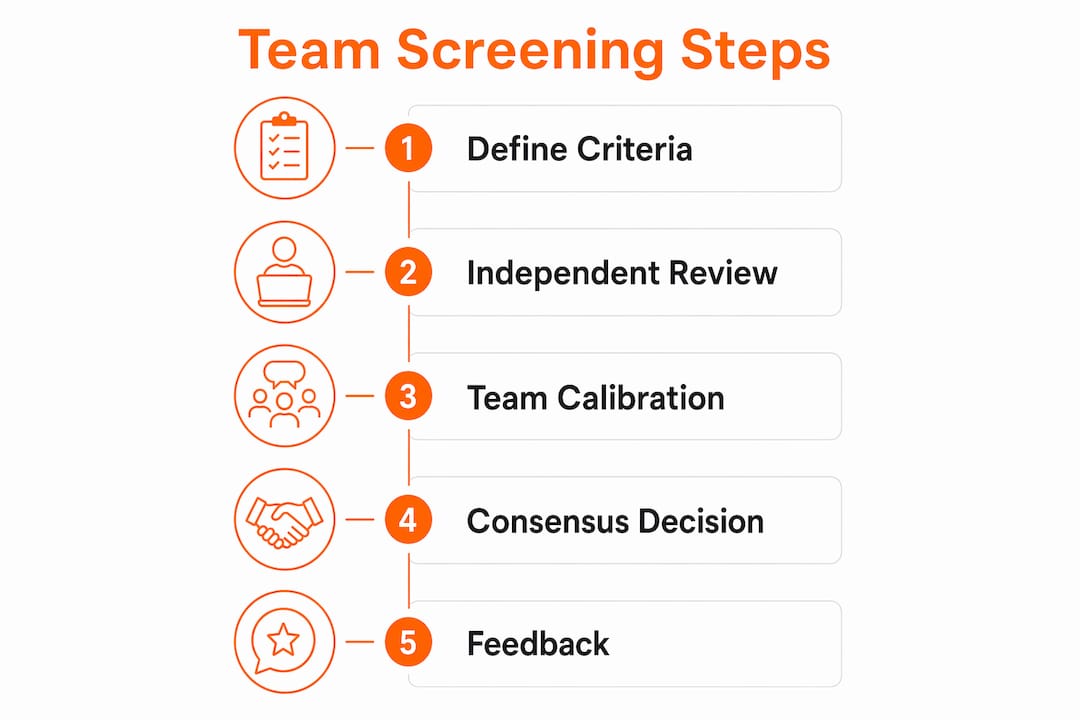
Phase 4: Consensus and decision. The team reaches a final assessment. In cases of persistent disagreement, a neutral tie-breaker reviewer prevents senior members from dominating the outcome.

Phase 5: Feedback or next action. The decision is documented and communicated, with clear rationale tied back to the original criteria.
The table below maps these phases to the TBL framework and the tools used at each stage.
| Phase | TBL Equivalent | Primary Tool | Key Outcome |
|---|---|---|---|
| Define criteria | Pre-class preparation | Shared rubric or scorecard | Aligned evaluation standards |
| Independent review | IRAT | Individual scoring form | Unbiased baseline scores |
| Team calibration | TRAT | Group discussion protocol | Reconciled perspectives |
| Consensus decision | Application activity | Final scorecard | Documented shared verdict |
| Feedback | Instructor debrief | Written summary | Transparent rationale |
Team member roles are equally important to the sequence. A facilitator keeps discussion on track and time-boxed. A recorder documents scores and key reasoning. A devil’s advocate challenges emerging consensus to prevent groupthink. Rotating these roles across sessions keeps the process from calcifying around one person’s preferences.
Pro Tip: Use a shared digital scorecard that locks individual scores before the calibration meeting opens. This single structural choice eliminates anchoring bias more reliably than any amount of training.
Where is team-based screening applied in education and healthcare?
The team-based learning model has been adopted across medical schools, nursing programs, and undergraduate STEM courses in the United States, largely because it solves a persistent problem: passive learners who can pass individual tests but struggle to apply knowledge in groups.
In education:
- Medical schools use IRAT and TRAT sequences to assess whether students have completed pre-class preparation before moving into clinical case discussions.
- Nursing programs run team quizzes where small groups must reach consensus on patient care decisions, mirroring real clinical team dynamics.
- Undergraduate courses in business and engineering use peer evaluation rubrics during project screening to assess both individual contribution and team output.
- Instructional designers embed collaborative readiness checks into online courses, using branching scenarios where learner groups must agree on a path forward before proceeding.
In healthcare beyond the classroom:
The same logic applies to clinical screening programs. A coordinated team at Cheat Lake Physicians, participating in the West Virginia Program to Increase Colorectal Cancer Screening, assembled a multidisciplinary group to implement evidence-based interventions. The result was a meaningful increase in colorectal cancer screening rates within one year, along with a strong return rate for Fecal Immunochemical Test kits.
Nutrition assessment teams in hospital settings use a similar structure: a dietitian, physician, and nurse each complete independent patient assessments, then align in a brief calibration meeting before finalizing a care plan.
| Setting | Screening Method | Key Outcome |
|---|---|---|
| Medical school | IRAT + TRAT readiness sequence | Higher pre-class preparation rates |
| Nursing program | Team consensus on patient scenarios | Stronger clinical reasoning skills |
| Primary care clinic | Multidisciplinary cancer screening team | 15.8% increase in screening rates |
| Hospital nutrition unit | Independent then joint patient assessment | More consistent care plan decisions |
| Corporate recruitment | Panel interviews with shared scorecards | Reduced bias, better hire quality |
What are the real benefits of team-based screening?
The benefits of team-based screening go well beyond fairness as an abstract principle. They show up in measurable outcomes.
Bias reduction. Distributing evaluation across multiple reviewers dilutes the effect of any one person’s blind spots. Up to 48% of HR managers acknowledge solo bias frequently impacts recruitment decisions. Spreading that responsibility across a panel doesn’t eliminate bias, but it makes it much harder for any single bias to determine the outcome.
Accuracy. Diverse evaluator panels detect gaps that individual screeners miss, producing fairer assessments overall. In recruitment specifically, bad hire rates drop significantly when using team-based structured interviewing compared to solo hiring when standardized rubrics are used.
Psychological safety and trust. When a team shares ownership of an evaluation process, members feel more accountable to each other and to the standard they set together. Organizational practitioners describe team-based screening as a cultural protection mechanism, one that builds transparency and group trust over time.
Retention and onboarding. When teams participate in hiring or placement decisions, they invest more in the success of the person they selected. Mentoring and integration efforts increase naturally, leading to more sustainable outcomes.
- Reduced individual unconscious bias through distributed evaluation
- Higher prediction accuracy for long-term performance or learning success
- Stronger team cohesion through shared decision ownership
- More consistent evaluations via standardized rubrics and scorecards
- Better onboarding outcomes driven by team investment in the hire
What does organizational research say about team-based screening in recruitment?
The research on team-based screening in recruitment points in one direction: structure and distribution of evaluation responsibility produce better long-term hires. The mechanism isn’t complicated. When one person screens a candidate, their judgment is the whole process. When a team screens collaboratively, each reviewer’s reasoning is tested against others’, and weak rationale gets challenged before it becomes a decision.
The structured process of predetermined criteria, independent reviews, and calibrated consensus discussions increases consistency and fairness across sectors. For instructional designers building recruitment screening tools, this translates directly: the rubric design phase is where most of the quality is determined, not the discussion phase.
Best practices from organizational research:
- Score independently first. All panel members complete their individual evaluations before any group discussion begins.
- Use a shared rubric. Every reviewer measures the same competencies against the same scale.
- Appoint a tie-breaker. When scores diverge significantly, a neutral third-party reviewer resolves the deadlock without letting seniority decide.
- Rotate panel composition. Keeping the same reviewers on every panel creates its own form of group bias over time.
- Document reasoning, not just scores. A score of 4 out of 5 means nothing without the evidence that supports it.
Collaborative screening also shifts the psychological framing of a hire. When a team selects someone together, they tend to mentor and support that person more actively during onboarding. For smarter hiring steps, this ownership effect is one of the most underappreciated advantages of the team-based model.
What challenges come with team-based screening?
Team-based screening is more effective than solo evaluation, but it’s not without friction. Educators and HR teams who implement it without accounting for these challenges often see the process collapse back into informal consensus driven by the most senior voice in the room.
Time and coordination costs. Gathering multiple reviewers, aligning schedules, and running calibration meetings takes significantly more time than a single-reviewer process. For high-volume screening, this cost compounds quickly.
Groupthink risk. Without structural safeguards like independent scoring before discussion, teams can converge prematurely on a shared view. The IRAT step exists precisely to prevent this, but it only works if it’s enforced.
Seniority dominance. In hierarchical organizations or classrooms, junior reviewers often defer to senior ones during calibration, even when their independent scores differed. Designating a neutral tie-breaker and anonymizing initial scores are the two most effective structural fixes.
Inconsistent rubric use. A shared scorecard only produces consistent results if every reviewer interprets the criteria the same way. Without calibration training, two reviewers using the same rubric can score the same candidate very differently.
Reviewer fatigue. Asking the same team members to screen repeatedly, without rotation, degrades evaluation quality over time. Fatigue and familiarity both introduce bias.
How does team-based screening compare to individual screening?
The core difference is accountability. Individual screening places the full weight of an evaluation on one person’s judgment, knowledge, and attention on a given day. Team-based screening distributes that weight, which changes both the process and the outcome.
| Dimension | Individual screening | Team-based screening |
|---|---|---|
| Bias exposure | High; one person’s blind spots determine the outcome | Lower; multiple perspectives dilute individual bias |
| Time required | Fast; one reviewer, one session | Slower; requires coordination and calibration meetings |
| Consistency | Variable; depends on the individual’s standards that day | Higher; shared rubrics anchor all reviewers to the same criteria |
| Accuracy | Adequate for simple, low-stakes decisions | Stronger for complex, high-stakes evaluations |
| Ownership | Belongs to one person | Shared across the team, improving downstream investment |
| Scalability | Easy to scale in volume | Requires process design to scale without losing quality |
Individual screening still has a place. For quick, low-stakes screening tasks where speed matters more than depth, a single trained reviewer with a good rubric is often the right call. The types of recruitment methods that benefit most from team-based approaches are those where the decision has long-term consequences: hiring for culture fit, placing students in advanced tracks, or making clinical care decisions.
The practical question isn’t which method is better in the abstract. It’s whether the stakes of the decision justify the coordination cost of assembling a team. For most high-impact evaluations in education, healthcare, and recruitment, they do.
Key Takeaways
Team-based screening consistently outperforms individual evaluation in accuracy, fairness, and long-term outcome quality when structured criteria, independent scoring, and calibrated consensus are all in place.
| Point | Details |
|---|---|
| Independent scoring comes first | All reviewers must complete individual evaluations before group discussion to prevent anchoring bias. |
| IRAT and TRAT structure the process | These two TBL tools sequence independent and collaborative assessment to maximize both accuracy and engagement. |
| Bad hire rates drop with team screening | Structured team-based interviewing reduces bad hire rates from 35% in solo hiring to 18% with team screening. |
| Tie-breaker reviewers resolve deadlocks | A neutral third party prevents senior members from dominating when panel scores diverge. |
| Ownership improves retention | When teams share hiring or placement decisions, onboarding investment and long-term success rates both increase. |
Testask brings the structure of team-based screening into your recruitment workflow. With AI-assisted evaluation, shared scorecards, and collaborative review tools, your team can assess candidates faster and with greater consistency. Start screening smarter with Testask.
Recommended
- Screening Checklist Guide for Smarter Hiring in 2026 | Testask Blog | testask
- Screening tools in hiring: Transform your recruitment efficiency | Testask Blog | testask
- Why Automate Screening: The HR Professional’s Guide | Testask Blog | testask
- Screening process best practices: smarter, fairer hiring steps | Testask Blog | testask