Talent Assessment Tools Comparison: 2026 HR Guide
Talent Assessment Tools Comparison: 2026 HR Guide

For most HR teams, Testask is the recommended starting point: AI-assisted test-task generation, integrated reviewer workflows, and fast time-to-pilot make it the strongest fit for structured, skills-based hiring. Beyond Testask, the right platform depends on your hiring volume, role type, and compliance requirements. Here is a compact shortlist to orient your search:
- Testask — Best for HR teams and hiring managers who need AI-assisted task generation, candidate submission management, and reviewer collaboration in one place.
- HackerRank / Codility / CodeSignal — Best for engineering teams running high-volume technical screens with automated code evaluation.
- SHL / The Predictive Index — Best for enterprise programs requiring normed psychometric instruments and EEO-compliant validation evidence.
- Pymetrics / Bryq — Best for teams adding behavioral and cognitive signals to complement skills tests.
- Harver / Criteria — Best for retail, contact centers, and seasonal hiring at scale.
- VidCruiter / Modern Hire — Best for distributed hiring where communication and presentation matter.
- TestGorilla / iMocha / Testlify — Best for in-house teams needing broad role coverage from large skills libraries.
Two trust signals worth anchoring your evaluation: talent assessment software has shifted toward end-to-end workflows combining structured measurement, job-specific evaluation, and analytics that support faster, defensible decisions. And modern platforms increasingly support remote, scalable testing designed to reduce bias while improving predictive selection quality.
Table of Contents
- How do the top talent assessment tools compare at a glance?
- Why Testask is the recommended pick for structured, AI-assisted assessments
- What makes technical skills testing platforms the right choice for engineering screens?
- Scalable coding-assessment platforms: HackerRank, Codility, and CodeSignal
- How do talent intelligence platforms fit into your hiring stack?
- When do structured interview and job-simulation platforms make sense?
- What do behavioral and neuroscience-based assessments actually measure?
- Psychometric assessment vendors: what enterprise compliance actually requires
- High-volume pre-employment testing: the right fit for retail and contact centers
- Live coding and collaborative interview tools: when to use CoderPad
- Skills-library platforms: TestGorilla, iMocha, and Testlify
- Fast-deployment platforms for quick pilots: Testlify and TestGorilla
- Video interviewing and candidate-experience platforms: VidCruiter and Modern Hire
- How we evaluated these tools
- How to choose the right talent assessment tool for your hiring process
- Testask deployment signals and practical implementation tips
- Key Takeaways
- What most HR teams get wrong when choosing an assessment platform
- Testask is the faster path to structured, skills-based hiring
- Further reading and sources used in this comparison
How do the top talent assessment tools compare at a glance?
The table below covers 22 platforms across the dimensions HR buyers consistently prioritize. Testask leads as the featured option; remaining entries follow in category order.
| Platform | Best for | Assessment types | AI / auto-scoring | Custom builder | ATS & HRIS integrations | Reporting & analytics | Anti-cheating / proctoring | Pricing shape | Scalability | Compliance & validation |
|---|---|---|---|---|---|---|---|---|---|---|
| Testask | HR teams needing AI-assisted task generation + reviewer collaboration | Skills tasks, work samples, open-ended | AI scoring, AI analysis, reviewer workflows | Yes — tailored task generation | Typical ATS connectors; API available | Candidate and team dashboards | Submission controls | Free tier + paid subscription | SMB to mid-market | Structured scoring; EEO-aligned workflows |
| HackerRank | High-volume developer screening | Coding, algorithms, data science | Automated code execution + scoring | Yes | Major ATS (Greenhouse, Lever, Workday) | Role-based analytics | Proctoring, plagiarism detection | Per-seat / per-test | Enterprise-ready | Validity documentation available |
| Codility | Repeatable junior-to-mid engineering screens | Coding challenges, live tasks | Automated scoring, rubric-driven | Yes | ATS integrations | Performance dashboards | Proctoring | Per-test / subscription | Enterprise | Validity reports |
| CodeSignal | Standardized technical benchmarking | Coding, industry coding framework | Automated scoring, benchmarking | Limited | ATS integrations | Benchmark analytics | Proctoring | Subscription | Enterprise | Industry-standard benchmarks |
| CoderPad | Live senior engineering interviews | Live coding, pair programming | Limited auto-scoring | Interview templates | ATS integrations | Interview playback | Session recording | Per-seat | Mid-market to enterprise | — |
| Eightfold AI | Enterprise talent intelligence + internal mobility | Skills matching, candidate rediscovery | AI skills graphing, matching | Limited | Deep HRIS/ATS integration | Workforce analytics | — | Enterprise contract | Large enterprise | Skills-graph validation |
| Modern Hire | Structured interviews + video for high-stakes roles | Video interviews, simulations, structured scoring | AI scoring, behavioral analysis | Yes | ATS integrations | Compliance-ready reporting | Proctoring | Enterprise contract | Enterprise | Predictive validity studies |
| Pymetrics | Behavioral + cognitive signals for culture fit | Neuroscience-based games | Algorithmic trait scoring | No | ATS integrations | Trait dashboards | — | Enterprise contract | Enterprise | Bias-reduction validation |
| SHL | Enterprise psychometrics + EEO compliance | Cognitive, personality, simulations | Automated scoring | Yes | Major ATS/HRIS | Norm-referenced reporting | Proctoring | Enterprise licensing | Large enterprise | Extensive validity/adverse impact studies |
| Criteria | Objective pre-employment screening across roles | Aptitude, personality, skills | Automated scoring | Yes | ATS integrations | Candidate comparison dashboards | Proctoring | Per-test / subscription | SMB to enterprise | Validation studies; EEO reporting |
| iMocha | Cross-functional skills assessment + L&D | IT, business, language, coding | Automated scoring | Yes | ATS + LMS integrations | Skill-gap analytics | Proctoring | Subscription | Enterprise | Validity documentation |
| Testlify | Fast role-specific pre-employment testing | Skills, cognitive, personality | Automated scoring | Yes | ATS integrations | Analytics dashboards | Anti-cheating controls | Free tier + paid | SMB to mid-market | — |
| VidCruiter | Distributed hiring + video-structured scoring | Video (one-way + live), structured interviews | Automated rating prompts | Yes | ATS integrations | Structured scoring reports | Video proctoring | Subscription | Mid-market to enterprise | Compliance-ready |
| TestGorilla | Broad role coverage + fast deployment | Skills, cognitive, personality, coding | Automated scoring | Yes | ATS integrations | Candidate ranking dashboards | Anti-cheating controls | Free tier + paid | SMB to enterprise | — |
| The Predictive Index | Behavioral + cognitive fit for team alignment | Behavioral, cognitive | Automated scoring | Limited | ATS/HRIS integrations | Team and role-fit analytics | — | Subscription | Mid-market to enterprise | Normed; validity studies |
| HiPeople | Reference checks + skills assessment combined | Skills tests, reference automation | Automated scoring | Yes | ATS integrations | Candidate insights dashboards | — | Subscription | SMB to mid-market | — |
| HiBob HRIS | HRIS-embedded people analytics | HRIS data, performance, engagement | People analytics | Limited | Native HRIS; ATS integrations | Workforce dashboards | — | Subscription | Mid-market to enterprise | GDPR-aligned |
| Indeed Hiring Platform | High-volume sourcing + basic screening | Skills screeners, assessments | Basic auto-screening | Limited | ATS integrations | Applicant dashboards | — | Pay-per-click / subscription | SMB to enterprise | — |
| Peoplebox.ai | OKR + performance-linked talent analytics | Performance, engagement, OKR tracking | AI insights | Limited | HRIS/ATS integrations | OKR and performance dashboards | — | Subscription | Mid-market to enterprise | — |
| Bryq | Cognitive + behavioral pre-hire screening | Cognitive, personality, culture fit | Automated scoring | Limited | ATS integrations | Fit-score dashboards | — | Subscription | SMB to enterprise | Bias-reduction validation |
| Harver | High-volume retail + contact center screening | Situational judgment, personality, skills | Automated scoring | Yes | ATS integrations | Volume-hiring analytics | Proctoring | Enterprise contract | Large enterprise | Predictive validity studies |
| Metaview | AI-generated interview notes + structured capture | Interview transcription, structured notes | AI note-taking, scoring prompts | Limited | ATS integrations | Interview summaries | — | Subscription | SMB to enterprise | — |
The single most important question to ask any vendor: “Can you share a validation study showing predictive validity for this role type, and an adverse impact analysis?” Vendors who cannot answer that question clearly are not ready for enterprise selection. Testask addresses this through structured scoring rubrics and configurable reviewer workflows that create an auditable evaluation trail from day one.
Quick-filter highlights:
- Technical hiring: HackerRank, Codility, CodeSignal, CoderPad, Testask
- High-volume hiring: Harver, Criteria, Indeed Hiring Platform, TestGorilla
- Enterprise psychometrics: SHL, The Predictive Index, Criteria
- Behavioral assessment: Pymetrics, Bryq, The Predictive Index
- Fast pilots and SMB teams: Testask, TestGorilla, Testlify, HiPeople
Why Testask is the recommended pick for structured, AI-assisted assessments
Testask is built for HR teams that need to move from job brief to live assessment without a long setup cycle. The core workflow: generate a tailored test task using AI, distribute it to candidates, collect submissions in one place, and score them with AI-assisted analysis alongside your reviewers. That loop is faster than building tests manually and more defensible than unstructured interviews.
Strengths:
- AI-assisted task generation reduces time spent writing role-specific assessments from scratch.
- Integrated reviewer collaboration keeps evaluators aligned on scoring criteria before results come in.
- Candidate submission management centralizes responses so nothing gets lost across email threads.
- AI-driven scoring and analysis surfaces patterns across candidates, supporting faster shortlisting.
- Free tier available for low-volume or pilot use, with paid plans for teams scaling up.
Trade-offs:
- Testask is optimized for work-sample and skills-task assessments; it is not a psychometric norming platform or a live coding environment.
- Teams with very high-volume automated screening needs (thousands of applicants per week) may want to pair Testask with a volume-screening layer.
- Deep HRIS integration may require API configuration depending on your existing stack.
Who should choose Testask:
- HR teams and hiring managers at SMB-to-mid-market companies who want structured, skills-based assessments without a long vendor onboarding cycle.
- Organizations piloting structured hiring for the first time and needing reviewer collaboration built in.
- Teams hiring for knowledge-work roles where a tailored work sample is more predictive than a generic aptitude test.
The predictive hiring guidance on the Testask blog covers reviewer calibration and scoring configuration in detail, which is useful during initial setup.
What makes technical skills testing platforms the right choice for engineering screens?
Technical skills testing platforms, including HackerRank, Codility, and CodeSignal, are purpose-built for developer and data-role screening. Their core capability is an in-browser code execution environment: candidates write real code, the platform runs it against test cases, and scores are generated automatically. That removes the need for a human to read every submission at the screening stage.

The category’s main strengths are speed and repeatability. A 60-minute coding challenge can screen hundreds of applicants in parallel, with results ranked automatically. Challenge libraries typically span dozens of languages and frameworks, which matters when you are hiring across a polyglot engineering org. Proctoring features, including webcam monitoring and plagiarism detection, are standard in enterprise tiers.
The honest trade-off: contrived coding challenges do not always reflect real job tasks. A candidate who scores well on a LeetCode-style algorithm problem may struggle with the messy, ambiguous work of production engineering. That gap is why many teams use a technical screen as a filter, then follow up with a live interview or take-home project before making a decision.
Pricing in this category typically follows a per-test or per-seat model, with enterprise contracts for large-volume programs. Deployment is usually fast: most platforms offer ATS connectors for Greenhouse, Lever, and Workday, and a basic workflow can be live within days.
Scalable coding-assessment platforms: HackerRank, Codility, and CodeSignal
These three platforms represent the most widely deployed options for repeatable developer screening at scale. Each offers automated scoring and rubric-driven evaluation as its core value.
Strengths:
- Automated code execution eliminates manual review at the screening stage.
- Large challenge libraries cover algorithms, data structures, SQL, machine learning, and more.
- Rubric-driven scoring creates consistency across reviewers and hiring cycles.
- ATS connectors (Greenhouse, Lever, Workday, and others) are well-documented.
- Proctoring and plagiarism detection reduce gaming risk.
Trade-offs:
- Assessment realism is limited: standardized challenges may not reflect actual job complexity.
- Candidate experience can feel impersonal, which matters for senior-level recruiting.
- Pricing scales with volume, and enterprise contracts can be significant investments.
HackerRank is the most widely recognized brand in this category and offers the broadest challenge library. Codility emphasizes rubric-driven evaluation and is popular with European engineering teams. CodeSignal differentiates with its industry-standard coding benchmark, which allows cross-company score comparison. For teams hiring junior-to-mid engineers at volume, any of these three will deliver repeatable, auditable screening results.
How do talent intelligence platforms fit into your hiring stack?
Talent intelligence and skills-matching platforms, with Eightfold AI as the leading example, operate at a different layer than assessment tools. Rather than testing candidates directly, they analyze skills signals across resumes, internal profiles, and external data to match candidates to roles and surface internal mobility opportunities.

The core capability is skills graphing: the platform builds a structured model of what skills each candidate or employee has, then maps those against role requirements. This is particularly valuable for enterprises with large internal talent pools, where the best candidate for a new role might already be on payroll.
Integration complexity is the main challenge. These platforms need deep connections to your HRIS, ATS, and often your learning management system to deliver their full value. Implementation timelines for enterprise deployments are typically measured in months, not days. The return is long-term: better internal mobility, reduced external hiring costs, and a more complete picture of workforce capability over time.
Short pros/cons:
- Pro: Skills graphing and candidate rediscovery can surface qualified candidates who would otherwise be missed.
- Pro: Supports strategic workforce planning beyond individual hiring decisions.
- Con: Integration complexity and implementation time are significant.
- Con: ROI is clearest at enterprise scale; smaller teams may find the investment hard to justify.
When do structured interview and job-simulation platforms make sense?
Structured interview and job-simulation platforms, including Modern Hire, are built for high-stakes hiring where defensibility matters as much as speed. The defining feature is a job simulation: candidates complete tasks that mimic actual role responsibilities, scored against a standardized rubric. That creates an evaluation record that holds up to legal scrutiny and reduces interviewer bias.
Strengths:
- Job simulations are among the highest-validity assessment formats available, particularly for customer-facing and leadership roles.
- Standardized scoring rubrics reduce interviewer-to-interviewer variance.
- Audit trails and compliance-ready reporting support EEO documentation.
- Enterprise security features (SSO, data residency options) are typically included.
Trade-offs:
- Simulation design is time-intensive: building a realistic, role-specific simulation requires significant upfront investment.
- Cost is higher than generic pre-employment tests, which limits accessibility for smaller teams.
- Scheduling live simulations adds friction to the candidate experience.
This category is the right choice when the cost of a bad hire is high, the role is externally visible or safety-critical, and your legal team wants a documented, bias-audited process. For most standard knowledge-work roles, a well-designed work sample (like those Testask generates) delivers comparable signal at lower cost and faster deployment.
What do behavioral and neuroscience-based assessments actually measure?
Behavioral and neuroscience-based assessment platforms, with Pymetrics and Bryq as representative examples, use game-like tasks to infer cognitive traits and behavioral tendencies. Instead of asking candidates to self-report their personality, these tools observe how candidates respond to time-pressured, ambiguous, or emotionally loaded stimuli.
What they measure: attention, risk tolerance, working memory, emotional regulation, and similar constructs. The claim is that these behavioral signals predict job performance and culture fit better than self-report personality questionnaires, because they are harder to game. Pymetrics specifically grounds its approach in neuroscience research and publishes bias-reduction validation studies.
The responsible use of these tools requires asking vendors two specific questions: What is the predictive validity coefficient for this role type? And has an adverse impact analysis been conducted for the demographic groups in your applicant pool? Without clear answers to both, you are using a black box for a consequential decision.
Best use cases are as a complement to skills tests, not a replacement. A behavioral screen can add a culture-fit or development signal after a candidate has already passed a skills threshold. Using behavioral games as the sole screening criterion for technical roles is not well-supported by the evidence.
Psychometric assessment vendors: what enterprise compliance actually requires
Psychometric assessment vendors, with SHL and The Predictive Index as the most established examples, offer normed, validated instruments backed by decades of industrial-organizational psychology research. “Normed” means scores are interpreted relative to a reference population, not in absolute terms. That matters for regulated industries and high-stakes selection programs where you need to demonstrate that your assessment does not produce adverse impact against protected groups.
What to ask vendors for:
- A technical manual with reliability coefficients (Cronbach’s alpha) and validity evidence (criterion-related validity studies).
- An adverse impact analysis for your specific applicant population.
- Documentation of EEO compliance and OFCCP alignment.
- A description of how norms were developed and when they were last updated.
Strengths:
- Built-in validity and reliability evidence reduces legal exposure.
- Norm-referenced scoring supports defensible, comparative candidate ranking.
- Suitable for regulated industries (financial services, healthcare, government contracting).
Trade-offs:
- Enterprise licensing costs are significant.
- Setup and norm-matching require time and often vendor support.
- Candidate experience can feel clinical, which affects completion rates for some populations.
SHL is the most globally recognized vendor in this category and offers the broadest assessment library. The Predictive Index focuses on behavioral and cognitive assessments with a strong team-alignment use case. For enterprise programs that need documented validity, either is a credible choice.
High-volume pre-employment testing: the right fit for retail and contact centers
High-volume pre-employment testing platforms, with Harver and Criteria as leading examples, are optimized for one thing: processing large applicant pools quickly and cost-effectively. The workflow is straightforward: bulk invite, time-limited test, automated pass/fail scoring, and ATS handoff for qualified candidates.
Harver specializes in retail, logistics, and contact center hiring, with situational judgment tests and personality assessments designed for frontline roles. Criteria offers a broader range of aptitude, personality, and skills tests with a per-test pricing model that scales well for seasonal hiring spikes. Indeed Hiring Platform adds a sourcing layer on top of basic screening, which is useful when you need to fill the top of the funnel at the same time.
Pricing in this category typically follows a per-invite or per-test model, which keeps costs predictable for volume programs. The trade-off is depth: these platforms are designed for fast filtering, not nuanced evaluation. They work best as a first-stage screen, with more substantive assessment reserved for candidates who pass the initial cut.
Live coding and collaborative interview tools: when to use CoderPad
Live coding and collaborative interview tools, with CoderPad as the primary example, are designed for a different moment in the hiring process than automated screening platforms. They support real-time, interactive evaluation during a technical interview, where a candidate and interviewer share a coding environment and work through a problem together.
Strengths:
- Real-time collaboration captures how a candidate thinks, communicates, and responds to feedback.
- Session recording and playback create an evidence record for post-interview review.
- Supports pair-programming formats that reflect actual engineering work.
Trade-offs:
- Scheduling friction is significant: live interviews require coordinating candidate and interviewer availability.
- Reviewer time cost is high compared to automated screening.
- Results are harder to standardize across interviewers without structured rubrics.
CoderPad is the right tool for senior engineering interviews where you need to observe problem-solving process, not just output. It is not a replacement for automated screening at the top of the funnel. The most effective technical hiring stacks use an automated screen (HackerRank, Codility, or Testask for work samples) to filter volume, then CoderPad for final-round technical evaluation.
Skills-library platforms: TestGorilla, iMocha, and Testlify
Skills-library and customizable assessment hubs give in-house HR teams the fastest path from job brief to live assessment. TestGorilla, iMocha, and Testlify all offer large banks of role-mapped test templates covering technical skills, cognitive ability, personality, and soft skills. The value proposition is breadth: instead of building assessments from scratch, you select from a library and customize.
TestGorilla is the most accessible entry point, with a free tier and a library covering hundreds of roles. iMocha goes deeper on IT and technical skills, with proctoring and LMS integration suited for enterprise L&D programs. Testlify offers a clean interface and fast deployment, making it popular with growing teams that need to hire across multiple functions simultaneously.
The honest limitation of this category is that pre-built templates are generic by definition. A software engineer assessment from a template library tests general coding ability, not the specific stack or problem type your team works with. For roles where job-specific accuracy matters, pairing a library platform with a custom work sample (as Testask enables) produces better signal.
Fast-deployment platforms for quick pilots: Testlify and TestGorilla
For small hiring teams and fast-moving startups, deployment speed and template availability often matter more than assessment depth. Testlify and TestGorilla both offer free tiers, pre-built templates, and candidate-facing interfaces that require minimal configuration.
Strengths:
- Free tiers allow pilots with no upfront commitment.
- Template libraries cover most common roles out of the box.
- Candidate experience is clean and mobile-compatible.
- ATS integrations are available on paid plans.
Trade-offs:
- Customization is limited on free tiers; deeper configuration requires paid plans.
- Pre-built templates may not reflect role-specific requirements accurately.
- Reporting depth is lighter than enterprise platforms.
These platforms are the right starting point for a team running its first structured assessment pilot. Once you have validated that assessments improve your hiring quality, you can graduate to a more configurable platform like Testask for role-specific work samples, or to an enterprise psychometric vendor for compliance-heavy programs.
Video interviewing and candidate-experience platforms: VidCruiter and Modern Hire
Video interviewing platforms combine structured scoring with candidate-facing workflows that work for distributed hiring teams. VidCruiter and Modern Hire both support one-way and live video formats, with structured evaluation rubrics that keep reviewer scores consistent across interviewers.
One-way video is the most operationally efficient format: candidates record responses to structured questions on their own schedule, reviewers score asynchronously, and the process can move forward without scheduling a live call. This is particularly valuable for roles where communication and presentation matter, such as sales, customer success, and client-facing positions.
The candidate experience trade-off is real. One-way video can feel impersonal, and completion rates drop when candidates do not understand why they are being asked to record themselves. Clear communication about the process and a short, well-designed question set mitigate this. Metaview takes a different approach: rather than replacing interviews, it uses AI to generate structured notes and scoring prompts from live conversations, reducing reviewer workload without changing the candidate experience.
How we evaluated these tools
This comparison draws on multiple data sources to give you a grounded, reproducible assessment rather than a vendor-marketing summary.
Evaluation criteria used:
- Assessment diversity: range of formats supported (coding, psychometric, video, work samples, behavioral).
- Scoring automation: quality and transparency of automated scoring and AI-assisted analysis.
- ATS and HRIS integrations: documented connectors and API availability.
- Reporting and analytics: depth of candidate and team-level dashboards.
- Security and proctoring: anti-cheating controls, data security certifications, and proctoring options.
- Validation evidence: availability of predictive validity studies and adverse impact analyses.
- Scalability: suitability for SMB, mid-market, and enterprise hiring volumes.
- Cost signals: pricing transparency, entry points, and licensing model clarity.
Data sources:
- Vendor documentation and public feature pages.
- Public validation studies and technical manuals where available.
- Customer reviews on G2 and Gartner Peer Insights, including category-level patterns.
- Testask deployment signals and assessment platform guidance from the Testask blog.
- Candidate screening checklists and practical assessment design frameworks.
- Resume screening best practices for auditability and compliance alignment.
Limitations: Public pricing is opaque for most enterprise platforms. Actual costs vary significantly by contract, volume, and negotiated terms. Regional availability differs, particularly for psychometric norm groups. Validation evidence quality varies widely across vendors; always request a technical manual before signing an enterprise contract.
How to weight criteria by use case:
- Technical hiring: prioritize code execution environments, automated scoring, and proctoring.
- Leadership hiring: prioritize simulations, structured interview rubrics, and validation evidence.
- High-volume hiring: prioritize bulk invite workflows, per-invite pricing, and ATS automation.
- Strategic/enterprise programs: prioritize psychometric validity, compliance reporting, and HRIS integration depth.
How to choose the right talent assessment tool for your hiring process
A reproducible selection process matters more than any single vendor’s feature list. Use this checklist and pilot plan to make a confident, defensible decision.
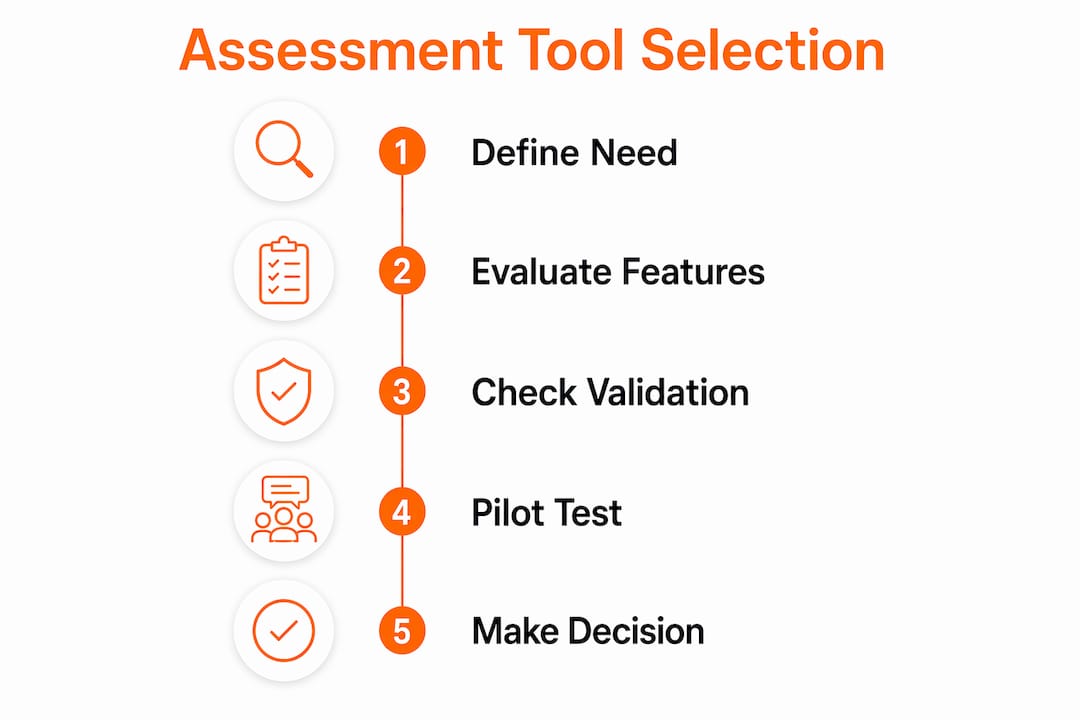
Must-have vs. nice-to-have features by role type
Must-have for technical roles:
- In-browser code execution or work-sample submission environment.
- Automated scoring with rubric transparency.
- Proctoring or anti-cheating controls.
- ATS integration with your existing system.
Must-have for leadership/professional roles:
- Structured scoring rubrics and reviewer calibration tools.
- Audit trail and compliance-ready reporting.
- Validation evidence for the assessment format used.
Nice-to-have (any role):
- Mobile-compatible candidate interface.
- Custom branding for candidate-facing screens.
- Advanced analytics and cohort comparison.
Vendor questions to ask during demos
- Can you share a validation study showing predictive validity for this role type?
- Has an adverse impact analysis been conducted for the demographic groups in our applicant pool?
- What ATS connectors do you support, and what is the integration timeline?
- How is candidate data stored, retained, and deleted? What are your data residency options?
- What proctoring controls are available, and how are they configured?
- What is your SLA for platform uptime, and what support is included at our contract tier?
- What does onboarding look like, and how long does a typical deployment take?
Red flags to watch
- No validation study available, or vendor deflects the question.
- Limited or undocumented ATS integration options.
- Opaque pricing with no clear per-test or per-seat structure.
- No proctoring or anti-cheating controls for remote assessments.
- No audit trail or compliance reporting for candidate dispositions.
Pilot plan template
Goal: Validate that the platform improves shortlist quality for [role type] within 30–60 days. Sample size: 20–50 candidates minimum for meaningful signal. Success metrics: Reviewer time per candidate, shortlist-to-offer conversion rate, reviewer satisfaction score. Timeline: Week 1 — configure and test; Week 2 — launch to live candidates; Weeks 3–6 — collect data; Week 7 — review and decide. Reviewers: 2–3 calibrated reviewers per role; run a calibration session before scoring begins. Decision gates: At 30 days, assess completion rates and reviewer feedback. At 60 days, compare shortlist quality against your baseline.
Pricing and timeline guidance: Most SMB-friendly platforms (Testask, TestGorilla, Testlify) offer free tiers or low-cost entry plans that allow a pilot with no contract commitment. Enterprise platforms (SHL, Harver, Modern Hire) typically require a contract negotiation before access, with implementation timelines of 4–12 weeks. Budget 2–4 weeks for ATS integration testing regardless of platform.
Pro Tip: A short, job-relevant work sample is often a higher-signal early assessment than a long standardized test. Keep early-stage tasks proportional to the hiring stage to respect candidate effort and improve completion rates.
Testask deployment signals and practical implementation tips
Testask’s deployment pattern is designed for speed. Most teams can configure a first assessment, invite candidates, and begin reviewing submissions within a single business day. The following signals and tips reflect how HR teams get the most value from the platform.
Deployment patterns:
- Pilot programs typically start with one role type and 20–50 candidates to validate the workflow before scaling.
- Teams that configure reviewer scoring criteria before inviting candidates report more consistent evaluation outcomes.
- AI-assisted task generation works best when the job brief is specific: include the primary skill area, the expected output format, and the seniority level.
- Reviewer collaboration features are most effective when at least two reviewers score independently before comparing results.
Practical implementation tips:
- Run a calibration session with your reviewers before the first live assessment. Agree on what a “strong” submission looks like for each scoring criterion.
- Use the AI scoring analysis as a first-pass signal, then have reviewers confirm or override for final decisions.
- For roles with high applicant volume, set a minimum score threshold to auto-filter before manual review begins.
- Connect Testask to your ATS early in the pilot so candidate status updates flow automatically.
Operational challenges and mitigations:
- Candidate volume spikes: Set clear assessment windows (e.g., 72 hours to complete) to smooth review workload.
- Reviewer inconsistency: Calibration sessions and shared scoring rubrics reduce variance significantly.
- Integration delays: Test ATS connectors in a sandbox environment before going live with real candidates.
For deeper guidance on building a predictive hiring system with structured assessments, the Testask blog covers reviewer workflows and scoring configuration in detail.
Key Takeaways
The strongest talent assessment programs pair a validated, job-relevant assessment format with a platform that supports reviewer collaboration, ATS integration, and audit-ready reporting from day one.
| Point | Details |
|---|---|
| Match platform to role type | Technical roles need code execution and auto-scoring; leadership roles need simulations and structured rubrics. |
| Demand validation evidence | Ask every vendor for a predictive validity study and adverse impact analysis before signing any contract. |
| Pilot before committing | A 30–60 day pilot with 20–50 candidates gives you enough signal to make a confident platform decision. |
| Start with a work sample | A short, job-relevant task is often more predictive than a long standardized test at the early screening stage. |
| Testask as your starting point | Testask’s AI-assisted task generation and reviewer collaboration make it the fastest path to structured, defensible assessments for most HR teams. |
Immediate next steps:
- Identify your primary hiring use case (technical, leadership, high-volume, or general skills).
- Select 2–3 platforms from this comparison that match your use case and request demos.
- Run a 30–60 day pilot using the template above, with calibrated reviewers and defined success metrics.
- Review assessment tool examples on the Testask blog to see pricing and value framing for your role type.
What most HR teams get wrong when choosing an assessment platform
The conventional wisdom in talent assessment is to start with the platform that has the most features or the highest G2 rating. That instinct leads teams to over-invest in enterprise psychometric platforms they do not have the internal expertise to configure, or to choose a coding-challenge tool for roles that have nothing to do with writing code.
The more useful frame: start with the hiring problem, not the platform. If your bottleneck is reviewer inconsistency, you need structured rubrics and calibration tools, not a bigger test library. If your bottleneck is candidate volume, you need automated scoring and bulk workflows, not a sophisticated behavioral game. The platform is a means to a specific end, and the end should be defined before you open a vendor’s demo.
There is also a persistent underestimation of validation evidence as a selection criterion. Most HR teams ask about integrations and pricing in demos, but skip the question about predictive validity. That is the single most important trust signal for any assessment that will influence a hiring decision, and vendors who cannot produce a technical manual with validity coefficients should not be on your shortlist for high-stakes roles.
Finally: the best assessment is one candidates actually complete. A technically sophisticated platform with a poor candidate experience will produce a biased sample, because the candidates most likely to abandon a long, impersonal assessment are often the ones with the most options. Keep early-stage assessments short, relevant, and clearly connected to the role. That principle applies regardless of which platform you choose.
Testask is the faster path to structured, skills-based hiring
Every platform in this comparison solves a real problem. But if your team is spending hours writing assessment tasks from scratch, chasing candidate submissions across email, or struggling to get reviewers aligned on scoring criteria, Testask addresses all three in one workflow.
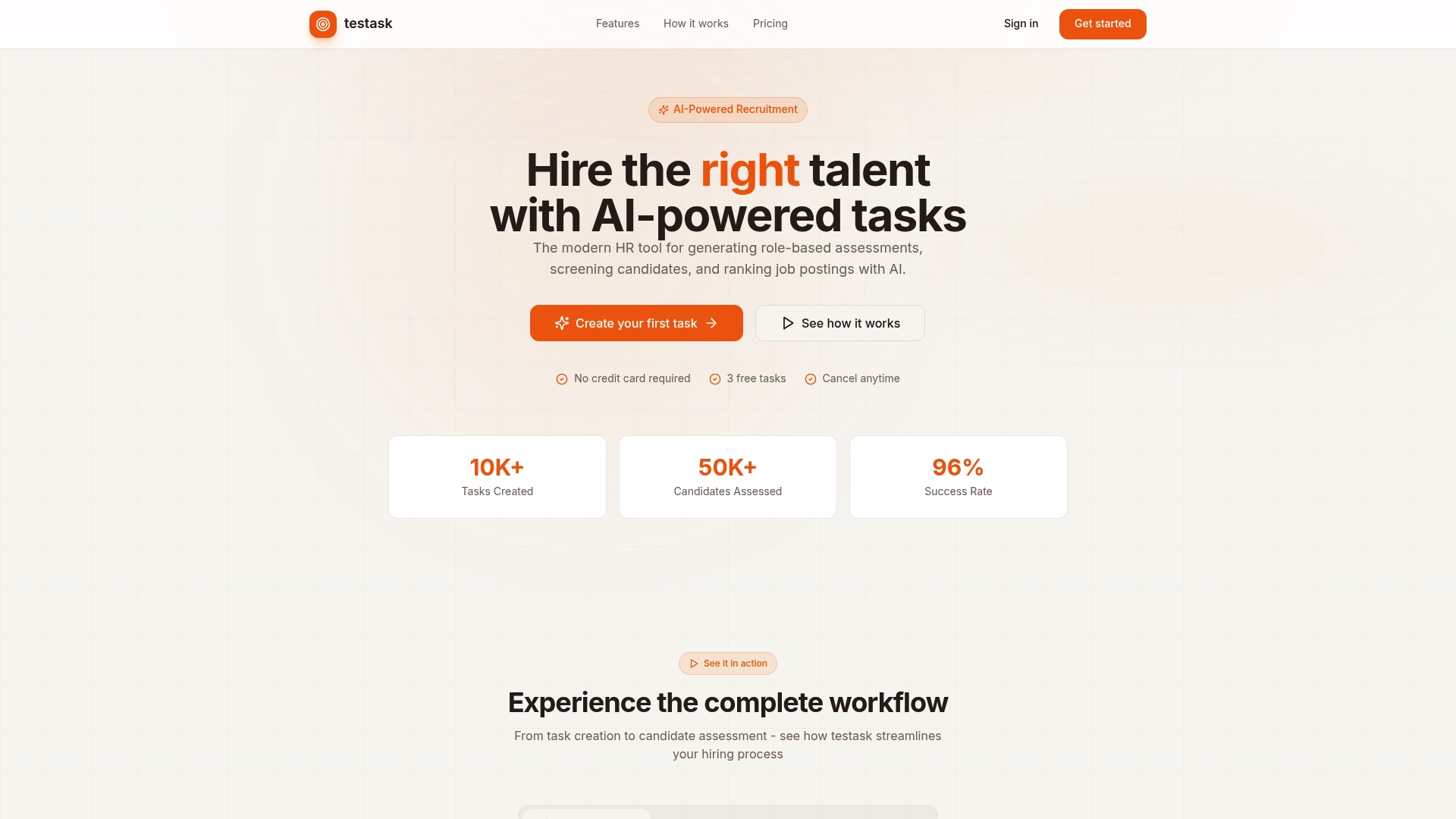
The free tier lets you run a live pilot with real candidates before committing to a paid plan. In the first 30 days, most teams complete their first assessment cycle, collect reviewer feedback, and have enough data to decide whether to scale. Testask is the strongest fit for knowledge-work roles where a tailored work sample outperforms a generic aptitude test. For very high-volume frontline hiring or regulated psychometric programs, the platforms profiled above may be a better primary layer, with Testask as a complementary work-sample tool.
Start your pilot at testask.org and have your first assessment live within a day.
Further reading and sources used in this comparison
| Source | Description | Type |
|---|---|---|
| Testask — AI-powered recruitment assessment platform | Primary product documentation for Testask’s capabilities and workflows. | Product reference |
| Talent Assessment: Build Efficient, Predictive Hiring Systems | Hands-on deployment guidance and pilot templates for structured hiring. | Implementation guide |
| Examples of assessment tools for HR teams in 2026 | Pricing and value framing for assessment tools across professional services use cases. | Comparison + pricing |
| Why adopt assessment platforms for better hiring | Business case and feature checklist for assessment platform adoption. | Decision guide |
| Best Talent Assessment Software (2026) | Market overview and category comparisons across assessment formats and workflows. | Market overview |
| The must-have checklist for candidate assessments | Checklist covering assessment types, fairness, and candidate experience design. | Checklist |
| Candidate screening checklist for consistent hiring | Practical screening checklist with early-assessment and ATS integration guidance. | Checklist |
| Resume screening checklist for HR | Auditability and compliance-focused resume screening best practices. | Checklist |
| How to Conduct a Talent Assessment | Feature priorities and product-fit guidance for talent assessment selection. | Feature guide |
| Best Talent Assessment Software Reviews 2026 — Gartner Peer Insights | Enterprise peer reviews across major assessment platforms. | Third-party reviews |
| Job board integration explained for recruitment teams | ATS and job-board integration best practices for hiring stacks. | Integration guide |
Sources containing validation studies or checklist templates:
- Gartner Peer Insights: enterprise-level peer reviews with feature validation signals.
- Candidate screening checklist (recruitment.link): practical checklist template for consistent hiring.
- Resume screening checklist (nextinhr.com): auditability and compliance checklist.
- Testask blog (talent-assessment-build-efficient-predictive-hiring-systems): pilot templates and reviewer calibration guidance.
Recommended
- Examples of Assessment Tools for HR Teams in 2026 | Testask Blog | testask
- Top 5 Testi.ai Alternatives for Talent Assessment 2026 | Testask Blog | testask
- How to Assess Candidates: A 2026 Hiring Guide | Testask Blog | testask
- Talent Assessment: Build Efficient, Predictive Hiring Systems | Testask Blog | testask