How to Build an HR Assessment Workflow That Works
How to Build an HR Assessment Workflow That Works

A repeatable, compliance-aware recruitment assessment workflow moves candidates from job analysis to validated selection in a predictable sequence: job analysis → Role Success Profile → assessment design → pilot multi-hurdle delivery → structured scoring → calibrated debrief → measurement and iteration. HHS guidance implementing Executive Order 13932 recommends multi-hurdle approaches that weigh reliability, validity, technology, legal context, and face validity at every stage. Google re:Work’s structured interviewing guidance adds standardized rubrics, recorded feedback, and interviewer training as non-negotiable design elements. Testask maps directly onto this sequence, handling test creation, candidate delivery, AI-assisted scoring, and team collaboration in one platform.
Pro Tip: Pick one role this quarter, run a 4–8 week pilot, and use pilot data to set cutoffs before scaling to additional roles.
Key Takeaways
A compliance-aware, AI-assisted recruitment assessment workflow built on structured rubrics, multi-hurdle sequencing, and documented cutoffs produces faster decisions, fairer outcomes, and measurable hiring quality improvements.
| Point | Details |
|---|---|
| Start with job analysis | Every assessment decision flows from a documented Role Success Profile tied to real competency data. |
| Use multi-hurdle sequencing | Automate early screens; reserve high-validity measures like work samples for the final stage. |
| Build rubrics before assessing | Teams with precise behavioral anchors cut debrief time and reduce subjective disagreement. |
| Monitor adverse impact | Calculate pass-rate ratios by protected group after each cohort; a ratio below 0.80 triggers review. |
| Testask accelerates the workflow | AI-powered task generation, automated delivery, and shared scorecards cover the full nine-step sequence in one platform. |
Table of Contents
- What does an HR assessment workflow look like step by step?
- How do you choose assessment types and build reliable rubrics?
- Who owns what: roles and governance in the assessment process
- Legal and fairness guardrails every U.S. hiring team needs
- Automated vs. manual delivery: what your tech stack needs
- How to set cutoffs and apply multi-hurdle decision rules
- Which metrics tell you if your assessment program is working?
- Your 4–8 week pilot checklist and timeline
- How Testask maps to this workflow
- How this guidance was developed
- The case for structure over intuition
- Testask makes this workflow faster to run
- Sources
What does an HR assessment workflow look like step by step?
A well-designed recruitment assessment workflow has nine distinct steps, each with a clear owner and a deliverable.
- Job analysis (HR specialist + hiring manager): Interview incumbents and SMEs, document required competencies, and produce a Job Analysis document.
- Role Success Profile (HR specialist + SME): Translate competencies into measurable behavioral indicators and weight them by job impact.
- Assessment design (HR specialist + SME): Select assessment types for each hurdle, build rubrics and scoring anchors, and draft candidate instructions and consent forms.
- Pilot build (HR specialist + platform admin): Configure assessments in your platform, load scorecards, and set submission deadlines.
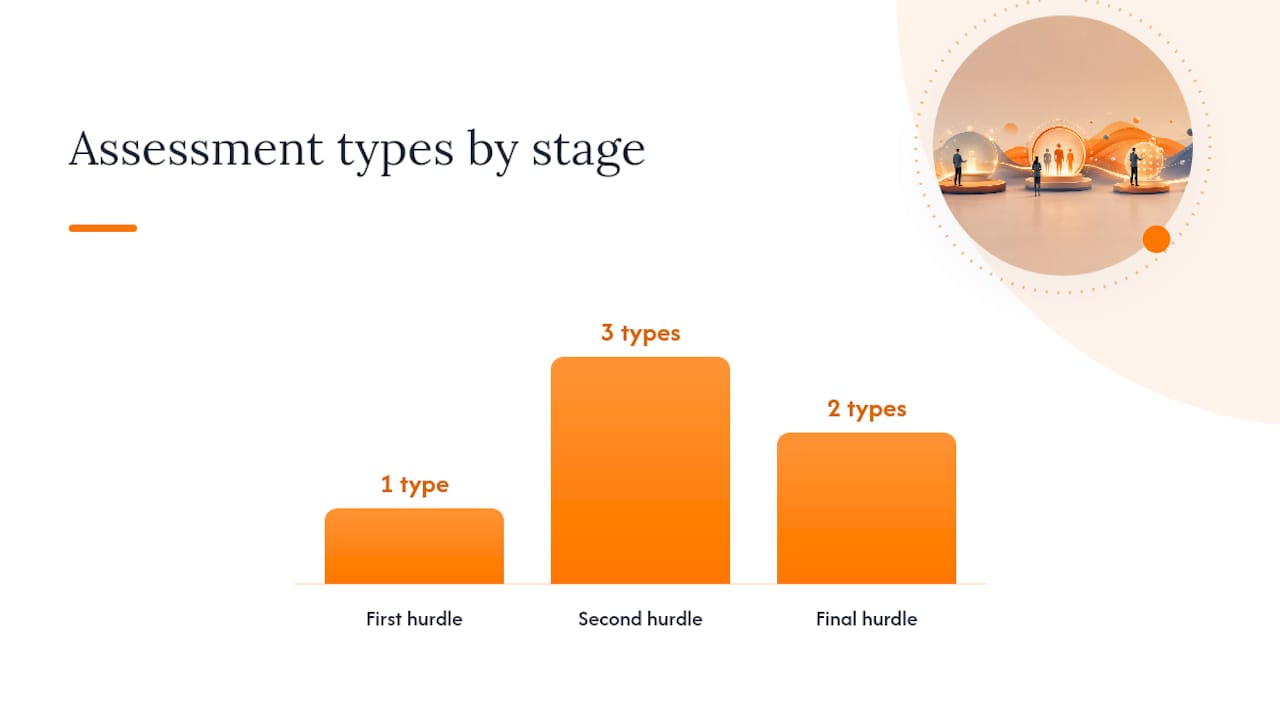
- First-hurdle delivery (talent team): Send automated screens (application review, short questionnaire) to all applicants. The DOI’s assessment cheat sheet lists application and questionnaire screens as the standard first-hurdle format.
- Second-hurdle delivery (talent team + SME): Administer cognitive, job-knowledge, or situational judgment tests to candidates who pass the first hurdle.
- Final-hurdle delivery (hiring manager + SME): Run structured interviews or work-sample tasks. Record scores on standardized rubrics immediately after each session.
- Structured debrief (HR specialist facilitates): Collect independent scores, surface disagreements, and reach a documented hiring decision.
- Measurement and iteration (HR specialist): Pull pass rates, adverse impact ratios, and time-to-offer. Feed findings back into rubric calibration.
Artifacts to produce: job analysis doc, Role Success Profile, scored rubrics, candidate instruction emails, consent forms, and a final selection report.
Pro Tip: Map each step to a calendar week before the pilot starts. Teams that schedule debrief sessions in advance cut decision lag by days.
How do you choose assessment types and build reliable rubrics?
Assessment type selection follows a simple rule: match the measure to the competency and the stage. Early hurdles should be low-cost and scalable; later hurdles should be high-validity and role-specific.
| Assessment type | Best use | Typical stage |
|---|---|---|
| Application review / questionnaire | Screen for minimum qualifications | First hurdle |
| Cognitive ability test | Predict learning speed and problem-solving | Second hurdle |
| Situational judgment test | Assess judgment in role-relevant scenarios | Second hurdle |
| Work-sample / test task | Directly measure job-relevant skills | Second or final hurdle |
| Structured interview | Probe competencies with behavioral evidence | Final hurdle |
Validity and reliability are the two technical pillars. Validity means the assessment actually measures what the role requires. Reliability means scores are consistent across raters and administrations. Face validity, the candidate’s perception that the assessment is fair and relevant, matters nearly as much. Google re:Work’s research found that rejected candidates who experienced structured interviews reported being notably happier than those who did not. That figure alone justifies the investment in clear rubrics and transparent candidate communications.
A behaviorally anchored rating scale (BARS) for a single competency looks like this:
- 5 (Exceptional): Candidate provides a specific example with measurable outcome, names their decision process, and anticipates second-order effects.
- 3 (Meets standard): Candidate describes a relevant situation with a clear action and result, but lacks detail on decision rationale.
- 1 (Below standard): Candidate gives a vague or hypothetical response with no measurable outcome.
Require an evidence field next to every rating. Raters who must type a quote or paraphrase before submitting a score produce far more consistent results than those who rate from memory.
Pro Tip: Design rubrics before you assess a single candidate. Teams that invest in precise anchors upfront cut debrief time and reduce subjective debate, as Google re:Work’s guidance confirms.
Who owns what: roles and governance in the assessment process
Ownership confusion is the most common reason structured hiring programs stall. A compact role matrix prevents it.

| Role | Key responsibilities |
|---|---|
| HR specialist | Owns workflow design, compliance documentation, cutoff rationale, and metric reporting |
| Hiring manager | Defines competency weights, participates in final-hurdle scoring, and signs off on selection decisions |
| SME(s) | Validates assessment content, scores work samples, and attends calibration sessions |
| Talent team | Manages candidate scheduling, communications, and ATS data entry |
When raters disagree by two or more points on a competency, the HR specialist makes the final determination after reviewing the evidence notes. This mirrors federal best practice from HHS guidance and keeps decisions auditable. Cutoff scores must be approved by the HR specialist and hiring manager jointly, documented in writing, and stored with the job analysis file.
Pro Tip: Run SME calibration sessions quarterly. Behavioral anchors drift over time, and a 60-minute recalibration session catches rater drift before it affects hiring quality.
Legal and fairness guardrails every U.S. hiring team needs
EO 13932 and HHS implementation guidance set the compliance floor for federal hiring and represent best-practice benchmarks for private employers. The core requirements translate into a practical checklist:
- Document everything: job analysis, competency weights, cutoff rationale, and scoring decisions must be retained per your organization’s record-retention schedule.
- Monitor adverse impact: calculate pass-rate ratios by protected group at each hurdle. A ratio below 0.80 (the four-fifths rule) triggers review.
- Obtain candidate consent: provide a clear notice explaining what data you collect, how scores are used, and how long records are retained.
- Build accommodation processes: identify how candidates can request testing accommodations before the assessment window opens.
- Communicate transparently: tell candidates what to expect, how long each assessment takes, and when they will hear back.
SHRM reports that 48% of HR managers acknowledge that bias affects their hiring decisions. Structured assessments with anonymized review and standardized scoring are the most direct countermeasure available.
Pro Tip: Send candidates a one-page assessment guide before each hurdle. It reduces no-show rates and improves face validity without adding administrative burden.
Automated vs. manual delivery: what your tech stack needs
Automated delivery scales. Manual scoring captures nuance. Most programs need both, sequenced by hurdle.
- Automated first hurdles: questionnaires, cognitive tests, and short work samples delivered via platform. Low marginal cost per candidate, consistent administration.
- Manual final hurdles: SME-scored work samples and structured interviews. Higher cost, higher validity. Reserve for candidates who clear automated screens.
Essential integration checklist:
- ATS: push candidate status and scores automatically after each hurdle
- HRIS: write final hire data for retention and performance tracking
- SSO: reduce login friction for both candidates and reviewers
- Reporting sink: export raw scores for adverse impact analysis
Capture these data fields for every candidate: assessment ID, hurdle number, raw score, rater ID, submission timestamp, and accommodation flag. Workday’s guidance recommends integrating assessment tools with ATS and HRIS from day one and monitoring pass rates and time-to-hire as primary outcome metrics. For automating candidate communications and consent forms, document automation tools can eliminate manual email drafting at scale.
Pro Tip: Embed scorecards directly into your ATS or assessment platform. Raters who score inside the tool they already use complete rubrics at a higher rate than those who work across separate systems.
How to set cutoffs and apply multi-hurdle decision rules
Three cutoff-setting methods work in practice:
- Pilot-based: run the assessment on a small cohort, examine score distributions, and set the cutoff at the natural break between qualified and unqualified performance.
- Criterion-referenced: define the minimum acceptable performance level before the pilot, then set the cutoff at that score regardless of distribution.
- Norm-referenced: rank candidates and advance the top N%, useful when seat count is fixed.
Multi-hurdle sequencing follows a clear logic. The first hurdle eliminates low-signal applicants at low cost. The second hurdle uses moderate-validity measures to narrow the pool further. The final hurdle applies the highest-validity, most resource-intensive tools to a small, pre-qualified group. The DOI cheat sheet maps this sequence explicitly: application/questionnaire → cognitive or job-knowledge test → structured interview or work sample.
Scoring frameworks to consider:
- Weighted competency total: multiply each competency score by its weight and sum. Useful when competencies differ in job impact.
- Minimum per competency: require a score of 3 or above on every critical competency before advancing. Prevents a high score on one dimension from masking a critical gap.
- Pass/fail for specific tasks: binary for safety-critical or non-negotiable skills.
Pro Tip: Document your cutoff-setting rationale in a one-page memo and attach it to the job analysis file. An audit trail protects the organization and speeds future role updates.
Which metrics tell you if your assessment program is working?
| Metric | What it tells you | Review cadence |
|---|---|---|
| Pass rate by hurdle | Whether cutoffs are calibrated correctly | After each cohort |
| Adverse impact ratio | Whether any group is screened out at a disparate rate | After each cohort |
| Interviewer agreement (inter-rater reliability) | Whether raters are applying anchors consistently | Quarterly |
| Time-to-offer | Whether the workflow is adding or removing delay | Monthly |
| Retention rate | Whether selected candidates are staying | Quarterly |
| Hiring manager satisfaction | Whether selected candidates meet role expectations | 30 days post-hire |
Collect applicant reactions via a short post-assessment survey (three to five questions on perceived fairness, clarity, and relevance). Pair that with hiring manager feedback at 30 days post-hire. Together, these two data streams give you both the candidate-side and employer-side picture of assessment quality. For a deeper look at assessment tools and monitoring strategies, Testask’s blog covers how to analyze and improve programs over time.
Pro Tip: When a metric signals a problem, link it to a specific remediation action. A low inter-rater reliability score means recalibrate anchors. A failing adverse impact ratio means review question content and scoring criteria before the next cohort.
Your 4–8 week pilot checklist and timeline
Week 1: Planning
- Select one role for the pilot
- Assign HR specialist, hiring manager, and at least one SME
- Schedule all calibration and debrief sessions in advance
Week 2: Design and build
- Complete job analysis and Role Success Profile
- Select assessment types for each hurdle
- Build rubrics, scoring anchors, and candidate instruction templates
- Configure assessments in your platform and test end-to-end
Week 3–4: Pilot run
- Open first hurdle to applicants
- Administer second and final hurdles on schedule
- Collect scores independently before any group discussion
Week 5: Analyze
- Pull pass rates, score distributions, and time-to-offer
- Calculate adverse impact ratios
- Collect candidate reaction surveys
Week 6: Calibrate and decide
- Run calibration session with raters; realign anchors where inter-rater agreement is low
- Review cutoffs against pilot data
- Document go/no-go decision for full rollout
Pilot acceptance criteria: pass rates that reflect the expected qualified applicant pool, adverse impact ratios at or above 0.80 for all protected groups, candidate satisfaction scores that indicate the process felt fair, and hiring manager confidence in the finalist pool.
Pro Tip: Use a project management tool (Asana, Notion, or a shared spreadsheet) to track each checklist item with an owner and due date. Pilots without assigned owners miss deadlines.
How Testask maps to this workflow
Testask covers the full recruitment assessment workflow from a single platform. Here is how its features map to the nine-step sequence:
| Workflow step | Testask feature |
|---|---|
| Assessment design | AI-powered test task generation tailored to the role |
| Candidate delivery | Automated task distribution with deadline management |
| Submission collection | Centralized candidate submission inbox |
| AI-assisted scoring | Automated scoring and analysis against defined criteria |
| Team review and calibration | Collaborative review with shared scorecards and comments |
| Reporting | Structured output reports for side-by-side candidate comparison |
A Testask pilot runs in four to six weeks. In week one, the HR specialist uses the platform to generate role-specific test tasks and configure scoring criteria. In weeks two and three, candidates receive tasks automatically and submit through the platform. In week four, the hiring team reviews submissions together using shared scorecards, with AI-assisted analysis surfacing score patterns and flagging outliers. By week five, the team runs a calibration session inside the platform, comparing scores and aligning on final candidates.
Pro Tip: Run your first calibration session using Testask’s shared review interface. Raters score independently, then the team compares divergences in one view, which captures evidence and speeds alignment.
For a broader look at HR assessment platforms and integration options, Testask’s resource library covers platform selection criteria in detail.
How this guidance was developed
This guide draws on federal hiring guidance (EO 13932 and HHS implementation), Google re:Work’s structured interviewing research, DOI practitioner resources, SHRM bias research, Workday’s assessment tool guidance, and Testask’s product knowledge. Primary sources are linked inline throughout.
- HHS hiring assessment strategies: EO 13932 compliance and multi-hurdle design
- Google re:Work structured interviewing guide: rubric design, candidate experience, and validity
- DOI assessment cheat sheet: hurdle sequencing and SME involvement
- SHRM bias and structured hiring research: bias reduction and AI-assisted review
- Workday assessment tool guidance: pilot strategy, integration, and outcome monitoring
Pro Tip: Bookmark the HHS and DOI sources. They are the most practical federal-facing references for U.S. compliance questions and are updated as guidance evolves.
The case for structure over intuition
Most hiring teams underestimate how much time they lose to unstructured processes, not in the assessment itself, but in the debrief. When raters walk into a meeting without pre-submitted scores and evidence notes, the conversation defaults to whoever speaks first and most confidently. That is not a selection process; it is a negotiation.
The evidence is consistent: structured rubrics, documented cutoffs, and calibrated raters produce faster decisions and better hires. It directly affects offer acceptance rates and employer brand. And the compliance argument is equally concrete: undocumented cutoffs and unmonitored adverse impact are the two most common triggers for EEOC scrutiny.
The teams that get this right are not the ones with the most sophisticated tools. They are the ones that design the process before they open the requisition.
Testask makes this workflow faster to run
Structured assessment programs take real effort to build. Testask reduces that effort at the stages where teams lose the most time: generating role-specific test tasks, distributing them to candidates, collecting submissions, and coordinating team review.
With Testask’s free plan, you can run your first pilot assessment without a budget commitment. The platform’s AI-powered task generation means you spend less time writing prompts and more time reviewing results. Shared scorecards and collaborative review replace scattered email threads. AI-assisted analysis surfaces patterns across candidate submissions so your team enters the debrief with data, not impressions. Visit Testask to start your first assessment and run the pilot workflow described in this guide.
Sources
- A guide to structured interviewing for better hiring practices
- Hiring assessment strategies
- Assessment cheat sheet for hiring managers (DOI)
- Eliminating Biases in Hiring: Structured Interviewing and AI Solutions
- Candidate Assessment Tools: What to Look For | Workday Aus & NZ
Recommended
- HR Assessment Platforms: What HR Teams Need to Know | Testask Blog | testask
- Build an employee assessment checklist that works | Testask Blog | testask
- Examples of Assessment Tools for HR Teams in 2026 | Testask Blog | testask
- Skills Assessment Strategies for HR Teams in 2026 | Testask Blog | testask