AI Hiring Platforms Comparison: Best Tools for 2026
AI Hiring Platforms Comparison: Best Tools for 2026

For structured skills assessment and fast, auditable screening, Testask is the top pick for most HR teams in 2026. It generates tailored test tasks, collects candidate submissions, and delivers AI-assisted scoring with team collaboration built in — all deployable without a multi-month implementation project. For teams with different priorities, the strongest runner-ups are: HireVue for high-volume video assessment programs, Eightfold for enterprise talent intelligence and internal mobility, Paradox (Olivia) for conversational scheduling in hourly hiring, and Gem for passive-pipeline management with outreach analytics.
The primary decision axis is straightforward: choose structured assessment plus explainable scoring when hiring quality and auditability matter most, or choose full-pipeline automation when speed and volume are the dominant constraints.
- Best for structured, auditable assessments: Testask
- Best for high-volume video screening: HireVue
- Best for enterprise talent intelligence: Eightfold
- Best for conversational hourly hiring: Paradox (Olivia)
- Best for passive sourcing CRM: Gem
Structured hiring enforces standardized scoring and produces more predictable outcomes than tools that only automate existing, inconsistent processes. According to SHRM’s 2025 talent trends research, AI adoption in HR is accelerating, with recruiting teams reporting measurable time savings when AI is applied to screening and scheduling workflows.
Table of Contents
- AI hiring platforms comparison: at-a-glance matrix
- How to choose the right AI hiring platform
- Per-platform reviews: what each tool actually does
- What each AI hiring feature category actually solves
- How we evaluated these platforms
- Key Takeaways
- The gap between AI hiring promises and what actually matters
- Testask is built for teams that need fast, auditable screening
- Useful sources and further reading
AI hiring platforms comparison: at-a-glance matrix
Two sentences of context before you scan: pricing in this market ranges from roughly $15 per user per month for budget ATS tools to $10,000+ per month for enterprise suites, so budget alone can eliminate half the field before you evaluate a single feature.
| Platform | Best for | Key AI features | ATS integrations | Pricing band | Setup speed | Candidate experience / fairness |
|---|---|---|---|---|---|---|
| Testask | Structured skills assessment, auditable screening | Tailored task generation, AI-assisted scoring, team collaboration | Works alongside existing ATS | Free tier + paid plans | Fast (days) | Structured, bias-reduced via standardized tasks |
| HireVue | High-volume video assessment | Async video interviews, gamified assessments, coding tests | Broad enterprise ATS | Enterprise pricing | Moderate | Candidate NPS tracked; fairness audits available |
| Paradox (Olivia) | Conversational hourly hiring | Chat-driven screening, auto-scheduling, SMS/WhatsApp | Major ATS (Workday, SAP, iCIMS) | Mid-market to enterprise | Fast | High-touch conversational UX |
| Eightfold | Enterprise talent intelligence | Predictive matching, skills inference, internal mobility | Broad HRIS/ATS | $50k+/year | Slow (months) | Explainable candidate scores; bias controls |
| Workable | SMB all-in-one ATS | AI sourcing suggestions, basic screening, job posting | Native ATS + extensive integrations | Subscription plans vary by team size | Fast | Standard; transparent pricing |
| HireEZ | Proactive sourcing | People search, outbound sequences, market analytics | Major ATS | Mid-market | Moderate | Passive candidate outreach |
| SeekOut | Enterprise diversity sourcing | Deep people data, diversity filters, talent analytics | Enterprise ATS | Enterprise | Moderate | Diversity-first sourcing controls |
| Gem | Passive pipeline CRM | Candidate sequencing, outreach analytics, pipeline tracking | LinkedIn, Greenhouse, Lever | Mid-market | Moderate | Personalized outreach sequences |
| Metaview | Interview intelligence | Auto-capture, interview summaries, structured notes | Zoom, Teams, ATS | Fast | Fast | Structured note-taking reduces bias |
| GoodTime | Interview scheduling | Scheduling orchestration, interviewer load balancing | Greenhouse, Lever, Workday | Mid-market | Moderate | Candidate communication automation |
| Manatal | Budget ATS/CRM | AI candidate scoring, pipeline management | Limited | ~$15/user/mo | Fast | Basic |
| Juicebox | Explainable talent discovery | Transparent candidate ranking, skills matching | Limited | Mid-market | Fast | Explainability-first design |
| Zoho Recruit | SMB ATS ecosystem | Applicant tracking, sourcing, basic automation | Zoho suite + third-party | Low | Fast | Standard |
| Skima AI | Workflow automation | AI-assisted hiring workflows, automation rules | Varies | Mid-market | Moderate | Workflow-driven |
| Truffle | Modern sourcing stacks | Sourcing and candidate discovery | Varies | Mid-market | Moderate | Standard |
| Greenhouse | Structured hiring + scorecards | Scorecards, structured interviews, AI layered in | 500+ integrations | Mid-to-enterprise | Moderate | Scorecard-enforced fairness |
| Textio (Textio Loop) | Inclusive job descriptions | Language augmentation, bias detection in JDs | ATS via API | Mid-market | Fast | Inclusive language controls |
| Humanly | High-volume conversational screening | Chat screening, scheduling, reference checks | Major ATS | Mid-market | Fast | Conversational UX |
| Plural (Plural Careers) | Niche sourcing/engagement | Candidate engagement workflows | Varies | Mid-market | Moderate | Engagement-focused |
| Canditech | Targeted assessments | Candidate evaluation, skills tests | Varies | Mid-market | Fast | Assessment-centric |
| Pinpoint | Auditable enterprise ATS | Workflow auditability, enterprise ATS features | Enterprise | Mid-to-enterprise | Moderate | Audit trail |
| Arya by Leoforce | Multi-source talent pooling | Profile consolidation, multi-source search | Major ATS | Mid-market | Moderate | Unified sourcing view |
| Phenom | Full talent experience | Attraction, internal mobility, employer branding | Enterprise HRIS | Enterprise | Slow | High-touch candidate experience |
| Beamery | Enterprise workforce planning | Skills intelligence, internal mobility analytics | Enterprise HRIS | Enterprise | Slow | Skills-based fairness controls |
| SmartRecruiters | Marketplace-enabled ATS | Recruitment marketing, marketplace integrations | 300+ integrations | Mid-to-enterprise | Moderate | Candidate marketing |
| TurboHire | HRMS-integrated AI recruiting | AI screening, HRMS integrations (SAP/Oracle/Workday) | SAP, Oracle, Workday | Mid-market | Moderate | Standard |
| LinkedIn Recruiter | Network-based sourcing | LinkedIn graph search, InMail, filters | LinkedIn ecosystem | Per-seat, high | Fast | Professional network UX |
| Pin | Broad profile coverage + outreach | 850M+ profiles, multi-channel outreach, scheduling | Major ATS | From $100/mo (free tier) | Fast | Multi-channel engagement |
| AvaHR | HR workflow automation | Workflow automation, candidate interactions | Varies | Mid-market | Fast | Automation-driven |
| Checkr | Background screening | Identity verification, background checks | 100+ ATS/HRIS | Per-check pricing | Fast | Compliant, candidate-facing status updates |
| ClearCo | Niche ecosystem use cases | Context-specific capabilities | Varies | Varies | Varies | Varies |
| Ezra | Async video interviewing | Automated video interviews, candidate evaluation | Varies | Mid-market | Fast | Async video UX |
| Teamtailor | Employer-brand ATS | Employer branding, candidate experience, ATS | Mid-market ATS | SMB-friendly | Fast | Brand-forward candidate experience |
| Mokka | Full-pipeline AI comparison | Broad AI pipeline capabilities | Varies | Varies | Varies | Full-pipeline view |
Compliance note: For US hiring teams, ask every vendor for SOC 2 Type II certification, a data residency statement confirming US-based storage, and a written data-deletion policy covering candidate records. If your industry touches healthcare, request HIPAA addenda. Enterprise platforms like Eightfold and Phenom typically provide these on request; smaller tools may not.
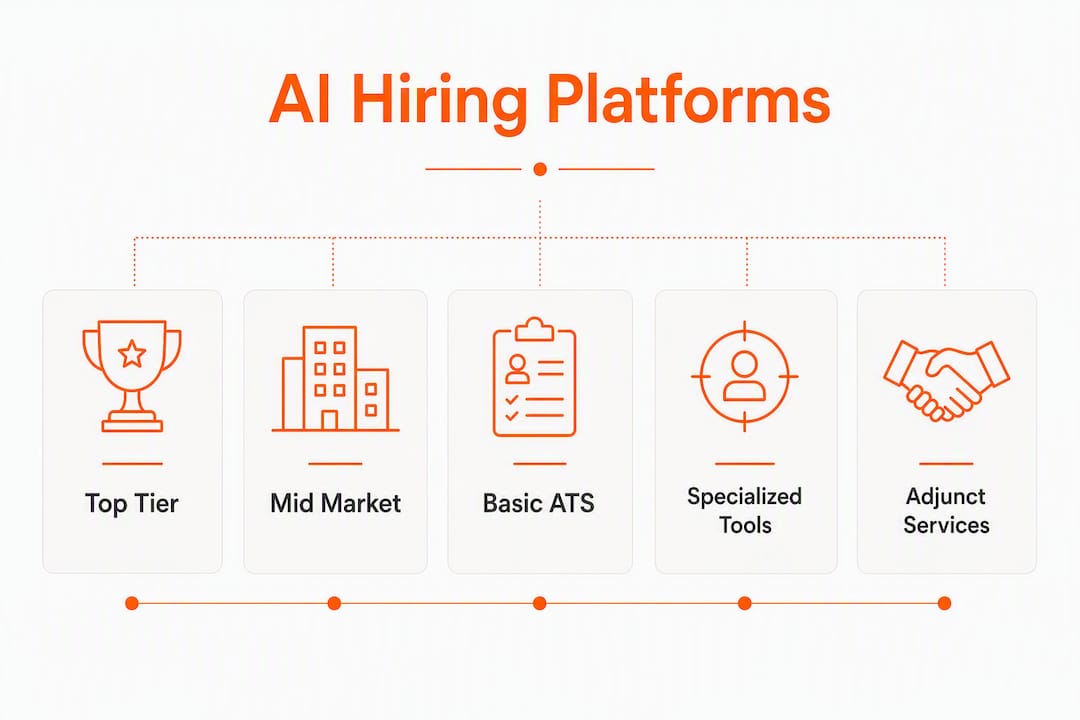
How to choose the right AI hiring platform
The single decision rule: pick the platform that enforces structured hiring and produces explainable scores for every decision that matters. Automating a broken process faster is not progress.
Prioritized evaluation checklist
- ATS/HRIS integration — Confirm native connectors or a documented API for your current stack before any demo. A platform that requires manual CSV exports will create more work, not less.
- Explainability and audit logs — Require a candidate-level explainability report. The shift from keyword matching to skills inference makes transparent scoring a procurement requirement, not a nice-to-have, especially for US teams subject to EEOC scrutiny.
- Bias mitigation controls — Ask for the vendor’s bias-mitigation methodology and any third-party audit results. Structured assessments and standardized scoring reduce exposure; black-box ranking does not.
- Candidate experience — Test the candidate-facing flow yourself. Drop-off rates during assessments or scheduling directly affect offer acceptance.
- Pricing model — Per-seat, per-role, and subscription models each favor different hiring patterns. Per-role pricing near $250/month per open role suits continuous high-volume hiring but gets expensive for occasional or project-based hiring. Per-seat subscription models favor stable teams.
- Setup time and time-to-value — Enterprise platforms often carry a significant implementation tax: configuration and vendor-led onboarding can take months. Assessment-first and agentic tools typically deploy in days.
- Vendor SLAs and support model — Confirm response-time commitments and whether you get a dedicated customer success manager or a shared support queue.
- Data privacy and US compliance — Request SOC 2 Type II, data residency confirmation, and a candidate data-deletion policy. Regulated industries need HIPAA addenda.
Questions to ask in vendor demos
- “Can you show a candidate-level explainability report for a real scoring decision?”
- “What is typical time-to-value for a team of our size?”
- “How do you handle candidate data deletion and retention for US hires?”
- “What does your bias-mitigation audit process look like, and who conducts it?”
- “Which ATS integrations are native versus API-only, and what is the setup time for each?”
Pro Tip: Before any demo, run a scripted test: submit two identical candidate profiles with different demographic signals and compare scores. A platform that cannot explain score differences should not advance to a pilot.
Implementation risk checklist
- Scope your pilot to one role type or one team before expanding.
- Avoid platforms that require full data migration before you can test.
- Confirm that your ATS integration is live, not “in progress,” before signing.
- Assign an internal owner for the pilot — vendor-only implementations almost always stall.
Per-platform reviews: what each tool actually does
Assessment and structured screening
Testask generates tailored test tasks for any role, collects candidate submissions in one place, and delivers AI-assisted scoring with team collaboration tools for structured review. It deploys in days alongside your existing ATS rather than replacing it. The free tier lets small teams start without a credit card. Paid plans unlock advanced scoring, collaboration features, and higher submission volumes. For HR teams that need auditable, skills-based screening without a months-long implementation, it is the fastest path to structured, defensible hiring decisions.

Canditech focuses on assessment-centric workflows with skills tests and candidate evaluation tools. It suits teams that want targeted assessment without the broader ATS overhead.
HireVue pairs asynchronous video interviews with gamified and coding assessments for high-volume programs. Enterprise pricing and a moderate setup timeline make it best suited for large organizations running structured assessment at scale. Fraud detection and candidate NPS tracking are features buyers should validate during demos.
Ezra automates asynchronous video interviewing and candidate evaluation at scale. It fits teams that want a dedicated async interview layer without building it inside their ATS.
Interview intelligence and scheduling
Metaview captures and summarizes interview insights automatically, reducing the note-taking burden and producing structured records that support calibrated hiring decisions. It integrates with Zoom and Teams and connects to major ATS platforms. Fast to deploy, and the structured output directly reduces post-interview recency bias.
GoodTime handles interview scheduling orchestration and interviewer load balancing. For organizations where scheduling complexity (multiple interviewers, time zones, panel coordination) is the bottleneck, it removes that friction without touching the rest of the hiring stack.
Sourcing and pipeline management
HireEZ specializes in outbound sourcing with deep people-search capabilities and engagement sequencing. It suits proactive sourcing teams focused on passive talent discovery rather than inbound applicant management.

SeekOut adds enterprise-grade diversity filters and talent analytics on top of deep people data. Large organizations with explicit diversity hiring targets and analytics requirements get the most from it.
Gem functions as a sourcing CRM: it manages passive candidate pipelines, tracks outreach sequences, and surfaces analytics on what is working. Teams running large passive pipelines alongside Greenhouse or Lever will find the integration tight.
LinkedIn Recruiter gives direct access to LinkedIn’s professional graph with advanced filters and InMail outreach. It is the default sourcing tool for recruiters who already live in LinkedIn, though per-seat pricing is high relative to third-party sourcing platforms.
Pin claims 850M+ candidate profiles with multi-channel outreach, automated scheduling, a starter plan at $100/mo, and a free tier with no credit card required. The profile coverage and outreach automation make it competitive for teams that need broad reach without enterprise pricing.
Arya by Leoforce consolidates profiles from multiple sources into a single search pane, useful for teams that currently juggle several sourcing databases.
Truffle and Plural (Plural Careers) appear in 2026 sourcing roundups as tools for modern recruiting stacks, with sourcing and candidate engagement as their primary focus. Both are worth evaluating if your sourcing workflow is the primary bottleneck.
ATS and full-pipeline platforms
Greenhouse is the structured-hiring ATS benchmark for mid-market and enterprise teams. Its scorecard framework enforces consistency across interviewers, and AI features are now layered into the workflow. With 500+ integrations, it connects to nearly every tool on this list.
Workable offers transparent pricing and a bundled ATS with AI sourcing suggestions, making it the practical choice for SMBs that want one platform rather than a stack. Plans start at a few hundred dollars per month.
Manatal enters at ~$15/user/mo, making it the most accessible ATS with basic AI scoring on this list. It suits small teams with straightforward pipelines.
Zoho Recruit fits teams already in the Zoho ecosystem. The ATS and sourcing tools are integrated, and the learning curve is low for existing Zoho users.
Pinpoint emphasizes auditability and enterprise ATS features for mid-market to enterprise teams that need a documented workflow trail.
SmartRecruiters combines a marketplace-enabled ATS with recruitment marketing features for mid-to-large enterprises that need both applicant tracking and employer-brand distribution.
Teamtailor targets employer-brand-focused SMBs and scale-ups with a candidate-experience-first ATS. The employer branding tools are the differentiator.
Enterprise talent intelligence
Eightfold operates at the enterprise tier with predictive matching, skills inference, and internal mobility analytics. Its AI Interviewer product reports large reductions in time-to-hire, but buyers should validate fraud detection and fairness controls during demos. Budget for $50k+/year and a multi-month implementation.
Phenom covers the full talent experience: attraction, internal mobility, and employer branding at enterprise scale. It requires significant configuration and is best suited for large organizations with dedicated talent technology teams.
Beamery focuses on skills intelligence and internal mobility analytics for enterprise workforce planning. Like Phenom and Eightfold, it is a long-term platform investment, not a quick deployment.
Specialized and adjacent tools
Paradox (Olivia) handles conversational screening and scheduling via chat, SMS, and WhatsApp. For high-volume hourly hiring where candidate drop-off during scheduling is the primary problem, it is the most purpose-built solution.
Humanly covers conversational screening, scheduling, and reference checks for high-volume hiring with a similar chat-driven approach.
Textio (Textio Loop) works at the job-description layer, augmenting language for inclusivity and performance. It does not screen candidates; it improves the top of the funnel by attracting a broader applicant pool.
TurboHire integrates with SAP, Oracle, and Workday HRMS stacks and has regional strength in Asia-Pacific. Mid-market teams already on those HRMS platforms should evaluate it for native integration depth.
AvaHR and Skima AI both focus on workflow automation for standard HR processes. They suit teams that want to automate repetitive candidate interactions without replacing their ATS.
Checkr is a background-screening provider, not a full hiring platform. It integrates into 100+ ATS and HRIS systems and is the standard choice for US teams that need identity verification and background checks as part of the hiring workflow.
ClearCo and Mokka appear in 2026 comparison roundups in context-specific roles. Mokka offers a full-pipeline comparison perspective useful for buyers evaluating pricing models across the market; ClearCo’s hiring-ecosystem role varies by review context.
Juicebox positions itself on explainability in candidate ranking and talent discovery, making it worth evaluating for teams where transparent AI scoring is a procurement requirement.
What each AI hiring feature category actually solves
The five core feature categories map to distinct hiring problems. Buying a platform with all five when you only need two creates complexity and cost without proportional benefit.
- Screening and assessments solve quality and consistency: evaluating candidates against a defined standard rather than a recruiter’s intuition. Testask, HireVue, Canditech, and Ezra operate here. Skills-inference screening produces more defensible decisions than keyword filtering.
- Interview intelligence — solves calibration: capturing what happens in interviews and making it structured and comparable. Metaview is the specialist; Greenhouse and Eightfold include this as a feature.
| Hiring scenario | Recommended feature focus | Expected benefit |
|---|---|---|
| High-volume hourly hiring | Conversational screening + scheduling automation | Faster time-to-offer, reduced drop-off |
| Hard-to-fill specialty roles | Deep sourcing + skills-inference assessments | Larger qualified pipeline, better match quality |
| Structured corporate hiring | Standardized assessments + interview scorecards | Auditable decisions, reduced bias exposure |
| Internal mobility programs | Talent intelligence + skills mapping | Retention, reduced external hiring cost |
| Employer-brand building | Job-description optimization + candidate experience tools | Higher applicant quality and diversity |
Explainability changes the workflow. When a platform can show a recruiter why a candidate scored 78 rather than 65, the hiring team can calibrate, challenge, and improve the model over time. Black-box rankings produce faster outputs but create legal and fairness exposure that structured teams cannot accept. Explainability is now a procurement requirement for risk-conscious HR organizations in 2026.
How we evaluated these platforms
Evaluating 35 platforms requires a consistent methodology. Here is what the assessment covered.
- Integration tests — against common ATS patterns (Greenhouse, Workday, Lever) to measure native connector depth versus API-only workarounds.
Rating dimensions used: integration burden (how hard to connect to your stack), adoption risk (how likely the team is to actually use it), fairness controls (bias mitigation and explainability), and time-to-value (how fast you see results).
This evaluation reflects expertise in AI-powered recruitment technology, structured hiring methodology, and US compliance requirements for talent acquisition teams.
Key Takeaways
Structured assessment with explainable AI scoring is the most defensible hiring approach for US teams in 2026, and the platform you choose should enforce that structure rather than automate around it.
| Point | Details |
|---|---|
| Structured assessment wins | Platforms enforcing standardized scoring produce more predictable, auditable hiring outcomes than black-box automation. |
| Budget filters fast | Pricing ranges from ~$15/user/month for budget ATS tools to $10,000+/month for enterprise suites; set your band before evaluating features. |
| Implementation tax is real | Enterprise platforms can take months to deploy; assessment-first tools like Testask go live in days alongside your existing ATS. |
| Explainability is now required | Skills-inference scoring with candidate-level explanations is a procurement requirement for risk-conscious US hiring teams in 2026. |
| Testask for structured screening | Testask generates tailored tasks, collects submissions, and delivers AI-assisted scoring with team collaboration — fast to deploy, free tier available. |
Next steps:
- Shortlist 2–3 vendors that match your hiring volume, ATS stack, and budget band.
- Run a 4–6 week pilot on one role type with defined metrics: time-to-screen, score consistency, and candidate completion rate.
- Require explainability reports and data-residency confirmation before signing any contract.
Bring to every vendor demo: a scripted candidate scenario, two identical profiles with different demographic signals, and a direct request for a candidate-level explainability report.
The gap between AI hiring promises and what actually matters
Most AI hiring platform conversations start with the wrong question. Teams ask “which platform has the most features?” when the question that determines outcomes is “which platform enforces the most structure?”
The platforms that disappoint in production are almost always the ones that automate existing workflows without standardizing them first. If your current screening process is inconsistent, an AI layer on top of it produces inconsistent results faster. That is not a technology problem; it is a process problem that technology cannot fix on its own.
The implementation tax is the most underestimated cost in this market. Enterprise talent intelligence platforms are genuinely powerful, but the organizations that get value from them have dedicated talent technology teams, clean data, and 12–18 months of patience. Most recruiting teams do not have any of those three things. Assessment-first tools and modern agentic platforms win for the majority of teams precisely because they do not require all of that upfront investment.
The other thing worth saying plainly: explainability is not a compliance checkbox. It is a feedback loop. When hiring managers can see why a candidate scored the way they did, they calibrate their own judgment, challenge the model when it is wrong, and improve the process over time. Teams that use black-box rankings lose that loop entirely and end up trusting a system they cannot interrogate. For US teams operating under EEOC scrutiny, that is a risk that compounds quietly until it does not.
Testask is built for teams that need fast, auditable screening
Most AI hiring platforms ask you to choose between speed and structure. Testask gives you both. It generates tailored test tasks for any role in minutes, collects candidate submissions in one place, and delivers AI-assisted scoring with side-by-side team collaboration — all without replacing your existing ATS or requiring a vendor-led implementation project.
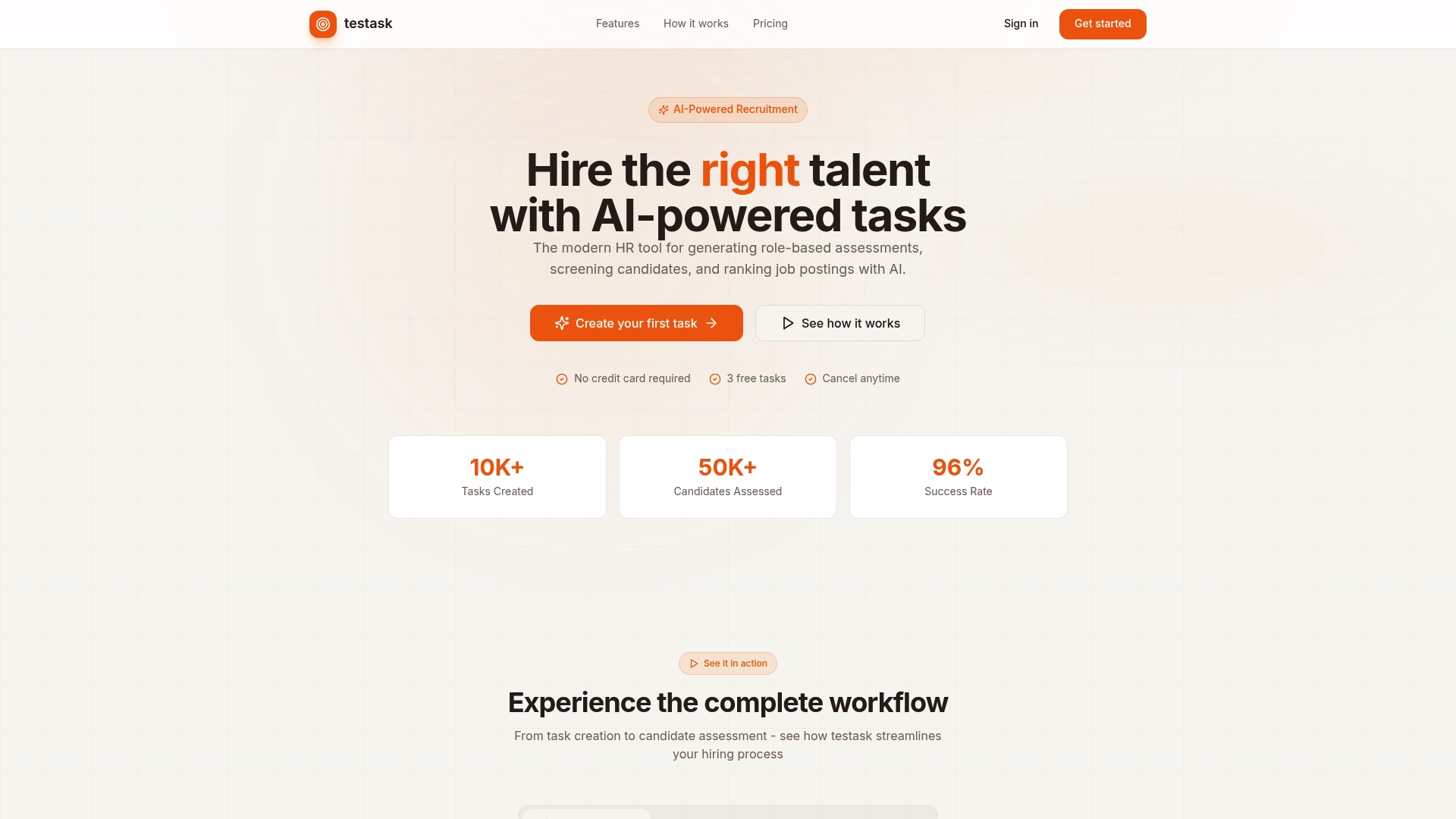
The teams that get the most from Testask are those running structured hiring at speed: HR managers who need defensible, skills-based screening decisions without waiting months for a platform to go live. The free tier lets you start immediately with no credit card. Paid plans unlock advanced AI scoring, higher submission volumes, and full collaboration features for larger teams.
If your current screening process relies on resume reviews and gut instinct, Testask replaces that with a structured, repeatable workflow that produces candidate-level scores your whole team can review, challenge, and act on. Start a free trial at Testask and run your first assessment today.
Useful sources and further reading
These sources back the claims in this article and give you the primary references for vendor due diligence.
- SHRM 2025 Talent Trends: AI in HR — Primary research on AI adoption rates and outcomes in HR teams.
- SHRM 2025 Recruiting Benchmarking — Benchmark data for recruiting efficiency and time-to-hire metrics.
- Gartner: Only 31% of Recruiting Teams Use Labor Market Data — Gartner research on data utilization gaps in recruiting.
- Gartner: Top Four Talent Acquisition Trends for 2026 — Gartner’s analysis of AI and cost pressures shaping talent acquisition.
- Greenhouse: Best AI Recruiting Software in 2026 — Practitioner-level comparison of 13 commonly evaluated platforms.
- Eightfold AI Interviewer product page — Vendor claims on time-to-hire reduction and fraud detection; validate during demos.
- Metaview: AI Hiring Tools — Interview intelligence context and tool comparisons.
- AI Recruiting Platforms Comparison: 2026 Buyer’s Matrix (Pin) — Pricing models, implementation tax analysis, and structured hiring evidence.
- Testask Blog: AI Candidate Screening Methods, Pitfalls, and Best Practices — Practical guidance on skills-inference screening and structured assessment workflows.
Due diligence checklist for vendor conversations:
- Request SOC 2 Type II certification documentation.
- Ask for a written data-residency statement confirming US-based storage.
- Request the vendor’s bias-mitigation methodology and any third-party audit results.
- For healthcare or regulated industries, require a HIPAA addendum before signing.
- Ask for a model card or algorithmic transparency report covering the scoring methodology.