Best Recruitment Assessment Tools for HR Leaders
Best Recruitment Assessment Tools for HR Leaders

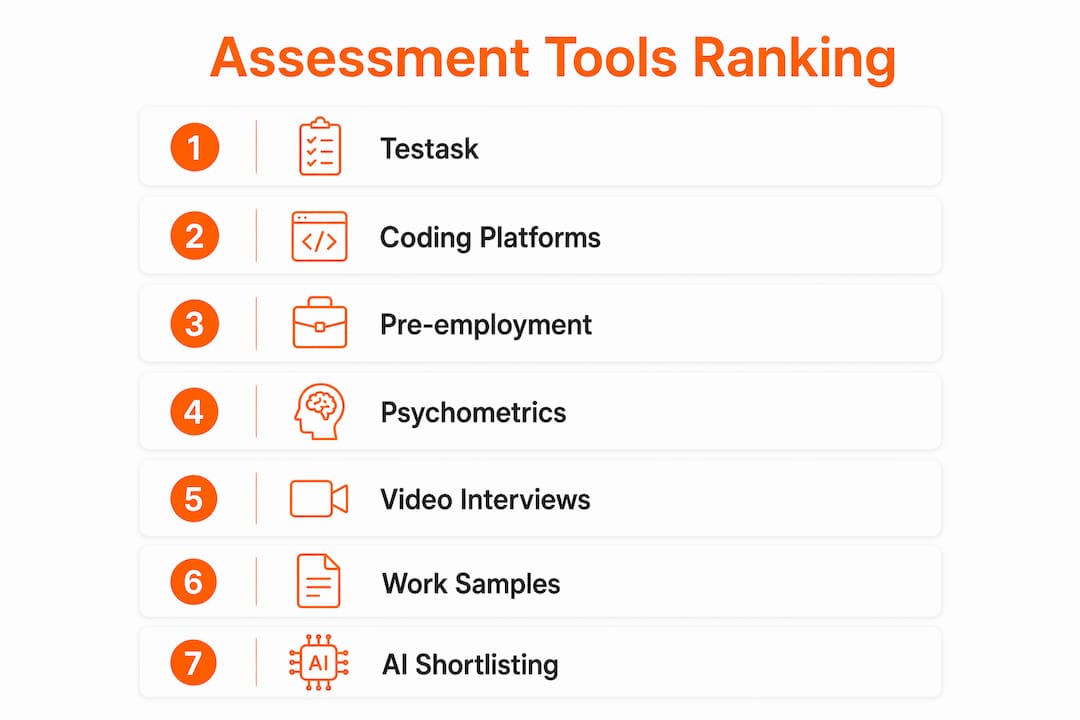
Testask is the recommended pick for most U.S.-based HR teams because it combines AI-assisted scoring, fast custom test creation, and EEO-aware reporting in a single platform. If your team needs a specialized alternative, here is a quick shortlist:
- Best for AI-powered custom test creation: Testask
- Best for coding and technical screening: HackerRank, Codility, or CodeSignal
- Best for high-volume pre-employment screening: TestGorilla or Criteria Corp
- Best for psychometrics and personality fit: Predictive Index or Pymetrics
- Best for asynchronous video interviews: HireVue or Spark Hire
- Best for work-sample simulations: Vervoe or Canditech
- Best for AI-first shortlisting at scale: Harver or Talview
Three reasons Testask earned the top spot: it generates structured, role-specific test tasks using AI in minutes rather than days; its audit logs and subgroup reporting support EEOC and Uniform Guidelines compliance; and its collaboration workflow lets hiring teams review and score submissions together without switching tools.
| Platform category | Best for | Assessment types | AI features | Compliance support |
|---|---|---|---|---|
| Testask | Custom task creation, AI scoring, audit-ready reporting | Work sample, skills, open-ended | AI generation, AI scoring, audit logs | EEO reporting, audit trails |
| Coding-assessment platforms | Technical/engineering roles | Live coding, automated code scoring | Auto-scoring pipelines | Varies by vendor |
| General pre-employment testing | High-volume multi-role screening | Cognitive, SJT, personality, skills | Automated scoring | EEOC-aligned, varies |
| Psychometrics specialists | Personality fit, leadership pipelines | Personality inventories, cognitive | Norm-group benchmarking | Validated instruments |
| Video-interview platforms | Communication, culture-fit screening | Asynchronous video, AI transcription | Auto-scoring, sentiment analysis | Varies by vendor |
| Work-sample and simulation providers | High-stakes specialized roles | Realistic simulations, work samples | Scoring rubrics | High job-relatedness |
| AI-first shortlisting platforms | Speed-driven volume hiring | Multi-signal AI screening | AI shortlisting, ATS integration | Varies by vendor |
Table of Contents
- How we evaluated and ranked the best recruitment assessment tools
- Detailed snapshots: Testask and the major platform categories
- Side-by-side comparison: features, pricing, and compliance
- How to choose the right recruitment assessment tool for your team
- Implementing assessments without slowing hiring
- Per-tool short reviews: standout features, pros, and cons
- Free trials, implementation timelines, and time-to-hire impact
- Total cost of ownership: hidden fees, training, and support
- What results and ROI look like in practice
- Post-purchase support and vendor reliability
- Security and data privacy compliance for U.S. recruitment tools
- Key Takeaways
- What actually matters when you test assessment platforms
- Testask makes structured hiring faster and more defensible
- Useful sources and further reading
How we evaluated and ranked the best recruitment assessment tools
Every tool in this guide was evaluated against five weighted criteria: predictive validity evidence, ATS/HRIS integrations, candidate experience quality, U.S. compliance support, and total cost of ownership. Predictive validity carried the most weight because a tool that cannot demonstrate it predicts job performance is not worth the administrative overhead.
The evaluation process included:
- Reviewing published validation studies and psychometric manuals for each platform category
- Running sample assessments across representative job types (technical, customer-facing, and managerial roles)
- Testing candidate-facing flows on both desktop and mobile to assess clarity and accessibility
- Verifying ATS integration depth (native connectors vs. Zapier workarounds)
- Requesting adverse-impact and subgroup reports from vendors to confirm availability
- Checking audit log functionality and data export options for compliance readiness
The OPM Assessment Decision Guide informed the validity weighting. OPM guidance identifies reliability, validity, legal context, and applicant reactions as the core technical factors when selecting assessments. Tools that could not supply a validation study or a technical manual were rated lower regardless of feature count.
Rating tiers used in this guide:
- Recommended: Strong validity evidence, solid integrations, EEO-aware reporting
- Good for pilots: Promising features but limited public validation data or narrow use case
- Enterprise-ready: Scales to high volume with dedicated support and SLA guarantees
Pro Tip: When requesting demos, ask vendors for four things upfront: a sample adverse-impact report, evidence of predictive validity (a technical manual or peer-reviewed study), confirmation of ATS connector depth, and a data export sample. Vendors who hesitate on any of these are signaling a gap you will discover after signing.
A sourced note worth anchoring here: combining cognitive ability tests with work samples raises combined validity to approximately .63 versus .51 for cognitive tests alone, according to OPM’s summary of Schmidt & Hunter’s meta-analytic research. That figure is the strongest argument for multi-method assessment designs and shapes the recommendations throughout this guide.
Detailed snapshots: Testask and the major platform categories
Testask
Testask is built for HR teams that need to move fast without sacrificing structure. The platform generates role-specific test tasks using AI, collects candidate submissions in a centralized workspace, and applies AI-assisted scoring so reviewers see ranked results rather than raw submissions. The collaboration layer lets multiple hiring team members score and comment on the same submission, and every action is logged for audit purposes.

Best for: HR teams running structured hiring across multiple roles who need custom assessments without a content-development budget.
Assessment types: Open-ended work tasks, skills challenges, written responses, and structured multi-step assignments.
AI features: AI test generation from a job description, AI-assisted candidate scoring, and structured review workflows with audit logs.
Integrations: ATS connectivity and team collaboration tools; free and paid subscription tiers available.
Pros:
- Generates tailored test tasks in minutes from a job description
- Audit logs and subgroup reporting support EEOC compliance
- Collaboration workflow keeps scoring consistent across reviewers
- Free tier available for low-volume or trial use
Cons:
- Narrower test-type library than large pre-employment testing suites
- Coding-specific auto-execution environments are not the primary focus
Pro Tip: When building a test task in Testask, paste the job description directly into the AI generator and review the output against your job analysis before sending. That 10-minute step catches misaligned items before candidates see them and strengthens your validity argument if a selection decision is ever challenged.
Coding-assessment platforms
HackerRank, Codility, and CodeSignal dominate this category. All three provide live coding environments, automated code execution, and scoring pipelines that remove manual grading from technical screens. HackerRank’s question library spans hundreds of languages and difficulty levels. Codility’s CodeCheck product focuses on real-world coding tasks rather than puzzle-style questions. CodeSignal’s Game-Based Assessments add a standardized score that candidates can share across employers.

Best for: Engineering and software development roles where live code execution is the primary screen.
Pros: High-fidelity coding simulations; automated, objective scoring; large question libraries.
Cons: Limited applicability outside technical roles; pricing scales with volume and can become expensive for enterprise use.
General pre-employment testing platforms
TestGorilla, Criteria Corp, iMocha, Mercer/Mettl, eSkill, EmployTest, Testlify, and Hire Success fall into this category. These platforms offer broad test libraries covering cognitive ability, situational judgment, personality, and role-specific skills. TestGorilla’s library exceeds 300 validated tests. Criteria Corp’s CCAT (Criteria Cognitive Aptitude Test) is one of the more widely cited cognitive instruments in U.S. hiring. iMocha and Mercer | Mettl both offer customizable question banks with proctoring. eSkill and EmployTest focus on job-specific skills tests for office and administrative roles.
Best for: High-volume hiring across multiple role types where a single platform needs to handle diverse assessment needs.
Pros: Broad test libraries; administrative efficiency; established validity evidence for flagship instruments.
Cons: Off-the-shelf content may not match niche roles; customization depth varies significantly by vendor.
According to SHRM Foundation guidance, work samples and simulations tend to provide higher job-relatedness than multiple-choice tests, but they are more expensive to develop. That trade-off is worth naming when choosing between a large library platform and a custom-task approach.
Psychometrics and personality specialists
Predictive Index, Pymetrics, Bryq, Traitify, and HiPeople anchor this category. Predictive Index uses a validated behavioral assessment and cognitive test normed against large U.S. samples. Pymetrics applies neuroscience-based games to measure cognitive and emotional traits, with built-in bias-mitigation tools. Bryq combines cognitive and personality measures with role-fit benchmarking. Traitify uses image-based personality assessments designed for high-completion rates in hourly hiring. HiPeople layers reference checks with personality and skills data.
Best for: Sales, customer service, and leadership pipeline roles where personality and behavioral fit are strong performance predictors.
Pros: Validated instruments with norm groups; benchmarking against role profiles; often strong adverse-impact documentation.
Cons: Personality tests alone have lower predictive validity than cognitive or work-sample tests; best used as one signal in a multi-method design.
Video-interview platforms
HireVue, Spark Hire, Willo, and Talview lead this segment. HireVue offers AI-driven scoring of video responses alongside structured interview guides. Spark Hire focuses on one-way video interviews with a clean candidate experience and straightforward reviewer tools. Willo targets smaller teams with a lightweight, affordable asynchronous video product. Talview combines video interviews with AI proctoring and cognitive assessments.
Best for: Roles where spoken communication, presentation quality, or cultural fit needs early evaluation without scheduling live calls.
Pros: Candidate convenience; standardized capture; reduces scheduling overhead significantly.
Cons: AI video scoring remains a contested area for adverse-impact risk; OPM guidance warns that technology can remove the human element if candidate communications are not designed for clarity.
Work-sample and simulation providers
Vervoe, Canditech, Wild Noodle, and Truffle occupy this space. Vervoe builds customizable work-sample assessments with AI scoring of open-ended responses. Canditech focuses on technical and coding work samples with a clean candidate interface. Wild Noodle specializes in realistic job simulations for software roles. Truffle offers structured work-sample tasks with collaborative review.
Best for: High-stakes or specialized roles where demonstrating actual skill matters more than answering multiple-choice questions.
Pros: High job-relatedness and face validity; candidates often prefer them over abstract tests.
Cons: Higher development cost and longer setup time than off-the-shelf tests.
AI-first shortlisting and additional platforms
Harver, HiBob HRIS, Indeed Hiring Platform, Metaview, and TestTrick round out the market. Harver integrates AI-driven shortlisting directly into ATS workflows for volume hiring. HiBob is primarily an HRIS with some assessment integrations rather than a standalone assessment platform. Indeed Hiring Platform offers built-in screener questions and assessments tied to job postings. Metaview uses AI to transcribe and analyze live interviews rather than administer pre-built tests. TestTrick provides a lightweight quiz-based screening tool suited to early-funnel filtering.
Side-by-side comparison: features, pricing, and compliance
For U.S. hiring teams, four columns matter most in any comparison: EEO compliance support, ATS integration depth, AI auto-scoring availability, and reporting quality. Everything else is secondary.
| Platform / category | Assessment types | AI features | ATS/HRIS integrations | Compliance and audit | Pricing shape | Free trial |
|---|---|---|---|---|---|---|
| Testask | Work sample, skills, open-ended | AI generation, AI scoring, audit logs | ATS connectors, collaboration tools | EEO reporting, audit trails | Subscription (free tier available) | Yes |
| Coding platforms (HackerRank, Codility, CodeSignal) | Live coding, automated code scoring | Auto-scoring pipelines | Major ATS integrations | Varies; limited adverse-impact tools | Per-seat or per-test | Limited |
| General testing (TestGorilla, Criteria Corp, iMocha, Mercer | Mettl, eSkill, EmployTest, Testlify, Hire Success) | Cognitive, SJT, personality, skills | Automated scoring, some AI shortlisting | Broad ATS support | Adverse-impact reports available | Subscription or per-test |
| Psychometrics (Predictive Index, Pymetrics, Bryq, Traitify, HiPeople) | Personality inventories, cognitive | Norm-group benchmarking, bias tools | ATS integrations | Validated instruments, norm data | Subscription | Varies |
| Video interview (HireVue, Spark Hire, Willo, Talview) | Async video, AI transcription | AI scoring, sentiment analysis | ATS integrations | Varies; AI scoring scrutiny growing | Per-seat or per-video | Yes (most) |
| Work sample (Vervoe, Canditech, Wild Noodle, Truffle) | Simulations, open-ended tasks | AI scoring of responses | ATS integrations | High job-relatedness | Subscription or per-assessment | Yes |
| AI shortlisting (Harver, Indeed, TestTrick, Metaview, HiBob) | Multi-signal AI screening | AI shortlisting, ATS-native | Deep ATS integration | Varies | Volume-based or bundled | Varies |
Pricing shapes across the market generally fall into three models: per-seat subscriptions (fixed monthly cost per recruiter), per-test or per-assessment fees (pay as you go), and volume-based enterprise contracts. Most platforms offer a free trial or a limited free tier. Testask offers a free tier for low-volume use, making it accessible for teams piloting before committing to a paid plan.
Structured, standardized assessment workflows combined with reporting and audit logs are the most defensible approach for U.S. employers facing EEOC scrutiny, according to Uniform Guidelines best-practice resources. That finding directly favors platforms with built-in audit trails over those that rely on manual recordkeeping.
How to choose the right recruitment assessment tool for your team
The single most important question to ask any vendor: Can you provide evidence of predictive validity and adverse-impact monitoring for this tool in my target role population? A vendor who cannot answer that question with a technical manual or a published study is not ready for U.S. hiring compliance.
Buyer checklist for shortlisting:
- Run a job analysis first. Identify the competencies the role actually requires before evaluating any platform. Assessment content should map to those competencies, not the other way around.
- Match assessment type to role level. Cognitive tests and work samples predict performance well for most roles. Personality assessments add value when combined with other measures, not as a standalone screen.
- Verify integration depth. Ask whether the ATS connector is native or webhook-based. Native integrations push candidate scores directly into your ATS; webhook setups require maintenance.
- Request a sample adverse-impact report. This is non-negotiable for U.S. employers. The report should show pass rates by demographic group so you can monitor for disparate impact.
- Check data export and audit log availability. U.S. employers must maintain documentation and evidence of validation to defend selection decisions under the Uniform Guidelines.
- Test the candidate experience yourself. Complete the assessment on a mobile device. If it is frustrating or unclear, expect lower completion rates and candidate drop-off.
Red flags to watch for:
- No validation study or technical manual available
- Content locked with no export option
- Adverse-impact reports not available or require custom development
- Audit logs absent or not accessible to HR administrators
- Mobile experience is broken or requires a desktop browser
Pro Tip: Run a two-week pilot with a live role before signing an annual contract. Track three metrics: time-to-hire for that role versus your baseline, assessment completion rate, and hiring manager satisfaction with the shortlist quality. Two weeks of real data beats any vendor demo.
Implementing assessments without slowing hiring
The common concern, that adding assessments will stretch time-to-hire, is largely a sequencing problem rather than an assessment problem. AI-powered platforms accelerate time-to-hire by routing only qualified candidates to manual review, reducing the volume of applications a recruiter must read individually.
A practical adoption sequence:
- Week 1–2 (pilot): Deploy a single short screen (10–15 minutes) for one active role. Measure completion rate and time from application to assessment result.
- Week 3–4: Add a work-sample or skills task for candidates who pass the screen. Track interviewer time saved per hire.
- Month 2 onward (scale): Roll out to additional roles. Monitor pass rates by demographic group monthly. Flag any group with a pass rate below 80% of the highest-passing group for review.
Metrics to track from day one:
- Time-to-hire vs. pre-assessment baseline
- Assessment completion rate by role and channel
- Pass rate by demographic subgroup (for adverse-impact monitoring)
- Interviewer time saved per hire
- Quality-of-hire signal at 90-day performance review
For U.S. compliance, the Uniform Guidelines on Employee Selection Procedures require employers to maintain records of selection rates by race, sex, and ethnic group. Platforms with built-in subgroup reporting make that obligation far easier to meet than manual spreadsheet tracking.
Pro Tip: Sequence assessment types to protect candidate experience: start with a short cognitive or skills screen (under 15 minutes), follow with a work sample only for candidates who advance, and reserve structured interviews for the final stage. Candidates who reach the interview stage will have already demonstrated baseline competence, which makes the conversation more productive for both sides.
Per-tool short reviews: standout features, pros, and cons
Testask generates custom test tasks from a job description in minutes and applies AI scoring to rank submissions. Audit logs make every scoring decision traceable. Best for teams that need structured, defensible assessments without a dedicated content team.
TestGorilla offers one of the largest pre-built test libraries on the market, covering cognitive ability, personality, and hundreds of role-specific skills tests. Strong for high-volume screening; less flexible for highly customized task formats.
HackerRank is the default choice for engineering teams screening at volume. Its coding environment supports most major languages, and its question library is extensive. The candidate experience is polished and familiar to developers.
Codility emphasizes real-world coding tasks over puzzle-style questions, which tends to produce better signal for senior engineering roles. Its CodeCheck product integrates cleanly with major ATS platforms.
CodeSignal adds a standardized score (the General Coding Assessment) that candidates can share across employers, reducing repeat testing friction. Useful for companies that want to attract candidates who have already been assessed.
Criteria Corp (also listed as Criteria) centers on the CCAT cognitive aptitude test, one of the more widely validated cognitive instruments in U.S. pre-employment testing. Its adverse-impact documentation is thorough.
Pymetrics uses neuroscience-based games to measure cognitive and emotional traits. Its bias-mitigation tools are among the most developed in the market, making it a strong choice for teams with active adverse-impact monitoring programs.
iMocha covers IT, business, finance, and language proficiency with customizable tests and proctoring. Its ATS integrations and reporting depth make it a solid enterprise option.
Mercer | Mettl combines cognitive assessments, coding challenges, and proctoring in a single platform. Strong for global organizations that need multilingual assessment support.
Canditech focuses on technical and coding work samples with a clean, candidate-friendly interface. Good for teams that want work-sample quality without the development overhead of a full simulation.
Truffle provides structured work-sample tasks with collaborative review features. Suited to teams that want a lightweight work-sample tool without enterprise pricing.
TestTrick is a lightweight quiz-based screening tool best used for early-funnel filtering where speed matters more than depth.
Predictive Index pairs a behavioral assessment with a cognitive test and role-fit benchmarking. Its norm data is extensive, and its reporting is designed for hiring managers rather than I-O psychologists.
Bryq combines cognitive and personality measures with role-fit scoring. Its benchmarking against role profiles is a differentiator for teams building structured hiring programs.
Harver integrates AI-driven shortlisting directly into ATS workflows. Built for volume hiring in retail, logistics, and customer service where speed is the primary constraint.
Traitify uses image-based personality assessments with completion times under five minutes. Designed for hourly and high-volume roles where candidate drop-off is a real problem.
Spark Hire delivers one-way video interviews with a straightforward reviewer interface. Its pricing is accessible for mid-market teams, and its candidate experience is consistently rated well.
HireVue adds AI-driven scoring to video responses alongside structured interview guides. Enterprise-focused with deep ATS integrations and dedicated compliance support.
EmployTest specializes in job-specific skills tests for office, administrative, and customer service roles. Its test library is narrower than TestGorilla’s but more targeted for those role types.
Willo is a lightweight asynchronous video tool suited to smaller teams that need video screening without enterprise pricing or complexity.
Vervoe builds customizable work-sample assessments with AI scoring of open-ended responses. Its scoring transparency is a strength; candidates receive feedback, which improves the experience.
eSkill offers a large library of job-specific skills tests with strong customization options. Particularly useful for manufacturing, healthcare, and office roles.
Talview combines video interviews with AI proctoring and cognitive assessments. Its proctoring capabilities make it a fit for high-stakes or regulated hiring environments.
Wild Noodle specializes in realistic job simulations for software engineering roles. Niche but high-fidelity for teams hiring senior developers.
Testlify provides customizable pre-employment tests with an analytics dashboard. Its interface is clean and its setup time is low, making it a good entry point for teams new to structured assessment.
HiBob HRIS is primarily a people management platform with assessment integrations rather than a standalone assessment tool. Useful for teams already on HiBob who want to connect assessment data to their HRIS.
Indeed Hiring Platform embeds screener questions and assessments directly into job postings. The reach is unmatched, but the assessment depth is limited compared to dedicated platforms.
HiPeople layers reference checks with personality and skills data into a single candidate profile. Its reference-check automation is the standout feature.
Metaview transcribes and analyzes live interviews using AI rather than administering pre-built tests. Best for teams that want structured notes and coaching insights from existing interviews.
Hire Success provides pre-employment testing with personality and skills assessments. Suited to small and mid-sized businesses that need a straightforward, affordable option.
Free trials, implementation timelines, and time-to-hire impact
Most platforms in this guide offer some form of free trial or free tier. Testask’s free tier supports low-volume use, making it practical for a two-week pilot without a procurement process. TestGorilla, Testlify, and Vervoe all offer free trials with access to core test libraries. HackerRank and Codility offer limited free plans for individual use. HireVue and Harver are enterprise-focused and typically require a demo and contract before access.
Implementation timelines vary significantly by platform type. A lightweight tool like Testask, Willo, or Traitify can be live within a day. Platforms with deep ATS integrations, custom content development, or proctoring setup, such as Mercer | Mettl, Talview, or HireVue, typically require two to six weeks for full deployment.
AI-enabled screening platforms reduce manual candidate review load and accelerate time-to-hire when integrated early in the funnel. The key is sequencing: deploy the assessment before the resume review stage, not after, so the platform does the filtering work rather than adding a step after human review has already happened.
Total cost of ownership: hidden fees, training, and support
The sticker price of an assessment platform rarely reflects the true cost. Per-test pricing models look affordable at low volume but can become expensive at scale. Subscription models offer predictability but often carry minimum seat counts that price out smaller teams.
Hidden costs to budget for:
- Content development: Custom test creation requires time from HR or subject-matter experts. Platforms with AI-assisted generation, like Testask, reduce this cost substantially.
- Integration setup: Native ATS connectors are included in most enterprise plans, but webhook-based integrations may require developer time.
- Training: Most platforms offer self-serve onboarding, but enterprise tools with complex rubric systems often require formal training for administrators.
- Proctoring fees: Platforms with live or AI proctoring typically charge per session, which adds up quickly in high-volume hiring.
- Support tiers: Free and entry-level plans often limit support to email or documentation. Dedicated customer success managers are usually reserved for enterprise contracts.
Work samples and simulated assessments are more expensive to develop than automated multiple-choice tests but tend to provide higher job-relatedness, per SHRM Foundation guidance. That trade-off is worth pricing explicitly: a platform with a lower per-test fee but high content development costs may be more expensive overall than one with AI-assisted task generation.
What results and ROI look like in practice
Published case studies from assessment vendors consistently point to three categories of measurable ROI: reduced time-to-hire, lower cost-per-hire, and improved quality-of-hire at the 90-day mark. The specific figures vary by organization size, role type, and baseline process maturity.
Teams that move from unstructured resume review to structured assessment typically see the largest gains. Structured interviews and skill-based assessments generally show higher predictive power than unstructured interviews and resume review alone, according to CIPD research. That predictive advantage translates directly into fewer mis-hires and lower turnover costs.
For technical roles, coding-assessment platforms like HackerRank and Codility report that automated screening reduces recruiter time spent on phone screens by routing only candidates who pass the coding threshold to human review. For volume hiring, platforms like Harver and Indeed report faster funnel velocity when assessments are embedded at the application stage.
The ROI case for AI-assisted platforms like Testask centers on content creation speed and scoring consistency. When a hiring team can generate a structured test task in minutes and receive AI-ranked submissions rather than raw applications, the time saved in the review stage compounds across every open role.
Post-purchase support and vendor reliability
Support quality is one of the most underevaluated dimensions in platform selection. A tool that works perfectly during the demo but lacks responsive support during a high-volume hiring sprint creates real operational risk.
Questions to ask before signing:
- What is the guaranteed response time for support tickets?
- Is a dedicated customer success manager included, or is that an add-on?
- What is the uptime SLA, and how are outages communicated?
- Is there a user community or knowledge base for self-serve troubleshooting?
Enterprise platforms like HireVue, Criteria Corp, and Mercer | Mettl typically offer dedicated account management and SLA-backed uptime guarantees. Mid-market tools like TestGorilla, Testlify, and Spark Hire offer strong self-serve documentation and community forums. Lightweight tools like Willo and Traitify rely primarily on email support and help centers.
Testask’s support model is aligned with its SaaS structure: documentation and in-platform guidance for self-serve users, with direct support available for paid plan subscribers. For teams running high-stakes hiring, the audit log and collaboration features reduce support dependency by keeping all scoring activity traceable within the platform.
Security and data privacy compliance for U.S. recruitment tools
U.S. employers collecting candidate data through assessment platforms face obligations under federal and state law. The key frameworks are EEOC and Uniform Guidelines requirements at the federal level, and CCPA (California Consumer Privacy Act) at the state level for California-based candidates. GDPR applies when assessing candidates located in the EU, even for U.S.-headquartered employers.
Minimum security and privacy requirements to verify before signing:
- Data encryption: Candidate data should be encrypted in transit and at rest.
- Access controls: Role-based access should limit who can view candidate scores and submissions.
- Data retention policies: Confirm how long candidate data is stored and whether you can delete records on request (required under CCPA for California candidates).
- Subprocessor disclosure: Vendors that use third-party AI scoring engines should disclose those subprocessors in their data processing agreements.
- Audit logs: Every scoring and review action should be logged with a timestamp and user ID. This is the foundation of a defensible selection record under the Uniform Guidelines.
Employers must maintain documentation, audit trails, and evidence of validation to meet U.S. legal standards and defend selection decisions, per Uniform Guidelines best-practice resources. Platforms that do not offer exportable audit logs are a compliance liability, not just a feature gap.
Testask’s audit log functionality addresses this requirement directly: every review action, score, and comment is recorded and exportable, giving HR teams a complete record of the selection process for any role.
This article provides general information about recruitment assessment tools and U.S. compliance frameworks. It is not legal advice. Confirm current EEOC, Uniform Guidelines, and state-law requirements with qualified legal counsel for your specific hiring context.
Key Takeaways
Testask is the recommended pick for most U.S. HR teams because it combines AI-assisted test generation, structured scoring, and audit-ready compliance reporting in a single platform.
| Point | Details |
|---|---|
| Multi-method designs predict best | Combining cognitive tests with work samples raises validity to a meaningful extent beyond cognitive tests alone. |
| Compliance requires audit trails | U.S. employers must maintain documentation and subgroup reports under the Uniform Guidelines; choose platforms with exportable audit logs. |
| Sequencing protects candidate experience | Deploy a short screen first, then a work sample, then a structured interview to reduce drop-off and keep hiring moving. |
| TCO exceeds sticker price | Budget for content development, integration setup, proctoring fees, and support tiers beyond the base subscription cost. |
| Testask for most U.S. teams | Testask’s AI test generation, collaborative scoring, and EEO-aware reporting make it the strongest fit for structured, defensible hiring. |
What actually matters when you test assessment platforms
The biggest lesson from hands-on evaluation of these platforms is that content quality and reporting depth matter more than the sophistication of the AI layer. Several platforms in this market lead with impressive AI branding but deliver scoring outputs that are opaque, hard to audit, and disconnected from the competencies the role actually requires.
Two patterns stood out during testing. First, platforms that let reviewers see the AI’s scoring rationale alongside the candidate’s response produced faster, more confident hiring decisions than those that returned only a numeric score. When a hiring manager can see why a submission scored the way it did, they trust the result and move faster. Second, candidate completion rates dropped noticeably on platforms where the assessment felt generic or disconnected from the actual job. Candidates who receive a test that clearly relates to the work they will be doing complete it at higher rates and report a better experience.
Testask performed well on both dimensions. The AI-generated tasks are grounded in the job description rather than pulled from a generic library, which means candidates encounter content that feels relevant. The collaborative review workflow, with visible scoring rationale and audit logs, gave hiring teams the confidence to act on AI-ranked results rather than second-guessing them. For teams that have been burned by black-box scoring tools, that transparency is the practical differentiator.
Testask makes structured hiring faster and more defensible
Skip the months-long content development cycle. Testask generates role-specific test tasks from a job description in minutes, collects candidate submissions in one place, and applies AI-assisted scoring so your team reviews ranked results instead of raw applications. Every scoring action is logged, and subgroup reporting gives you the adverse-impact visibility U.S. hiring teams need.
The free tier lets you run your first assessment without a procurement process. Paid plans add advanced AI scoring, deeper ATS integrations, and full audit log exports for compliance-ready hiring. If your team is evaluating assessment platforms right now, start with Testask and run a live role through the platform before committing to anything else. Two weeks of real data will tell you more than any vendor demo.
Useful sources and further reading
- OPM Assessment Decision Guide — The authoritative U.S. federal reference for assessment selection, covering validity, reliability, legal context, and applicant reactions. Start here for any compliance or methodology question.
- Uniform Guidelines on Employee Selection Procedures — The legal standard for U.S. employers on adverse impact, recordkeeping, and validation requirements. Required reading before deploying any selection tool.
- CIPD Selection Methods Factsheet — UK-based but widely cited for its evidence review of structured interviews, work samples, and psychometric tests versus unstructured methods.
- SHRM Foundation / LeadDev: Choosing Effective Talent Assessments — Practical overview of assessment types, development costs, and the trade-off between off-the-shelf and custom content.
- Tribepad: 8 Reasons to Use Candidate Assessments in Recruitment — Practitioner-focused article on why assessments accelerate rather than slow hiring when implemented correctly.
- Gartner Peer Insights: Talent Assessment Software — Aggregated user reviews of talent assessment platforms; useful for benchmarking vendor satisfaction across enterprise buyers.
- Testask Blog: Why Adopt Assessment Platforms for Better Hiring — Practical guidance on integrating assessment platforms into hiring workflows and measuring operational impact.
- Testask Blog: HR Assessment Platforms — What HR Teams Need to Know — Feature-level overview of what to evaluate in an assessment platform, including integrations, reporting, and candidate experience.
Recommended
- Examples of Assessment Tools for HR Teams in 2026 | Testask Blog | testask
- Build an effective recruitment checklist for HR success | Testask Blog | testask
- Best Recruitment Platforms for HR Teams in 2026 | Testask Blog | testask
- Screening tools in hiring: Transform your recruitment efficiency | Testask Blog | testask